Episode 16: Leadership for Building High-Performing Teams – Team Talk podcast

Leadership lessons from elite sport for anyone building a high-performing team.
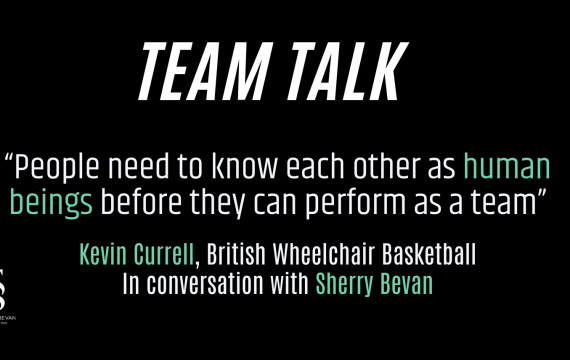
In this episode, British Wheelchair Basketball Performance Director Kevin Currell shares practical insights on adaptive leadership, shared purpose and creating teams that perform when it matters most.

Listen here

add link

Listen on Spotify

Listen on Apple

Episode 16: Leadership for Building High-Performing Teams

In conversation with Kevin Currell, British Wheelchair Basketball

Sherry Bevan: Hello and welcome. Today I’m absolutely delighted to be joined by Kevin Currell. Kevin is the Performance Director at British Wheelchair Basketball, where he oversees the performance programme on their exciting journey towards the Los Angeles Paralympics.

Kevin has spent two decades working in high-performance sport as both a practitioner and a leader, so a very warm welcome to you today, Kevin.

Kevin Currell: Thank you. It’s a pleasure to be here.

Let’s start by hearing a little about your career journey and how you came to be in your current role.

I’ve been in my current role for about a year now. Like many people, I started out as a sports-mad kid and teenager. I thought I’d play football for England, but I quickly realised I wasn’t good enough!

Fortunately, I was pretty good at science, so when it came to choosing what to study, sports science felt like the obvious route. I always knew I wanted to work in sport and make a difference to performance.

Growing up as a teenager in the 1990s wasn’t exactly the best time to be a fan of British sport. England failed to qualify for the World Cup, the cricket team struggled, and at the Olympic Games we won just a single gold medal. I could never quite understand why that was.

I went on to study sports science, completed a PhD, and specialised in nutrition. After finishing my doctorate, I was fortunate enough to secure an internship with the English Institute of Sport.

That was just after London had won the bid to host the 2012 Olympic Games. I remember sitting in my PhD office watching the announcement and thinking, I just want to work there. I don’t really care what I’m doing, I just want to be part of it. That really set me on the Olympic and Paralympic pathway.

My role evolved as I provided nutrition support across a range of sports, particularly triathlon, canoe slalom and short-track speed skating, so I experienced both summer and winter sports. I was incredibly fortunate to be part of the support team for the GB triathlon squad at the London Olympics.

I’ll never forget the atmosphere when Britain won its first-ever Olympic triathlon gold and bronze medals. There were reportedly a million people lining the streets of London watching these athletes race, and this incredible wave of sound travelled around the Serpentine. It was unlike anything I’d ever experienced.

I remember sitting in the stands afterwards, with Union Jacks waving and David Bowie’s Heroes playing, as it did after every medal ceremony. I found myself thinking, How does it get any better than this? As a practitioner, it felt like an unbelievable privilege to be part of a home Olympic Games.

Around that time I’d also become fascinated by leadership. I was beginning to read about it and had started managing people, and I think I made the decision there and then that I wanted to move into leadership.

I was given the opportunity to lead the nutrition service at the English Institute of Sport, moving from delivering my own profession to leading others within it.

As my interest in leadership continued to grow, I wanted to lead broader, multidisciplinary teams. I spent eight years leading all of the science services at the English Institute of Sport, now the UK Sports Institute.

Then, about a year ago, I made the move to lead an actual sports programme, something I’d always wanted to do. That journey has brought me to my current role as Performance Director at British Wheelchair Basketball, where I oversee the entire performance programme.

Wow, it sounds like an incredible career. I remember that triathlon so clearly because I took my daughters up to Hyde Park to watch it. I was really interested in triathlon at the time – I even entered a couple, although I pulled out because I was too nervous about the swim! Coming from a cycling and running background, it was a sport that really appealed to me.

What I remember most was being amazed by the sheer number of people lining the streets to watch.

Even now, the hairs on my arms stand up when I think about it. It was such an incredible moment and a wonderful demonstration of the power of sport to bring people together. There was such a positive atmosphere, and it felt like a real privilege to be the right age, at the right time, to experience a home Olympic Games. It’s a once-in-a-generation opportunity.

Absolutely. London 2012 really was special.

You’re now working with British Wheelchair Basketball. I’ve watched wheelchair basketball a few times and, if I’m honest, I actually prefer watching it to the running game because it feels so energetic, exciting and fast-paced.

For those who aren’t familiar with the sport, where does Great Britain currently sit in the world rankings?

The men’s team won silver in Paris and have consistently reached the finals of major championships over the last decade or so. We’ve only won one world title, though, so that’s something we’re looking to change over the next few years, starting with this summer’s World Championships and then building towards the Paralympic Games.

The women’s team are also consistently among the world’s best. They’ve never won a Paralympic medal and have one World Championship medal in recent history, but they’re regularly in Europe’s top two and consistently ranked in the world’s top five.

Given that Britain isn’t traditionally a basketball nation, it’s remarkable that we’ve developed the talent to compete with the very best.

Our ambition for Los Angeles is to come home with two medals, with at least one of them being gold. That would be Britain’s first-ever Paralympic basketball gold medal and, for the women’s team, their first Paralympic basketball medal of any colour.

That’s a fantastic ambition, and it certainly doesn’t sound unrealistic given where both teams are competing internationally.

Absolutely. We’ve had opportunities before that just haven’t quite gone our way.

The prospect of trying to win a basketball gold medal in the United States, on a court where players like Kobe Bryant and LeBron James have competed, is incredibly exciting. It’s such an iconic venue and it would be a very special moment for our athletes to perform there—and hopefully succeed.

It’s a really exciting time to be involved.

It certainly is.

You mentioned earlier that, at one point, you made a conscious decision that you wanted to become a leader. What was it that drew you towards leadership?

That’s a great question.

To be honest, managing people always seemed quite daunting. For most people, leadership starts when you’re asked to line manage someone for the first time, and that can feel like a big step.

I’m not sure I can pinpoint exactly what drew me to it, but I’ve always enjoyed working with people and helping them develop.

One memory that really stands out is from the build-up to the London Olympics. I was working with the canoe slalom team after they’d moved from Nottingham to Lee Valley to prepare for the Games. I’m based in the Midlands, so every couple of weeks a colleague of mine, James Glover, and I would drive from Loughborough to Lee Valley together.

James was doing a leadership course at the time and recommended a TED Talk. This was around 2010 or 2011, when TED Talks were still relatively new. He said, “I think you’ll really like this.”

I’d never even heard of a TED Talk, but I watched it anyway.

It was Simon Sinek’s Start With Why, and it just clicked.

I remember thinking, that makes complete sense. You start with why, you create an emotional connection, and people buy into what you’re trying to achieve. Suddenly leadership didn’t seem like something reserved for people in suits—it felt accessible. I remember thinking, I could actually do this.

Around the same time, I went on a coaching skills course for line managers. Between Simon Sinek’s ideas and learning how to coach by asking questions rather than simply giving answers, I started to dip my toe into leadership.

I began leading the nutrition service at the English Institute of Sport, and you could see the difference. People started coming together around a shared purpose. You could almost see their eyes light up when they understood the “why”.

That’s probably when I realised I genuinely wanted to lead.

From there, I became fascinated by leadership—how you improve as a leader and how your leadership has to evolve depending on the people and situations around you.

That’s something that’s come up in a few of these conversations—this idea of adaptive leadership. It’s about staying true to yourself and being authentic, while recognising that different situations, different people and different challenges all require something slightly different from you. You’re still you, but you’re responding to what’s in front of you.

Exactly. I think it’s really important that you stay authentic—you’re still yourself. But different people need different things. Some people need more structure and process. Others need more inspiration or a stronger emotional connection.

When you’re leading teams, the reality is that everyone is different, so you have to recognise that and adapt your approach.

One of the most powerful leadership experiences I’ve had came from a course involving horses. I remember turning up thinking, Oh, here we go, one of those gimmicky leadership courses. But it turned out to be one of the most authentic leadership experiences I’ve ever had.

The horses responded entirely to how you showed up. They could sense whether you were nervous, confident or calm. It really made you think about your own presence as a leader. Sometimes you need to lead from the front. Sometimes you walk alongside people. Other times, you lead from behind and gently encourage them forward.

That idea has stayed with me ever since. It’s something I still think about today—where do I need to position myself to help these people achieve what we’re trying to achieve together?

That’s fascinating. I’ve heard people talk about leadership programmes involving horses before. Horses don’t have a hidden agenda—they simply respond to the person standing in front of them. They’re reacting to how you present yourself.

What did you learn about yourself through that experience?

The biggest lesson was understanding that different situations require different styles of leadership.

Sometimes people need direction—you go to the front and lead. Sometimes they simply want you beside them, walking alongside. Other times, they need you behind them, giving them a little encouragement.

It also made me think much more consciously about how I show up as a leader. If horses can sense your emotions, then people almost certainly can too.

Whether you’re walking into a one-to-one, a team meeting or giving a presentation, how are you preparing yourself? What energy are you bringing? How do you need to show up for the people in front of you?

Absolutely.

As you prepare for the Los Angeles Paralympics—which are now only a couple of years away—how does your role change throughout an Olympic cycle?

It’s amazing how quickly those four years disappear! At the start of a cycle, four years feels like a long way away, and then suddenly you’re halfway through.

Early in the cycle, you’re casting the net wide. You’re exploring ideas, trying different ways of working and giving coaches and athletes the space to be creative.

You’re also dealing with the reality of funding decisions, because every four years the funding is reviewed. That can mean more resources, fewer resources, or simply changes that you have to adapt to.

As the Games get closer, everything becomes much more focused. You have to be really clear about what’s important, what isn’t, and where your effort will make the biggest difference when competition arrives.

There’s also an enormous amount of operational planning involved. Taking a team to an Olympic or Paralympic Games is a huge logistical exercise.

Then, of course, the pressure starts to build. What feels like a distant goal suddenly becomes very real. Everyone becomes more aware of what’s at stake, emotions naturally become heightened, and as a leader you have to think even more carefully about what each individual needs from you during that period.

And does the fact that Los Angeles is so much further away than Paris make a difference? Paris felt almost on our doorstep, whereas LA brings long flights, major time differences and a very different environment.

It certainly adds another layer.

We’re talking about a 10 to 12-hour flight, seven or eight time zones, and almost certainly hotter conditions because of the time of year. Having said that, we’re quite used to travelling internationally. We’ve got a World Championships in Canada this September, for example, so travelling long distances and adapting to different environments is part of what we do.

Across British sport we’ve become very experienced at planning those challenges. You know you need to arrive early enough to adjust to the time zone. You know you need to think about the heat.

For us, the heat isn’t so much an issue inside the arena because we’ll be competing in air-conditioned venues. It’s more about day-to-day living and how each athlete responds, because our players have a wide range of disabilities and medical conditions, some of which require much more careful management in hotter conditions.

One thing that’s really opened my eyes since moving into wheelchair basketball is just how difficult travel can be for wheelchair users.

Airports simply aren’t designed particularly well for people travelling with wheelchairs. You watch baggage handlers loading equipment onto aircraft and, unfortunately, broken wheelchairs aren’t uncommon when they arrive at the other end.

Then there are the logistics. We have two squads of 12 players. Each athlete has at least one chair, and some travel with two, so you could easily have more than 40 wheelchairs to fit into the hold of an aircraft.

That depends on the size of the plane and the airport infrastructure, so it’s another layer of planning that simply doesn’t exist in many other sports.

I’d never really thought about that. I used to travel with my bike quite a lot and I’d always sit on the plane watching it being loaded, thinking, Please be careful—that’s my bike!

But a wheelchair is so much more than a piece of sporting equipment. It’s far more personal and, of course, essential to everyday life.

Exactly. And it’s much more specialised as well.

Yes, and much more personal as well, I’d imagine.

I’d never really considered the logistics of moving so many athletes and all of that specialist equipment around the world. It’s a huge operation.

Before we move on, can I ask something about the sport itself? Is a wheelchair basketball team the same size as a running basketball team, or is it smaller?

It’s exactly the same. You have a squad of 12, with five players on court at any one time.

Most of the rules are almost identical. The court is the same size, the markings are the same and the basket is the same height. There are a few rules specific to the wheelchair itself and how it’s set up, but the biggest difference is the player classification system.

Every player is given a classification between 1.0 and 4.5, depending on the level of functional ability they have. A 1.0 player has the greatest level of impairment, while a 4.5 player has the highest level of mobility.

Those classifications really matter because the five players on court can’t have a combined total of more than 14 points.

You can be under 14, but then you’re probably giving away a competitive advantage. So coaches are constantly trying to build line-ups that total 14 points while giving them the best tactical balance.

That classification system adds another layer of complexity to coaching and substitutions, but apart from that, it’s remarkably similar to the running game.

I imagine that eventually just becomes second nature for the coaches.

It does. They’ll have a number of line-ups already planned and they’ll know exactly how to adapt if someone gets injured or if they want to make a tactical substitution. Those combinations are all thought through in advance.

You have five players on court, but a squad of 12. How do you create a team that performs at such a high level? What are the key ingredients?

First and foremost, people need to know each other as human beings.

Because wheelchair basketball is a relatively small sport, many of the players have grown up together. That’s probably an advantage, although sometimes it can be a disadvantage too.

It’s really important that everyone has a shared understanding of what you’re trying to achieve, how you want to work together and how you want to behave as a team. The best way to do that is collaboratively—bringing together the athletes, coaches and support staff to shape that environment together rather than imposing it from the top down.

The reality is that high-performing teams are messy. You’ve got lots of different personalities, different ways of working and different preferences. At times it can feel chaotic.

For me, though, that’s what makes it enjoyable. In the moment, you’re constantly adapting.

If I had to boil it down, the two biggest things are helping people genuinely understand each other and creating absolute clarity around the common goal you’re all working towards.

And for the team heading to Los Angeles, that common goal is very clear—it’s to win.

Exactly. One of the advantages of elite sport is that the goal is usually obvious. Nobody competes at this level without wanting to win.

The danger is becoming too obsessed with the medal itself.

The question I think we should ask more often is: What does winning actually mean?

Winning gives you a platform. It gives you an opportunity to influence society.

We’ve seen that with teams like the Lionesses. They won the European Championship and almost immediately used that success to campaign for equal opportunities for girls in PE.

I’d love to see us do more of that.

Winning matters—there’s no point pretending otherwise—but once you’ve won, then what?

How are you going to use that success to make a difference?

Because otherwise there’s a real danger that you spend years chasing a medal, you finally achieve it, and then ask yourself, Now what?

And I imagine that’s where some athletes experience quite a significant emotional drop afterwards.

Absolutely.

Sometimes people build this idea in their minds that becoming an Olympic or Paralympic champion will finally make them feel complete or fulfilled.

In reality, that’s often not what happens.

We’ve seen plenty of examples across different sports where incredibly successful athletes have struggled after achieving everything they’d worked towards.

Which brings us right back to Simon Sinek and Start With Why.

Exactly.

I also wonder whether having that deeper sense of purpose helps if things don’t quite go to plan.

If you come home with a silver or bronze medal rather than gold, perhaps the disappointment isn’t quite so overwhelming because you still have the opportunity to inspire young people, grow participation in the sport or influence society in a positive way.

I think that’s exactly right.

There’s definitely more work we can do around that as a sporting community. We’ve already seen how effectively teams like the Lionesses and the Red Roses have used their success to create a much bigger impact than simply winning trophies.

All sport relies on external funding in one way or another. Football relies on supporters buying tickets and commercial sponsorship, for example. But Paralympic sport is much more dependent on grant and National Lottery funding.

How does that shape both the opportunities and the challenges for your team?

Well, first of all, we need everyone to keep buying their National Lottery tickets!

The Olympic and Paralympic system in the UK simply wouldn’t exist in the way it does today without National Lottery funding. It supports athletes and sports at every level—not just elite performance, but participation too. It’s absolutely vital.

Of course, there are pros and cons. We’re incredibly fortunate to receive public funding, but that also brings responsibility. We’re part of a much bigger system, and no system works perfectly for every individual sport.

You have to balance those realities, but overall I think we’re incredibly lucky that the public enables us to do what we do—whether that’s employing people like me as a Performance Director or supporting athletes to compete at the Paralympic Games.

When you look at how British sport has developed over the last 30 years, Lottery funding has played an enormous part in that success.

It really has. When you think about the sports where Britain is now competing at the very highest level, they’re sports that, 30 or 40 years ago, we’d never have imagined becoming world leaders in.

Exactly.

Every four years, the Olympic and Paralympic Games become Britain’s shop window. If I’ve remembered correctly, Team GB and ParalympicsGB are among the most admired and trusted brands in the country, alongside organisations like the NHS and the Armed Forces.

The challenge is that we only get that spotlight once every four years. For the rest of the time, people’s attention naturally shifts back to football, cricket and other sports.

But sport has a unique ability to bring people together.

If, for a few weeks every four years, we can inspire the country and give people something positive to rally around, then I think that’s a wonderful return on the investment the public makes through the National Lottery.

There are even studies suggesting that fewer people visit their GP during the Olympic and Paralympic Games because they’re distracted from some of the pressures of everyday life. I don’t know whether that’s true of other major sporting events, but it does show the wider impact sport can have on people’s wellbeing.

Absolutely.

Going back to London 2012, I was a Games Maker. If you walked around London in your Games Maker uniform, complete strangers would stop you to say thank you, ask to have their photograph taken with you, or tell you how proud they were of what everyone was doing.

It was an amazing experience. For those few weeks it genuinely felt as though the whole country had been lifted.

I remember walking around London in my Team GB kit and people asking if I was an athlete.

I’d have to say, “No, I’m just the nutritionist!”

I felt slightly embarrassed.

I actually got married in 2012 and started my wedding speech by talking about what an incredible year it had been and how privileged I’d been to be involved in the Olympics.

Everyone burst into applause.

I remember thinking, No, no… you’re supposed to applaud when I start saying nice things about my wife—not because I happened to be part of an amazing summer of sport!

It really was an extraordinary summer.

I volunteered at the Paralympics as a Games Maker on the marathon. I was stationed on The Mall, just a short distance from the finish line when David Weir won.

The crowds were so deep that I couldn’t actually see the finish itself, but the roar that travelled along The Mall told us instantly that he’d crossed the line first.

It was one of those moments you’ll never forget.

Those are the moments that make everything worthwhile.

High-performance sport has plenty of difficult days, but then you experience moments like that, or you see the country completely captivated by Team GB and ParalympicsGB.

Or perhaps you’re watching an athlete you’ve worked with appear on Channel 4 in the closing stages of a Paralympic final.

Those moments remind you why you do it, and they make all the hard work worthwhile.

It does, doesn’t it? And that leads me nicely to the question I ask every guest. What’s one of your all-time favourite sporting moments?

That’s a great question.

Obviously, being involved in London 2012 was an incredible experience, but I’m actually going to choose something different.

I’d go for Rory McIlroy’s Masters victory.

I was watching it at home into the early hours of the morning, and I thought it was one of the greatest demonstrations of performance and resilience I’ve seen.

For years he’d been asked, “Is this your year? Are you finally going to win?” He’d come close before and suffered some heartbreaking disappointments, and then even in that final round it looked as though the opportunity might slip away again.

The resilience, persistence and sheer drama of it were extraordinary.

It’s the sort of story you couldn’t write. No novelist would come up with an ending quite like that. That’s what makes sport so special.

For me, it perfectly captures the pursuit of excellence and the emotional journey that comes with it.

Thank you for sharing that.

What strikes me about Rory McIlroy’s story is that, despite all his talent, he wasn’t competing in isolation. Every year he was facing other world-class golfers, all capable of winning.

Golf feels particularly unforgiving because, ultimately, it’s all down to you. I’m not a golfer, so I can’t speak to the technical side, but it seems to demand incredible resilience and mental strength.

I think so.

What I hope is that, if you asked me the same question in three years’ time, I’d be talking about watching our wheelchair basketball players produce something truly special on one of the world’s most iconic basketball courts.

I’d love for the wider public to see just how good this sport really is.

I hope so too.

I’m going to make a note in my diary and come back to you after Los Angeles so we can celebrate.

Fingers crossed!

Fingers crossed indeed.

Kevin, thank you so much for joining me today.

I’ve really enjoyed our conversation about leadership, building high-performing teams and the importance of creating a shared purpose. I think one of the biggest takeaways for me is that successful teams aren’t just built around talent—they’re built on people understanding one another, working collaboratively and knowing why they’re doing what they do.

Thank you again for sharing your experiences, and I wish you and everyone at British Wheelchair Basketball every success on the road to Los Angeles.

Thank you very much.

About the guest

Kevin Currell is Performance Director at British Wheelchair Basketball, where he overseas the performance programme on the journey to the LA Paralympics.

He has two decades of experience of high performance sport as a practitioner and leader.

Important links

About the host

Sherry Bevan believes that high-performing teams start with confident leadership.

Before becoming a Leadership Consultant, she spent more than 25 years working alongside technology teams, including in organisations such as McDermott Will & Emery, Credit Suisse and Arthur Andersen. That experience gives her a deep understanding of the challenges facing today’s IT leaders, particularly within law firms and professional services.

Through her consultancy, coaching and leadership development programmes, Sherry combines commercial understanding with honest conversations, skilled facilitation and practical leadership support to help leaders build confident, high-performing teams.

A former racing cyclist and lifelong sports enthusiast, Sherry is fascinated by what enables teams to perform under pressure. That’s why Team Talk goes behind the headlines to speak with the coaches, performance directors, and leaders who create the environments where success becomes possible.

Because whether it’s a law firm, an IT department or an elite sporting environment, great results rarely happen by accident. They happen when leaders create the conditions for people to perform at their best.

Connect with Sherry

Episode 15: Adaptive Leadership – Team Talk podcast

In this episode, Sherry Bevan talks with Stephen Gilpin of Wolverhampton Wanderers Football Club about his thoughtful and refreshing approach to leadership that goes far beyond the world of sport.

Listen to the episode here:

Listen on Spotify.

Listen on Apple.

Episode 15: Adaptive Leadership

In conversation with Stephen Gilpin, Wolverhampton Wanderers

Sherry Bevan: Today, my guest is Stephen Gilpin. Stephen is the Assistant Director of Performance at Wolverhampton Wanderers Football Club and co-founder of the charity Prostate United. Stephen, a very warm welcome.

Stephen Gilpin: Thank you, Sherry. Good morning, and thanks for having me on.

It would be great to start by hearing a little about your career and how you came to be in your current role.

Stephen: It all goes back to university. In 2009 I went to Sheffield Hallam to study physiotherapy, and during my third year I completed an internship at Sheffield Wednesday Football Club. Looking back, that internship was probably the reason I got my foot in the door of professional sport so early in my career.

After graduating I spent a short time working in private practice, but during my internship I’d volunteered virtually all my free time – weekends, evenings, anything I could give. I’d almost created a role before there was actually a vacancy.

When I qualified and moved into private practice, that left a gap. The Head of Medical at the time, Paul Smith, gave me a call and offered me a role as First Team Physiotherapist. I was very junior and inexperienced, but it was an incredible opportunity to begin my career in elite Championship football.

I spent four years at Sheffield Wednesday during a period of major change. The club came under new ownership, significant investment came in, and overnight the environment was transformed. We were able to develop a much more progressive medical and performance department, and many of the players joining the club had experienced world-class environments elsewhere, so expectations were high.

As one of the junior members of staff, I was exposed to everything. I travelled to specialist appointments in the UK and abroad and had the opportunity to learn from some of the best rehabilitation experts in Europe. Those four years became my deep dive into learning – making mistakes in a supportive environment, developing quickly, and preparing myself for the next stage of my career.

On the pitch we had some incredible experiences too. We reached a play-off final, then a play-off semi-final, although unfortunately we fell short both times. It was a brilliant period for developing both professionally and personally, surrounded by fantastic colleagues.

In 2017 I moved to Rotherham United as Head of Medical. It was my first real leadership role, moving from leading myself to leading other people. It was also a smaller organisation with fewer resources, which meant culture became incredibly important.

I was brought in by Ross Burbeary, who later became a great friend and my co-founder at Prostate United. Working under Paul Warne, I learned the value of creating an environment where everyone moves together with a shared purpose. We had around 20 players and a dozen staff, but there was a real sense of collective commitment.

We consistently punched above our weight. We won promotion to the Championship in my first season, and although we bounced between the Championship and League One over the following years, we were competing against clubs with budgets four, five or even seven times larger than ours. What kept us competitive wasn’t resources – it was the culture we’d built.

That period was also my first real experience of leading people. Like most new leaders, I made plenty of mistakes. I probably thought there was a “right” way to lead, when actually leadership is far more nuanced than that. Fortunately, I was in another supportive environment where mistakes were seen as part of learning rather than something to be punished.

From there I was headhunted by Nottingham Forest to lead their rehabilitation programme, working under Martin O’Neill and Roy Keane. For a variety of reasons, including management changes and uncertainty around the club, it didn’t work out as planned, and I moved to Hull City.

At Hull I returned to a more technical role as Senior Physiotherapist. The club had just been relegated from the Premier League, so it was another opportunity to help stabilise an organisation going through significant change. I really enjoyed my year there.

Then Paul Warne called again and invited me back to Rotherham, this time to oversee all performance services. That was my first experience of leading people outside my own technical expertise – sports scientists, athletic development coaches, nutritionists and psychologists.

That was a huge learning experience because I wasn’t the subject matter expert in every area anymore. My role became enabling others to be the experts while bringing everyone together around a common philosophy and way of working.

That eventually led me to Wolverhampton Wanderers. Initially, I joined to help create greater alignment between the academy and the first team, bringing together medical and performance services across the club.

Very quickly that role evolved into my current position as Assistant Director of Performance. I now work across the Boys’ Academy, Women’s First Team and Men’s First Team, supporting Phil Hayward, our Director of Performance, on people and strategy, while also leading significant parts of our academy and women’s programmes.

It’s a hugely varied strategic leadership role. Rather than delivering everything myself, my role is to work through other leaders. I have heads of department who each lead their own teams, and together we’re focused on creating a high-performance environment where people can do their best work.

Looking back, it’s been an incredible leadership journey. I’ve invested heavily in my own development through Premier League programmes, further study and vocational learning.

What’s given me a really broad perspective is experiencing both ends of the spectrum. I’ve worked in clubs with very limited resources, where culture means everything, and now I work in an organisation with significant resources, large teams and complex systems. The challenge today is how you create that same strong culture in a much bigger, noisier and more complex environment.

That’s the journey that’s brought me to where I am today.

From physiotherapist to performance leader

It sounds as though that internship at Sheffield Wednesday was one of those real sliding-door moments. If you hadn’t secured that opportunity – and then committed all those hours volunteering – your career could have looked very different.

I think a lot of people have those sliding-door moments. When I talk to colleagues, there’s often one opportunity they said yes to that changed everything.

My philosophy has always been simple: say yes first and figure it out afterwards.

With that internship, while friends were enjoying holidays or travelling, I committed all of my free time to what I knew was my long-term goal – getting into elite sport. I didn’t necessarily mind whether that was football or another sport, but football became the platform that allowed me to build my career.

Getting the internship wasn’t a given. I applied, went through a recruitment process and earned the opportunity. Once I was there, I knew I had to make the most of it. I said yes to everything, became someone people could rely on, and looked for every opportunity to learn.

At that stage in my life I didn’t have the responsibilities of a family, so I could afford to prioritise experience over salary. I could have earned more working in the NHS or staying in private practice, but I knew what my long-term goal looked like. The environment, the role and the learning opportunities were far more valuable than the extra money.

Leading across teams with very different seasons

You’re now at Wolves, and anyone who follows football will know it’s been a difficult season for the men’s team, while the women’s team has enjoyed a fantastic year. How do you balance leading across teams experiencing such different levels of success?

It’s been fascinating because my three major areas of responsibility – the Boys’ Academy, the Women’s First Team and the Men’s First Team – have all had completely different seasons.

The men’s programme has faced significant challenges. The academy has had a hugely positive year, with some exciting young players progressing into the first team, which is ultimately what the academy exists to do. And the women’s programme has achieved promotion, moving from a hybrid part-time set-up into the Women’s Championship for the first time.

Each programme has been on its own journey.

We’re incredibly proud of what’s happening with the women’s team. It’s a progressive group of players and staff, led by a head coach who’s created enormous momentum. The club has invested significant time and resources into building an environment that allows that programme to keep growing.

The men’s season, on the other hand, has provided a different kind of opportunity.

By Christmas, when we were sitting on just two points, there was a very real possibility of relegation. As difficult as that was, it forced us to stop, reflect and ask some challenging questions.

For probably the first time in a long time, the club was prepared to be genuinely vulnerable. We held up the mirror and asked ourselves what wasn’t working, what we wanted to keep, and what kind of football club we wanted to become.

Alongside changes in senior leadership and the arrival of Rob Edwards, we’ve created much greater collaboration across the organisation. We’ve involved people throughout the club in some deep and honest conversations about our purpose, our values and the direction we want to take.

Knowing there was a realistic possibility of relegation actually gave us several months to prepare – not just operationally, but culturally.

We asked ourselves:

  • What do we stand for?
  • Who are we here to serve?
  • How do we reconnect with supporters?
  • How do we create the energy we’ll need for what’s ahead?

Those conversations have been incredibly valuable.

When people ask what the atmosphere is like around the men’s team, they’re often surprised by my answer. If you walked into the training ground today, you probably wouldn’t guess we were bottom of the league.

That’s because the leadership team has worked hard to create an environment built on honesty, accountability and optimism. We’ve acknowledged where we’ve fallen short, but we’ve also created a shared belief about where we’re going next.

We’ve also sought ideas from outside football. We’ve worked with some fascinating people, including Steve Hewitt, the former CEO of Gymshark, who has helped us rethink our business model, purpose and identity.

Ironically, if we’d survived by a single point, some of those difficult conversations might never have happened. Sometimes failure creates the opportunity for the most meaningful change.

At the same time, we have an academy that’s thriving and a women’s programme that’s full of energy. The challenge is making sure one programme doesn’t define the mood of the whole organisation.

We’re fortunate to have strong leaders within each area who act as cultural architects. Dan McNamara, our Women’s Head Coach, is a great example. He’s created tremendous belief and energy within that programme, and that’s something worth celebrating.

My role is to move across all three environments while remaining consistent in how I lead. On a Monday morning, the men’s team may have lost 3-0 while the women’s team has won 7-0. Those conversations require different approaches, but the leadership principles stay the same.

That’s a challenge – but it’s one I genuinely enjoy.

Purpose, trust and adaptive leadership

I think the work you’re doing around purpose, values, collaboration and connection is going to benefit the whole club. Those values run across every part of the organisation, and I imagine they’ll make a huge difference as you rebuild and move forward.

Absolutely. If you’d stopped people around the club five months ago and asked, “What’s the purpose of this organisation?”, I think a lot of people would have struggled to answer.

What we’ve tried to create is clarity. We want everyone to understand why they come to work, what their role is, and how that contributes to the wider organisational objectives.

It doesn’t matter where you sit within the club – we’re all working towards the same goal. But first we had to define that goal. We had to be really clear about where we’re heading and then help everyone understand how their role contributes to the bigger picture. That creates ownership.

Alongside that, we’ve spent a lot of time focusing on trust.

How do you build trust when people are naturally anxious about relegation, the financial implications, and the uncertainty that follows? How do you keep people motivated, engaged and believing in what Wolves is trying to achieve?

That’s been a huge focus over the past few months.

For me, it’s all about clarity, trust, purpose, understanding our audience and strengthening the connection between the club and the people we serve.

That’s something I see in every organisation I work with. Having a clear purpose is important, but making sure everyone understands that purpose is fundamental. If people aren’t all pulling in the same direction, it’s very difficult to achieve anything meaningful.

I’m also really interested in your own leadership journey. You’ve gone from being a technical expert to leading people across multiple specialist disciplines. What have you learned about your own leadership style?

It’s definitely been a journey – and one that’s still evolving. I’ve made plenty of mistakes along the way.

One of the biggest lessons was realising that before I could lead other people effectively, I had to learn how to lead myself.

I started asking myself questions like:

  • How do I become a high-performing individual?
  • How do I show up consistently?
  • What am I like on a good day? On a bad day?
  • What are my values?
  • How do I respond to feedback?

Over the last ten years I’ve invested a lot in understanding myself through 360-degree feedback, psychometric profiling, Insights Discovery and, more recently, Hogan Assessments.

That process has helped me understand both my strengths and my blind spots, and it’s given me a much clearer development plan.

The word I keep coming back to is consistency.

Earlier in my leadership career, I probably wasn’t as consistent as I wanted to be.

People often talk about authenticity, and I’ve been on quite a journey with that idea. Where I’ve landed is that I don’t aspire to be an authentic leader as much as I aspire to be an adaptive leader.

The Hogan work really helped me think about this differently. I almost picture it like a DJ mixing desk. Depending on the situation, the person or the context, I can turn different aspects of my personality up or down.

If I approached every conversation in exactly the same way simply because I was being “authentic”, I don’t think I’d always get the best outcome.

Earlier in my career I probably tried to lead in one particular style. I might have focused on being more data-driven, more direct or more objective, but I realised that approach didn’t connect with everyone.

Now I think much more about the situation I’m walking into.

Sometimes I need to be the quietest person in the room and allow someone else to lead. If I speak too early, I might unintentionally shut down creativity.

Other times I need to bring more energy, more presence or more strategic thinking.

Sometimes I need to stay at a helicopter level, looking three years ahead. Other times I need to get into the detail and understand exactly what’s happening on the ground.

For me, that’s adaptive leadership.

My values stay constant, but how I express them changes depending on what the situation needs.

People sometimes think authenticity means being exactly the same in every circumstance. I don’t see it that way. I think you can remain true to your values while still flexing your leadership style.

That’s been one of the biggest lessons in my leadership journey.

Leading people is difficult, but it’s also a real superpower.

I’ve been fortunate to work with some outstanding leaders and mentors, and seeing them up close has shown me the impact great leadership can have. Often it isn’t about systems or technology – it’s about presence, consistency and the way people make others feel.

When I think back to Paul Warne at Rotherham, we didn’t have outstanding facilities or huge budgets. The pitches weren’t always great, the resources were limited, but people bought into something much bigger than that.

That’s people leadership.

It can be every bit as powerful as investing in expensive technology or new systems. Those things absolutely matter, but without the people element, they rarely deliver their full potential.

So I’m still learning.

I hope that journey never stops because leadership is something that’s always evolving.

Leadership is a journey

It’s interesting because quite a few of the leaders I’ve spoken to for the Team Talk podcast have said something similar. I recently interviewed John Dutton, who has more than 30 years’ leadership experience, and he’s still learning, still adapting and still looking to improve.

That willingness to keep learning seems to be one of the defining characteristics of great leaders.

I completely agree, because the context is always changing.

The environment changes. The people change. The challenges evolve. The performance landscape we’ll be working in by 2050 will look completely different to today.

As leaders, we’ll be navigating AI, new technologies and innovations that we can’t fully predict yet. So the question becomes: how do we continue learning from great people and keep evolving ourselves?

When I compare the leader I was in 2017 with the leader I am today, it’s night and day. I know I need to keep that momentum going because I’m passionate about leadership and the impact it has – not just on performance and results, but on people.

Ultimately, I want to help people in my teams grow into leaders themselves. If someone I’ve worked with goes on to have a successful leadership career, that’s success for me.

That’s what gives me purpose.

Every environment I step into is another opportunity to learn.

Most of my learning has come through failure. Looking back, I can see that the biggest lessons didn’t happen immediately. They unfolded over time.

Even now, I can reflect on situations from two years ago and only just realise how I could have approached them differently. Sometimes the learning comes long after the event.

People often say, “Fail fast, learn fast.” There’s certainly value in immediate feedback, but I think real learning is much slower than that. It’s thoughtful, deliberate and reflective.

That’s something I’ve come to appreciate through further study and research, and it’s really influenced how I develop as a leader.

I completely relate to that.

Even now I find myself reflecting on situations from 20 or 30 years ago and thinking, “If I knew then what I know now, I would have handled that differently.”

Sometimes you don’t even realise you’ve made a mistake until years later, when you’ve gained more experience and perspective.

Absolutely.

Building Prostate United

I’d love to talk about the work you’re doing at Wolves all day, but I also want to shine a light on Prostate United. Tell me how it started and how you became a co-founder.

This is my passion project.

It’s something that gives me enormous energy, both personally and professionally.

My grandad died from prostate cancer in 2010. He was a hugely inspirational figure in my life and I always knew I wanted to do something in his memory. At first, I imagined that might simply be a fundraising challenge or a physical event.

Then, in 2018, while I was at Rotherham, I spoke to my colleague Ross Burberry.

I said, “What if we ran 10 kilometres every day throughout November? I’ll also run the London Marathon afterwards. Let’s use our football fixtures to raise awareness and see if we can raise some money.”

Ross thought about it for about 30 seconds and simply said, “I’m in.”

That’s how it all began.

At that stage it wasn’t even called Prostate United. It was simply a fundraising challenge for Prostate Cancer UK.

In that first year we raised around £7,500, and I was absolutely delighted.

But something interesting happened.

As we travelled around the country, people at other clubs kept saying, “I’ll join you next year.”

Ross and I looked at each other and laughed because there wasn’t supposed to be a next year.

But after hearing that over and over again, we realised perhaps there should be.

So in 2019, instead of two of us taking part, there were ten people from clubs across the country.

The fundraising doubled.

Then it kept growing.

People started saying, “I can’t run, but I can cycle.”

Great.

Others said, “I can walk.”

Fantastic.

The challenge evolved into something that anyone could take part in.

The fundraising grew from £7,500 to £15,000, then £50,000, £125,000, £250,000, £350,000, eventually reaching almost £500,000 in a single campaign.

Today, after eight campaigns, we’ve raised more than £1.5 million.

It’s been an incredible journey.

Prostate Cancer UK has become a fantastic partner, working closely with Ross and me to help grow the campaign. We now have branding, merchandise, marketing campaigns and agency support. Together we’re building something much bigger than we ever imagined.

Football gives us an amazing platform.

We all know about events like Soccer Aid, but beneath that there wasn’t really a national football movement bringing supporters together around prostate cancer awareness.

Sadly, prostate cancer affects one in eight men, and one in four Black men.

Football reaches exactly those communities.

The idea is simple. Support your football club while taking on a challenge that means something personally – whether that’s for your dad, your grandad, your brother, your uncle or a friend.

That’s the magic of it. It’s not my challenge anymore. It’s everyone’s challenge.

People tell me, “You’ve given me a way to honour someone I loved.”

That’s incredibly powerful.

The more people who get involved, the more awareness we create, the more money goes into research and the closer we get to changing those devastating statistics.

That’s what keeps us going. Every year we set ourselves bigger goals. This year we’re aiming to raise £750,000.

By our tenth campaign in 2027, we want to raise £1 million in a single year.

When I think back to two friends running around Rotherham in 2018 hoping to raise £7,500, it’s amazing to see how far it’s come.

And I genuinely believe it’s only just getting started.

It sounds incredible, and your passion really comes through. I’m curious – are there things you’ve learned through Prostate United that you’ve brought back into your work at Wolves?

Absolutely.

One of the biggest things has been understanding how different organisations operate. Working in the charity sector has given me a completely different perspective on stakeholders, governance, ownership and decision-making, and that’s been invaluable in my role within professional football.

I’ve also learned a huge amount about scaling projects.

How do you grow an idea? How do you become a better project leader? How do you create clear accountability, involve the right people, consult effectively and keep everyone informed? Those lessons transfer directly into the workplace.

Another area is communication.

I’ve really come to appreciate the power of storytelling – how sharing your own story can inspire other people to become part of something bigger.

If storytelling can create a movement around Prostate United, then why can’t it create momentum behind a workplace project or organisational change?

The other lesson is the power of collective effort.

One thing we often say at Prostate United is that we’re standing on the shoulders of giants. None of this has happened because of one or two people. It’s happened because thousands of people have chosen to get behind the cause.

Great things are rarely achieved alone.

If I’m trying to achieve something on my own, I’ll only ever get so far. If I can bring ten people with me, we’ll achieve far more together.

I’ve taken so much learning from building Prostate United over the last decade, and it’s undoubtedly made me a better leader in the professional environment as well.

That really comes across.

The thread running through everything you’ve talked about today – whether it’s Wolves or Prostate United – is purpose. You have such a clear sense of what you’re trying to achieve, and that enables everyone around you to work towards the same goal.

I honestly feel like I could spend all day talking to you because you’ve shared so many fascinating insights about leadership and team performance.

Favourite sporting moment

Before we finish, I always ask my guests the same question.

What’s your favourite sporting moment? It doesn’t have to be football – it could be anything – but what’s the one moment that stands out for you?

For me, a great sporting moment is one where you can remember exactly where you were, who you were with and how you felt.

A few immediately come to mind.

David Beckham’s free kick against Greece. I know exactly where I was standing when that went in.

Johnny Wilkinson’s drop goal to win the Rugby World Cup in 2003.

Tiger Woods winning The Masters while playing through injury.

And Sergio Agüero’s last-minute goal against QPR to win the Premier League for Manchester City.

Those moments stay with you because they create memories.

You can ask almost anyone, “Where were you when Beckham scored against Greece?” and they’ll immediately have a story.

That’s what makes sport so special. It brings people together through moments that become part of our shared history. The excitement, the emotion, the sense of belonging – those are the things that make sport so powerful.

I completely agree.

Johnny Wilkinson has actually come up before with another guest, and I think that’s exactly what sport does. It creates those shared moments that bring people together and build a real sense of community and connection.

It’s one of the reasons I love working in this world.

Stephen, thank you so much for joining me today.

I’ve really enjoyed hearing about your leadership journey, your commitment to continuous learning, and your perspective on adaptive leadership – staying true to your values while adapting your approach to the individual, the situation and the challenge.

It’s been a fascinating conversation.

Thanks, Sherry. I’ve really enjoyed it. Thanks for having me.

Important links

About Stephen Gilpin

Stephen is Assistant Director of Performance at Wolverhampton Wanderers Football Club and co-founder of Prostate United.

About the Host

Sherry Bevan believes that high-performing teams start with confident leadership.

Before becoming a Leadership Consultant, she spent more than 25 years working alongside technology teams, including in organisations such as McDermott Will & Emery, Credit Suisse and Arthur Andersen. That experience gives her a deep understanding of the challenges facing today’s IT leaders, particularly within law firms.

Through her consultancy, coaching and leadership development programmes, Sherry combines commercial understanding with honest conversations, skilled facilitation and practical leadership support to help leaders build confident, high-performing teams.

A former racing cyclist and lifelong sports enthusiast, Sherry is fascinated by what enables teams to perform under pressure. That’s why Team Talk goes behind the headlines to speak with the coaches, performance directors, and leaders who create the environments where success becomes possible.

Because whether it’s a law firm, an IT department or an elite sporting environment, great results rarely happen by accident. They happen when leaders create the conditions for people to perform at their best.

Connect with Sherry

Episode 14: Turning values into everyday behaviours – Team Talk podcast

In this episode, Sherry Bevan talks with Jon Massie about leadership, turning values into everyday behaviour, and what it really takes to lead a global team working in a fast-moving environment where the stakes are high.

Listen to the episode here

Listen on Spotify.

Listen on Apple.

Episode 14: Turning values into everyday behaviours

Guest: Jon Massie, Chief People Officer and Technical Officer – SailGP

Sherry Bevan: Today’s guest is Jon Massie, Chief People and Technical Officer at SailGP, where he leads the league’s global people strategy alongside its technical and engineering operations. Jon has played a central role in scaling SailGP through rapid international growth, building high-performance teams and aligning culture with commercial success.

Previously, Jon held senior roles at the LTA and the Rugby Football Union. He was part of the recruitment leadership team delivering workforce operations for the London 2012 Olympic and Paralympic Games.

He specialises in organisational transformation, performance culture and driving growth in complex sporting environments.

So, a very warm welcome to you, Jon.

Jon: Nice to chat.

Thank you so much for joining me today. I’m curious to hear about your career background and how you came to be in your current role because you don’t come directly from a sporting background. Tell us about how you got to where you are now.

Yeah, absolutely. I’d say I have a fairly modest amateur sporting pedigree. Sport has always been a huge part of my life. Football, athletics – it’s always been something I’ve been incredibly passionate about and it still takes up a lot of my time outside work.

I was fortunate enough to fall into an opportunity to work in sport back in 2009. I was due to leave my employer at the time when they offered me the chance to stay and work on-site within the recruitment function for London 2012.

The opportunity to be involved in the biggest sporting event on the planet, in my home city, was something I simply couldn’t turn down. From there, the rest is history.

Wow, that’s amazing. I was one of the Games Makers. London 2012 was such an incredible experience and holds so many happy memories.

Talk to us about your current role. The Chief People Officer part is fairly straightforward, but what does it mean to be the Technical Officer as well?

It’s a great question because it’s not the most common combination.

A couple of years ago, we moved our entire engineering and build facility from New Zealand to the UK. SailGP not only manages and delivers the championship, but we also build and design the F50 catamarans that race in the series.

We used to have a facility north of Auckland, but for a number of reasons we relocated the operation to Southampton. My role now oversees that operation and supports the leadership structure across the various technical teams.

I can’t claim to contribute much mechanical engineering expertise, but hopefully what I’ve been able to bring is leadership support. We’ve got a brilliant team in Southampton, and many of those people travel around the world putting the boats on the water and making sure the show goes on.

That’s two very different roles, but I can see how the leadership side connects them. I hadn’t realised that SailGP actually builds the boats as well.

It’s one of the things that makes us different. People often describe SailGP as Formula One on water, and in some ways that’s true.

The key difference is that all of the boats are exactly the same when they hit the water. Our team ensures every F50 is measured and engineered to the same standard, so success comes down to the skill of the athletes and the decisions they make on the water.

That’s why you see so many different winners and such exciting racing.

That’s fascinating because in many sports the equipment itself can create an advantage. Here, everyone starts with the same boat, so it’s really about athletic ability and performance.

For people who aren’t familiar with SailGP, tell us a bit more about how it works.

Absolutely.

We were founded in 2018 off the back of the America’s Cup. Essentially, we’re redefining sailing.

Many people think of sailing as something calm and leisurely, but SailGP takes it to another level. Using foiling technology, the boats literally fly above the water at speeds of more than 100 kilometres an hour.

We race identical F50 catamarans in a nation-versus-nation format. In our first season in 2019, we had six teams competing across five events. We’re now entering Season Six with thirteen teams and thirteen events around the world.

We build the boats, race them, pack them into containers, ship them to the next destination and do it all again. It’s been an incredible period of growth.

Beyond racing, we’re focused on creating a positive legacy through sustainability, ocean health and gender equity. We truly believe that many of the roles on the boat can be performed equally by men and women.

Alongside the sporting championship, we also run the Impact League, where teams compete on the difference they make on and off the water.

The fact that you pack everything up and move it around the world makes me think about the scale of the logistical challenge. Does that sit within your remit as Technical Officer?

Partly, yes.

We have a pit crew of around 120 people responsible for putting the boats on the water. That’s made up of boat builders, electronic technicians, hydraulic technicians and on-water safety teams.

They’re responsible for taking the F50s out of their containers, assembling them, running system checks and launching them. After racing, they dismantle and pack everything away again.

The boats are then handed over to our events operations and logistics teams, who manage transport to the next destination.

It’s a real team effort. One of the things I’ve always loved about major sporting events is seeing teams come together under intense time pressure and deliver something extraordinary.

There are certainly a lot of moving parts.

One thing that interests me is the global nature of SailGP. You’re racing all over the world and working with people in different countries. How does that influence your approach to leadership and culture?

It’s a great question.

As we’ve grown as a league, we’ve had to evolve continuously. One of the most important leadership capabilities has been change management.

In the early days, one global team could manage our events and operations. Today we have our headquarters in London, offices in New York, Auckland and Sydney, and a combination of regional and travelling teams.

That means balancing remote leadership with in-person leadership while continually evolving roles and responsibilities as the organisation scales.

One thing I’ve consistently seen in sport is the ambition and commitment people bring. Individuals often step beyond their formal job descriptions to solve problems and support each other. Watching teams come together under pressure is one of the most rewarding parts of the job.

How do cultural differences show up in day-to-day working? You’re dealing with people in different countries and different disciplines.

You see it in lots of ways. There are geographical challenges, time-zone challenges and different professional backgrounds.

You might be speaking with an engineer one minute and a marketing manager in another country the next, yet you’re trying to communicate the same core message.

We’ve learned the importance of simplicity and clarity. In the early seasons it was very much about moving at a million miles an hour and getting things done. Now, as we enter Season Six, our focus is much more on planning, learning from what we’ve experienced and using those insights to guide the future.

Everyone here is ambitious, which is fantastic, but we can’t do everything. We’ve had to become much clearer about our vision, our mission and what we’re trying to achieve each season.

Otherwise, you end up taking on too much and reducing your overall impact.

So we focus on making things simple, ensuring people understand how the bigger picture relates to their role, and helping every part of the organisation understand that they play a vital role in our success.

You mentioned the passion and ambition people bring. In many sports organisations, people love what they do so much that they risk overworking. How do you manage burnout?

I’d actually say not everyone at SailGP is necessarily a sailing fan. There are lots of different reasons people are attracted to the organisation – sport, racing, technology, data and innovation among them.

But you’re absolutely right that when people love what they do, their instinct is often to throw themselves into it completely.

That’s why one of our core values is Strike a Balance. We recognised that from the beginning.

We know events can be intense and fast-paced, so we’ve put a number of things in place to help people maintain that balance. We treat people like adults. We trust them to deliver.

We also have recharge days where the entire business shuts down once a quarter, a flexible holiday policy, company shutdown periods and other initiatives designed to help people recover.

We want people to bring energy and commitment, but we also want them to arrive with fully charged batteries.

It links back to what you said earlier. If you try to do too much, you’re not making the biggest impact.

Exactly.

In a growing business, it’s important not only to focus on what’s directly in front of you but also to look ahead. When people are exhausted, they naturally become more reactive.

Some repetition and routine are helpful, but you also need the headspace to think about what’s next. What might make you more efficient? What could improve performance? What decisions do you need to make now for the future?

As we’re growing, many of the things that work today won’t work in three years’ time. So how do we make the right decisions now that support where we’re heading?

That’s really interesting. How do you know when it’s time to change a process or rethink the way you’re operating?

Often it’s when you find yourself making the same mistakes repeatedly and not moving forward.

Over the last six to twelve months we’ve spent a lot of time developing our next five-year strategy, which we launched to the business last week.

We actually flew everyone to the UK because we felt it was important to get people aligned around where we’re heading and how we’ll get there.

Once you’ve defined where you want to be in five years, you can work backwards and ask whether today’s structures, processes and ways of working will still get you there.

It’s not necessarily about making wholesale changes immediately. It’s about identifying the adjustments you can make now that will help you become the organisation you want to be.

We’re no longer a startup. I’d describe us as being in a scale-up phase. The passion, ambition and willingness to roll up our sleeves got us this far, but growth creates opportunities for greater efficiency and effectiveness. You have to be willing to address those opportunities when they emerge.

You’ve already mentioned Strike a Balance. What about your other values? One of the conversations we often have in the Team Culture Club is how organisations bring their values to life rather than simply displaying them on a wall.

Stand Together is another really important value for us.

We have so many different departments and specialisms across the organisation, but I probably see that value come to life more than any other, especially during events. People aren’t confined to their own boxes. They step up, support each other and work together to solve challenges.

We’ve also recently evolved one of our values. For the first five years we had Break Boundaries. We’ve now refreshed that into Make It Count and Evolve With Focus.

Innovation remains hugely important to us, but we’ve recognised that not every good idea can become a priority. We need to focus our energy where it will make the greatest impact.

For example, within engineering we now use structured frameworks and scoring systems to evaluate innovation opportunities and decide which ones deserve attention first.

We reinforce our values through quarterly awards, peer recognition programmes and leadership awards. We deliberately celebrate people who live those values every day, including those whose contributions might not always be visible.

Our CEO regularly uses the language of our values, and we talk about them in leadership meetings and throughout the business. We want them to become part of how we operate rather than something separate from the work.

It sounds like you’re layering the values into the organisation at multiple levels. I particularly like Evolve With Focus because it reflects the stage SailGP is at now. Innovation matters, but it has to be directed where it creates the most value.

Exactly.

Another value is Deliver Quality and Consistency.

When we first developed our values, we could have chosen something like “deliver the best”. But if you’re always striving for absolute perfection, you can sometimes limit innovation and growth.

Instead, we focused on delivering quality. Now we’re adding consistency because the next stage of our growth requires greater predictability across our operations.

In the early years we were often entering new markets and creating things from scratch. Today we want cities and fans to know that SailGP is returning year after year and delivering the same exceptional experience.

We’re using our values to support that evolution. They’re not a set of rules people must follow. They’re how we operate.

We try to embed them into everything from onboarding to recognition programmes and people practices.

I think that’s absolutely fundamental. Values need to reflect how you operate – or aspire to operate – rather than words chosen because they sound good. Otherwise they’ll never truly become embedded.

Absolutely.

We may well put them on the walls at some point, but that’s not the goal. The goal is making them part of everyday language and behaviour.

I’m really enjoying this conversation and could talk about values-driven leadership and culture for hours.

As we start to bring things to a close, you obviously work in sport and enjoy sport outside work too. What’s your personal favourite sporting moment?

London 2012 had such a profound impact on my career and my life. I met my wife through London 2012 and it was just an extraordinary experience.

I felt incredibly humbled being a torchbearer. Sitting on the bus with the other torchbearers, I certainly didn’t feel worthy of being among some truly incredible people.

But the defining moment for me was Super Saturday.

I’d finished work for the day and was sitting in the Olympic Park watching the big screen. Even talking about it now gives me goosebumps.

It was the atmosphere. It was London coming alive behind some incredible athletes. Of course the sporting performances were extraordinary, but there was also a huge sense of pride in seeing London deliver such a remarkable event.

It felt like all the scepticism disappeared and the city showed what it was capable of. Combined with those incredible performances, it was something really special.

London 2012 was an incredible moment for London, and for the country as a whole. It was amazing to be part of it and to witness it.

Jon, thank you so much. I’ve really enjoyed talking to you. I’m fascinated by your values-driven approach to leadership and culture, and by the challenge of leading teams spread across the world while moving what feels like a travelling circus from city to city.

And the logistics still blow my mind. Somewhere there must be a very large spreadsheet keeping all of this running.

There are definitely a few spreadsheets involved, and they change quite a lot.

I can imagine.

If people would like to learn more about SailGP or connect with you, where should they go?

SailGP.com is the best place to start.

If you’re in the UK, come along to our Portsmouth event in July. It’s going to be absolutely epic with huge grandstands and, hopefully, plenty of sunshine on the South Coast.

You can also find me on LinkedIn. If anyone has questions, feel free to get in touch.

Brilliant. Thank you so much for joining me today, and good luck with the next event.

Great stuff. Thanks, Sherry.

Important links

About Jon Massie

Jon Massie, Chief People and Technical Officer at SailGP, where he leads the league’s global people strategy alongside its technical and engineering operations.

Jon has played a central role in scaling SailGP through rapid international growth, building high-performance teams and aligning culture with commercial success.

Previously, Jon held senior roles at the LTA and the Rugby Football Union. He was part of the recruitment leadership team delivering workforce operations for the London 2012 Olympic and Paralympic Games.

He specialises in organisational transformation, performance culture and driving growth in complex sporting environments.

About your host, Sherry Bevan

Sherry Bevan believes that high-performing teams start with confident leadership.  Before running her own consultancy, she spent more than 30 years leading and working alongside technology teams in organisations such as McDermott Will & Emery, Credit Suisse and Arthur Andersen. 

Through her coaching and consultancy work, Sherry’s simple approach combines commercial understanding with honest conversations, strong facilitation and practical leadership support.

A former grassroots cyclist and still a runner, Sherry is fascinated by what makes teams perform well under pressure – which is why she draws so much inspiration from sport, leadership and the power of teamwork.

Because whether it’s a law firm, a technology team or an elite sports environment, great results rarely happen by accident. And it’s these ideas she explores with leaders and experts on Team Talk.

Connect with Sherry

Episode 13: Leadership, High Performance and Building Trust in Elite Sport – Team Talk Podcast

In this episode, Sherry Bevan talks with Tom Duggan about leadership, high-performance sport, and what it really takes to build environments where athletes and teams can thrive.

Listen to the episode here

Listen on Spotify.

Listen on Apple.

Episode 13: Leadership, High Performance and Building Trust in Elite Sport

Guest: Tom Duggan, Performance Director – Paddle Sport

Sherry Bevan: Welcome to today’s episode. I’m delighted to be joined by Tom Duggan.

Tom has more than 20 years’ experience working in sport, from sports development in local authorities and national governing bodies through to elite sport with the UK Sports Institute, squash, archery, and canoe slalom across Commonwealth, Paralympic and Olympic settings.

He was Team Leader for Archery at the Tokyo Paralympic Games in 2021 and again in Paris in 2024. Since April last year, he has been Performance Director at Paddle UK for the Canoe Slalom and Kayak Cross World Class Programme.

Tom, a very warm welcome.

Tom Duggan: Thanks for having me.

Tell us about your career journey to where you are today.

I think my journey started at school. I played lots of sports growing up and originally thought I’d become a PE teacher. I had a conversation with my PE teacher when choosing university courses, and he actually advised me not to specialise in teaching straight away. He suggested studying sport first and deciding later whether to do a PGCE.

I followed that advice, but by the end of university I’d forgotten to apply for teacher training. I took a gap year and volunteered with the local authority in an Active Sports Partnership role. That experience made me realise I wanted to pursue sport professionally.

I then completed a Master’s degree to help differentiate myself in what was a very competitive field. It led to a Sports Development Officer role in local government, which involved everything from organising participation opportunities for children to marketing and community engagement.

From there, I moved into national governing bodies — first England Squash as a Regional Development Manager, then Badminton England, where I spent around six years.

During that time, I became increasingly interested in high performance sport. I was fortunate to secure a secondment with the English Institute of Sport at Bisham Abbey during the London 2012 Olympic and Paralympic cycle.

What started as a six-month placement became 18 months, working with several programmes including hockey and synchronised swimming. That experience made it clear to me that elite sport was the direction I wanted to pursue.

After that, I returned to squash to oversee the talent pathway before eventually becoming Performance Director for the Glasgow Commonwealth Games in 2014.

Following Rio, funding changes meant my role was made redundant, which actually gave me an opportunity to look at what was next. I moved into para-archery in 2017, despite not having a background in the sport itself.

That eventually led to becoming Performance Director and Team Leader through to Paris 2024.

Now I’m at Paddle UK working in canoe slalom and kayak cross — and it’s been almost a year.

One thing that really struck me listening to your career history is how varied the sports are. How important is that variety when moving between roles?

The sports have all been very different. Squash and badminton obviously shared similarities as racket sports, but beyond that the environments have varied hugely.

People sometimes assume that working in sport means being deeply technical in the sport itself, but my role is much more about leadership, strategy, people and culture.

The coaches are the technical experts. My job is to create the environment that enables athletes and coaches to thrive.

That said, I’ve always made a real effort when entering a new sport to understand what it takes to win. I don’t need to become the technical expert, but I do need enough understanding to have meaningful conversations with athletes and coaches.

In some settings, like archery, I’ve supported athletes directly in competition environments, but usually from a psychological perspective rather than a technical one. In high-pressure moments, athletes often need belief and calm more than technical instruction.

I imagine there’s an advantage in not coming from within the sport itself because you can step back and see things more objectively.

I think so.

In smaller sporting communities, people can carry perceptions about athletes or staff based on history — what someone was like five years ago, for example.

I tend to approach things with a clean slate. I’d rather form my own view of people and situations.

Not being emotionally attached to a sport’s traditions or politics can help you focus on what really matters: creating the right environment for people to perform.

You moved from Archery GB to Paddle UK last year. What does starting in a new leadership role look like for you?

I was very aware that I was the first Performance Director in the programme to come from outside the sport.

I was also stepping into a programme that had just delivered a very successful Paris Olympics, bringing home four medals.

So from the start, I was very clear that this was about “evolution, not revolution.”

I wanted people to understand I wasn’t arriving to tear everything up and impose my own way of doing things.

The team had also been through a period of uncertainty after Paris, with people covering interim responsibilities and carrying additional workloads. There was an opportunity to pause, recalibrate and establish direction for the Los Angeles cycle.

A big part of those early months was getting to know people.

On my first day, I was asked to speak to the staff and tell them a bit about myself — not just professionally, but personally too.

A few weeks later, one of the senior athletes asked whether I’d do the same session with the athletes because they’d heard about it from staff.

That was a really important moment.

I talked about my background, my family, what drives me, and how my experiences shape my leadership approach.

I think that openness helped build trust early on.

Over time, it was also about small things — team meals, creating opportunities for connection, helping people feel valued and settled.

Ultimately, it’s about creating the right environment for athletes and staff to perform.

I think getting to know people as human beings first — rather than simply by their role — is fundamental to building trust.

Absolutely.

Life as an athlete can be incredibly demanding. Careers can be short and intense.

We often talk about athletes needing identities beyond sport, and I think leaders need to role model that too.

For me, I want to be defined first as a dad, husband, son and brother. My job comes somewhere after that.

It’s important to understand what’s happening in people’s lives because those things inevitably affect how they show up in training, competition and pressure environments.

If we want people to thrive, we need to understand the human being behind the performance.

How is the sport performing internationally?

At elite level, we’re in a strong position.

We’ve consistently delivered medals across multiple Olympic Games, and Paris was particularly successful with four medals.

We also have exciting academy athletes emerging and beginning to challenge established senior athletes.

At the World Championships in Australia last year, Joe Clark won his fourth consecutive world title in kayak cross, which is an incredible achievement.

Ryan Westley and Kim Woods also won medals.

One of the challenges for the UK is that canoe slalom remains a relatively small sporting community compared to sports like athletics or football.

Another challenge is geography.

Our waterways are very different from those available to athletes in parts of Europe. UK athletes often develop on man-made courses, whereas athletes elsewhere may gain experience on a much wider range of natural white-water environments.

That variety helps develop different technical instincts and river-reading skills.

So one of our key challenges is making sure athletes are exposed to enough varied environments to broaden their skillset.

The Los Angeles Olympics will be very different for your sport because events are taking place in Oklahoma rather than LA itself.

Yes — we’ll be based in Oklahoma, which is around a three-hour flight away from Los Angeles.

That’s largely because the organisers are increasingly trying to use existing facilities rather than building new venues.

It creates an interesting challenge because part of what makes the Olympics special is feeling connected to the wider Games.

Paris felt incredibly connected. We were right in the centre of the city with iconic venues around us.

Oklahoma will be very different.

That said, having visited the venue earlier this year, I came away much more positive. There’s genuine excitement locally about hosting part of the Olympics.

Softball will also be based there, which helps create more of a satellite village atmosphere.

As team leaders, our role will be to help athletes feel part of the Olympic experience while also keeping things normal enough for them to perform well.

Ultimately, it’s still the same course, the same equipment and the same task — going through the gates cleanly and quickly.

The challenge is making the environment feel special without creating unnecessary pressure.

How connected do athletes feel to Team GB beyond their own sport?

In Paris, athletes definitely embraced that wider experience.

The archery athletes spent time with athletes from other sports, went to watch events, and really made the most of being part of the Games.

That’s one of the things that makes the Olympics unique.

It only happens every four years, and suddenly you’re surrounded by the best athletes in the world across every discipline.

That can inspire people, although it can also create pressure if not managed well.

The key is helping athletes reframe pressure as opportunity.

You don’t suddenly need to become a different athlete because it’s the Olympics. The routines and behaviours that got you there are usually the same things that help you perform once you arrive.

I ask all my guests this question — what’s been your favourite sporting moment?

I can’t narrow it down to one.

Johnny Wilkinson’s drop goal in 2003 is definitely up there.

Super Saturday at London 2012 was incredible. My wife and I had been at the badminton earlier in the day, then watched the evening events with friends in a bar in London. The atmosphere was unbelievable.

More recently, watching the Lionesses win with my children was really special. I now have two daughters playing football who weren’t interested in it before.

I’ve really loved this conversation.

One thing that stands out is how much your role is about leadership and creating environments where people can thrive, rather than technical expertise alone.

I also loved hearing how you introduced yourself to both staff and athletes as a human being first. There’s something all leaders can learn from in that.

Thank you so much for joining me.

Thanks, Sherry. I appreciate it.

Important links

About Tom Duggan

Tom Duggan has more than 20 years’ experience working in sport, from sports development in local authorities and national governing bodies through to elite sport with the UK Sports Institute, squash, archery, and canoe slalom across Commonwealth, Paralympic and Olympic settings.

He was Team Leader for Archery at the Tokyo Paralympic Games in 2021 and again in Paris in 2024. Since April last year, Tom has been Performance Director at Paddle UK for the Canoe Slalom and Kayak Cross World Class Programme.

About your host, Sherry Bevan

Sherry Bevan believes that high-performing teams start with confident leadership.  Before running her own consultancy, she spent more than 30 years leading and working alongside technology teams in organisations such as McDermott Will & Emery, Credit Suisse and Arthur Andersen. 

Through her coaching and consultancy work, Sherry’s simple approach combines commercial understanding with honest conversations, strong facilitation and practical leadership support.

A former grassroots cyclist and still a runner, Sherry is fascinated by what makes teams perform well under pressure – which is why she draws so much inspiration from sport, leadership and the power of teamwork.

Because whether it’s a law firm, a technology team or an elite sports environment, great results rarely happen by accident. And it’s these ideas she explores with leaders and experts on Team Talk.

Connect with Sherry

Episode 12: Learning to Lead Without Controlling Everything – Team Talk podcast

Learning to Lead Without Controlling Everything

In this episode of the Team Talk Podcast, Sherry Bevan speaks with Kerri Coombs. At the time of the interview, Kerri was Head of Girls’ Football and First Team Coach at Oxford United. She talks openly and honestly about what it really takes to build high-performing teams – on and off the pitch.

Listen to the episode here:

Listen on Spotify.

Listen on Apple.

Episode 12: Learning to Lead Without Controlling Everything

Guest: Kerri Coombs, Oxford United

Sherry Bevan: Welcome to the Team Talk Podcast. This is the show where we discover how to build high-performing teams using lessons learned from the world of sport.

I’m your host, Sherry Bevan, and today I’m delighted to be talking to Kerri Coombs, who is Head of Girls’ Football and First Team Coach at Oxford United.

Kerri is very much a globetrotter. Between 2012 and 2022 she coached full-time overseas in private clubs, academies and companies in Morocco, the United States, China and Hong Kong. During that time she also held roles such as Academy Head Coach and Coach Educator.

Kerri returned to the UK in 2022 to take the role of Pathway Technical Lead with the then Women’s Championship side Lewes Football Club, before taking up her current role at Oxford United, who are in Tier 3. She also recently completed her UEFA A licence with the Football Association of Wales. A very warm welcome to you, Kerri.

Kerri Coombs: Hey Sherry, thank you for having me.

Tell us a bit about your background and how you got into football coaching.

Very simply, I played as a young girl from probably five or six years old all the way through. My dad coached grassroots teams that my sister played in, and I got the bug there.

Through university it was a good way to earn money – flexible hours, not too many hours a day – and I worked for a few community trusts around London while I was studying. Then it kind of just evolved. It wasn’t really a plan, and then it ended up being my full-time job. Twenty-odd years later I’m still doing it and still enjoying it, so that’s how I got into coaching.

Wow, it really sounds like football’s in your blood. You’ve been doing it for a long time, and if your father was coaching as well, I guess it was a natural thing for you to do.

Yeah, and probably quite strange because I was extremely shy as a kid. Football gave me confidence. I love the game – whether I’m playing or coaching – and because I had such a strong desire to be part of it, it forced me out of my comfort zone.

I ended up developing that coaching personality. I’m still quite a shy person away from the pitch, but in front of teams and groups of players I’m a very different version of myself.

I can imagine. And at university, just out of curiosity, did you do a sports-related degree?

I studied sports science. My original thought was to work in the background staff, maybe in a lab or something like that. But I quickly realised biomechanics and things like that were not for me, so I carried on down the coaching route.

You’ve worked with a lot of different teams in different cultures and countries. I’d really love to hear what you see as the difference between teams that are successful and perform well and those that aren’t so successful?

If we think first about teams of coaches – the multi-disciplinary team, if you like – the places where I’ve thrived, and where other coaches have thrived, have always had strong collaboration. There’s open-mindedness, people are willing to challenge each other constructively, but they also support each other. No one’s trying to tear anyone else down, which unfortunately does happen sometimes.

I’ve been very fortunate to be part of clubs, companies and academies where those values were already there, so I’ve really thrived in those environments.

In environments where it’s more like “you do you, you’re on your own”, where there’s a lot of criticism but not many solutions, that’s where things tend to fall down – especially for young coaches.

If you bring players into the picture, the most successful teams I’ve seen are built on very simple things: open communication, collaboration and getting their input. It’s not just you and them – it’s us.

That communication, trust and honesty with each other – even when the conversation isn’t easy – is the key to success.

You mentioned the coaching teams that worked well together had that collaboration and open feedback. What made the difference so that honesty and trust develop?

That’s hard to define. I think it often comes down to the type of people and why they’re there.

Earlier in my career, when I was working in the US for example, there were a lot of coaches trying to get time on the grass. But there was a huge range of people – some thought they were further along their journey than they were, while others were just starting out and knew it. They were trying to learn and absorb everything around them.

If you’re around people who are open when you ask a question – people who share their ideas, their challenges, or say “this is where I got it wrong” – that kind of behaviour spreads. It creates a culture.

From a personal point of view, if someone is open with me, I find it much easier to be open with them. But if there’s defensiveness or gatekeeping, it becomes much harder to reach out to that person for their experiences, whether good or bad.

When I’m part of a team now, or leading one, I try to create that openness myself. Even when I’m leading a session as the Head of the Pathway, I’ll ask the coaches: What did you think? What worked? What didn’t? What would you change?

By approaching things that way, I think it helps people feel more relaxed. At least I hope so – some of them might say they’re not always relaxed when I’m there, which I’m trying to work on!

But I think if the people in leadership positions show that vulnerability first, it creates a culture where everyone else feels able to do the same.

None of us have all the answers in coaching or support roles, so being open-minded, willing to communicate, share and be vulnerable is what builds those cultures of trust.

It sounds like role-modelling from leaders is really important. Once that culture starts to form in a club or academy, it almost becomes self-perpetuating. When someone new joins, they gradually adapt to that open style of communication.

Definitely. Whenever we bring in a new coach – whether during recruitment or later on – I always try to emphasise that my role is to be a second pair of eyes for them.

I wish I’d had more of that earlier in my career. It’s so valuable to understand your blind spots, because you don’t know what you don’t know.

If someone has an idea or challenges what I’m doing, it can open my mind. I have my own philosophy, and there’s a club philosophy we need to align with for the players’ sake, but I still want those conversations.

I’ve had a couple of mentors who gave me patience too. They let me fail, then helped me reflect and pick things back up afterwards. That’s the way I try to lead now.

You mentioned failure and mistakes. Do you think that’s a key part of developing as a coach?

Absolutely. I think it’s impossible not to fail or make mistakes because the goalposts are always moving. The context is always changing, and the people in front of you are changing day to day – especially young people.

I find it hard to understand if someone says they’ve never failed or made a mistake. I know I’m a different coach from who I was even a month ago sometimes, when I’ve learned something new.

The way I phrase things, the way I approach conversations, or how I teach aspects of the game – all of that evolves. If I look back to last year or ten years ago, I probably wouldn’t even recognise myself as a coach.

Hopefully that’s growth in a good direction. But I’m sure six months from now I’ll look back again and think, “Why did I used to do it like that?”

Failure is part of the process. You have to go through it to improve.

That’s continuous learning and development. You make the best decision you can with the information you have at that moment. Six months or six years later you may see it differently, but you were doing your best with what you knew at the time.

That’s where those collaborative coaching teams you mentioned become really valuable.

What about the teams themselves – the football teams? What do you think makes a successful team on the pitch?

Are we talking youth teams or senior teams?

You choose. Pick a team and tell me what’s worked.

I’ll go with youth teams, because that’s where most of my experience is.

With youth players, it’s about trusting them more than you might think you can. They don’t have the same perspective or life experience as you, and emotionally they’re still developing. But their perspective can be really refreshing and eye-opening.

Just as they can’t fully see things from your perspective, you can’t truly see things from theirs either.

It’s about trusting them, creating leadership groups, encouraging them to share ideas and acting on those ideas – even if you’re not completely convinced in the moment.

When you do that, it builds trust. Then when you give honest feedback, they’re more receptive because they know you trust them.

Earlier in my career I sometimes did it the other way around. It was all about the tactics and structure – do this, do that – thinking that would make them better players and the relationship would follow.

I realised that approach was wrong, especially with young players.

A good example was when I was at Lewes. We had an under-16 girls team and decided to put them in a boys’ league. We thought it would challenge them and improve the games programme.

But they really struggled – technically and tactically. Our first instinct was to double down on coaching: more technique, more tactics, more structure.

Eventually we realised they weren’t looking forward to games anymore, and that’s heartbreaking as a coach.

We stripped everything back and started talking about confidence – what it means, why it matters, and how they could support each other.

The next game they played was one of the most rewarding moments of my career. You could see the belief and the fight come back. We praised their intent, bravery and confidence.

They still lost the game, but the way they felt afterwards was completely different. We’d listened to them, acted on their feedback and created a turning point.

Listening to your examples, there’s a strong thread of openness and collaboration running through everything you do – whether it’s with coaches or players.

I really admire that. In some organisations or teams you can tell when trust isn’t there, because people simply aren’t performing at their best.

It takes courage to step back and ask, “What’s going on? What are we missing here?”

What have you learned about yourself through all these experiences – working with different teams in different countries?

There’s a long list!

If we’re talking about being part of or leading a coaching team, one thing I’ve learned is that although I love collaboration and opening the floor for discussion, sometimes I need to be more decisive.

People still need clarity and guidance.

I sometimes describe it to our coaches and players as “drowning in freedom”. If things are too open, people don’t know which direction to go because there are a thousand ways to do the job.

Over the last year with this group of coaches, I’ve realised I need to meet them where they are in their journey and provide more guidance.

My instinct was to avoid being prescriptive because I didn’t want to be a dictator. I wanted to build relationships first and understand where everyone was at.

But I’m learning that leadership sometimes means giving clearer direction and explaining why we’re doing something a certain way.

Another thing I’m learning about myself is around emotional regulation.

I’m not explosive, but I feel like I need to be more aware of myself. Our job is hard and it’s tiring. We’re often rushing in from somewhere else, and sometimes I know I arrive a bit like a hurricane because I haven’t taken the time to regulate myself. That’s something I’ve only really started learning about recently – that it’s something I can control much better. I think being more mindful of that will really help me.

I’m always still in the learning phase – it comes back to what we talked about earlier. Don’t let people drown in freedom, but also I need to delegate more. I need to give people tasks that might not be done exactly the way I would do them, and that’s okay, because then we can talk about it afterwards. Sometimes it might even come out better, and then I’ve learned something as well.

I think it’s about learning to be more decisive, learning emotional regulation as a leader – because you can’t be all over the place, you’ve got to be consistent – and… I’ve forgotten my last point now. I’ve talked too long.

Allowing people to do it their way.

Exactly – delegating and letting people grow that way. Being patient, even if we don’t get to the outcome I want as quickly as I’d like. That’s okay, because we’re building other things in the meantime.

You’ve coached internationally – what interesting opportunities has that created compared to working in the UK?

I think one of the most organic opportunities has simply been working with players and parents from different backgrounds, with different expectations of what a coach should be.

For example, in Morocco it was an Arsenal soccer school, so it was a private company, and in Hong Kong it was also a private academy. As coaches, we all have our beliefs about how we should coach – not joystick coaching, not constantly telling the player on the ball what to do and not being overly expressive on the sideline.

But you quickly realise that parents sometimes expect that. They’re paying for coaching and they have a certain idea of what coaching looks like. When I first stepped into that environment, my philosophy was probably too heavily weighted towards “the game is the teacher”. Looking back now, I think that was probably a bit of a cop-out. I didn’t fully know what I was doing yet, so I leaned on that idea. But it didn’t really work for the players or the parents. I had to learn to be more expressive and adapt my approach.

In America, the players are very respectful of the coach, but they also want answers from you. You’ll hear a lot of “Yes, coach” and “No, coach”, and they’ll run through brick walls for you. That’s very much their mentality. But if a parent has a question, they will approach you. That environment gave me a lot of experience in managing parent relationships and the coach-parent dynamic. I really enjoyed working with players who were incredibly hard-working and passionate about the game.

The opportunities weren’t necessarily material things like trips or events. But looking back now, those experiences stretched and challenged me. If I’d stayed in one environment or one culture, I definitely wouldn’t be the coach I am today. I’ve had to adapt and grow in ways that maybe British parents and players wouldn’t have pushed me to in the same way. I went abroad simply to coach football – I didn’t realise how different football culture could be around the world.

That’s fascinating. You’ve had to adapt to the cultural norms around football and coaching in different places. Even something as simple as how expressive you are on the sideline depending on the country or the club environment. It proves to you that you can adapt your coaching and leadership style.

I’d probably add that maybe it’s because I’ve spent so much time in the youth game, and I have such a passion for youth development.

On a Saturday or Sunday, the result isn’t the be-all and end-all. In the environments I’ve worked in, it’s about developing players. The joy comes when you see something a player has been working on appear in a game, or something the team has been practising come together on the pitch. Or when players simply love being part of the club, and they keep coming back year after year because they feel committed to the environment you’ve created. That’s a huge win as a coach.

When you come back to the UK, where football is such a huge part of people’s lives, it’s different. Football used to be everything to me as a player, but it isn’t in quite the same way any more. In some ways that gives me a sense of calm. I still love the competitiveness, I love seeing teams play well and dominate games, but my ego isn’t tied as strongly to the result.

Since stepping back into senior football recently, I feel that emotional side starting to come back a little bit. Being on the sideline again brings that excitement. I’m being stretched again – how do I stay level and balanced in that environment? Last year I was around it, but I didn’t really feel it, and I remember thinking, “What’s wrong with me?” Because as a player I was incredibly passionate and quite emotional about football.

Those years spent in environments focused on development – planning sessions, supporting players, helping them grow – changed my perspective. If I’d stayed coaching only in the UK, I might still be quite volatile about results.

It highlights the difference between youth football and senior football. With youth teams, the focus is very much on developing players. You can still lose a game but see lots of positives in the performance to encourage and build on.

Exactly. Those are the moments I really get excited about. When something a player has been working on suddenly appears in a match and you’re on the sideline thinking, “Yes! That’s brilliant.” Those are the moments that give you that visceral feeling.

Now when I’m with the senior team on a Sunday, I find myself thinking a lot more about the result – desperate for us to score and not concede. Thankfully the emotional side of me as a player hasn’t fully returned, because that was a bit too much.

I imagine it’s very different when you’re the one on the pitch. As a coach you’re probably able to step back a little and look at things more objectively.

Exactly. And that comes back to lived experience. I have much more empathy now than I did as a young coach for what players are going through. They haven’t experienced everything yet, so they might not realise that getting overly emotional can sometimes work against them.

Looking back at how I was as a player has helped me as a coach. It makes me think about what I would want from a player now, and how I can support them. And what I might have needed at that age to become a better player and person.

I’m getting such a strong sense of what a thoughtful coach you are. As we come to the end, I’d love to ask you one final question.

What has been your favourite sporting moment ever? It doesn’t have to be football, although I have a feeling it might be!

The obvious one would be the first Euros win. I was still in Hong Kong at the time, so we were watching it at about two or three in the morning.

That was the first time in a long time that I felt that real excitement watching football again. I was nervous before the game, completely invested in it, full of emotion and passion.

Another moment that really stands out for me was my time at Lewes with the under-16s. When we really stripped everything back and focused on what the players needed as people. How do we genuinely support them on the pitch, but also give them the tools to grow into successful young women?

That was a turning point.  There was a particular performance from that team that has always stayed with me. Two moments: the Euros win, and that time with the Lewes under-16s.

Brilliant. Thank you so much, Kerri. And if people want to connect with you or follow your work, where’s the best place to find you?

The best place is LinkedIn. Feel free to reach out. We’re always looking for keen coaches in the women’s game, and we’re always looking to develop them too, so there are often opportunities.

Thank you so much. It’s been fascinating listening to you and hearing about the different elements involved in building a successful team – the openness, the trust, the honesty in communication and collaboration. You’ve also talked about having a growth mindset: being willing to learn, make mistakes, and keep developing.

Thank you so much for joining me today.

Thank you for having me. I really appreciate it.

Important Links

About Kerri Coombs

Between 2012-2022, Kerri Coombs was overseas, coaching full time in private clubs/academies and companies in Morocco, the US, China and Hong Kong.

During that time, she held roles such as Academy Head Coach and Coach Educator.

Kerri returned to the UK in 2022 to take the role of Pathway Technical Lead with then Women’s Championship side Lewes FC before taking on her role (at the time of recording) as Head of Girls Football and First Team Coach at Oxford United who are in Tier 3. She moved to Bristol City Women as U21 Head Coach in February 2026.

She recently completed her UEFA A License with the FAW.

About your host, Sherry Bevan

Sherry Bevan helps teams under pressure and teams in transition perform at their best – without the fluff. A former Global Head of IT Service in an international law firm, she specialises in supporting technology teams in professional services and the sports world.

Through her Team Performance Reset, Sherry supports new and changing teams to build trust, strengthen collaboration and set the foundations for high performance.

A former grassroots cyclist and still a runner, Sherry is fascinated by what sport can teach us about teamwork, leadership and sustainable performance – and it’s these ideas she explores with leaders and experts on the Team Talk podcast.

Connect with Sherry

Episode 11: Leadership Beyond Expertise: What High-Performance Sport Teaches Us About Teams, Trust and Purpose – Team Talk podcast

What does it really take to lead high-performing teams – across different sports, cultures and global stages?

In this episode of Team Talk, Sherry Bevan is by Jon Dutton, Chief Executive of British Cycling and incoming CEO of Team GB. With over 30 years in sport, Jon shares what leadership looks like behind the scenes – from delivering world-class events to building teams that perform under pressure.

Listen to the episode here:

Listen on Spotify.

Listen on Apple.

Episode 11: Leadership Beyond Expertise: What High-Performance Sport Teaches Us About Teams, Trust and Purpose

Guest: Jon Dutton, British Cycling

Thank you for joining me today.

If you don’t know by now, I’m a huge cycling fan, so I’m especially excited to be talking to Jon Dutton, Chief Executive of British Cycling.

Jon was appointed in April 2023 and will leave in July to become CEO of Team GB. He brings over 31 years’ experience in sport, including roles with the PGA European Tour, Manchester FA (with a secondment to UEFA), Managing Director of a sports consultancy, COO of the Rugby League World Cup 2013, Director of Readiness for the Tour de France Grand Départ 2014, Director of Projects and People at the Rugby Football League, Tournament Commissioner for the Rugby League World Cup 2017, and CEO of the Rugby League World Cup 2021.

He was awarded an OBE for services to Rugby League in the 2023 King’s Birthday Honours and an honorary Doctor of Civil Law from Northumbria University.

Welcome, Jon—great to have you here.

Jon Dutton: Thank you very much for the opportunity, Sherry.

I was thrilled to hear the news that the Cyclocross World Cup is coming to Glasgow this December—my favourite discipline. How involved were you?

It’s been a big team effort and a long-held ambition to bring the World Cup back to the UK. We’re delighted it’s happening at Kelvingrove Park with strong support from Glasgow City Council. It’s going to be an incredible event—mud, energy, family atmosphere, and the world’s best riders.

Very exciting. My daughter’s at university in Glasgow—no interest in cyclocross, disappointingly—but at least I’ve got somewhere to stay.

Let’s come back to you. Tell us about your career and how you got here.

I always wanted to be a professional athlete—rugby was my first passion—but I realised I wasn’t quite good or brave enough. So I studied sport management at Northumbria and pursued that dream in a different way.

My career started with the European Golf Tour. At 22, travelling the world was incredible. I didn’t love golf, but it sparked my passion for working in sport—especially events.

Since then, I’ve been fortunate to work with great people across different sports and cultures. More recently, my focus has been on making a social impact—something that’s been central to my time at British Cycling and previously with the Rugby League World Cup.

You’ve worked across golf, football, cycling, and rugby. From behind the scenes, what’s similar—and what’s different?

There are far more similarities than differences. When I joined British Cycling, some people questioned my cycling credentials. But I wasn’t hired to ride a bike—I was hired to lead.

The fundamentals—event delivery, sponsorship, team development, culture—are transferable across sports. The same applies to performance: how athletes prepare has parallels with leadership and organisational performance.

Sport may differ on the surface, but at its core, the principles are shared.

You’ve also worked on major events like the Tour de France, which rely heavily on volunteers. How do you get volunteers ready, motivated, and engaged?

Volunteers are the backbone of community sport—it simply wouldn’t exist without them. But numbers have declined post-pandemic, and that’s a real concern.

People stepped away, formed new habits, and we’ve also got challenges around how welcoming sport feels. We need to look at accessibility, succession planning, and how we create meaningful experiences.

Some roles—like event organisers—are highly specialised. We rely on incredibly committed individuals, and the question is: who replaces them?

We need to both value existing volunteers and create pathways for new ones to join and stay. Too often, people come for a one-off experience and leave. We need to find a better balance.

That’s especially true in cycling, where there are fewer grassroots events and fewer opportunities to learn those skills.

Exactly. Roles like marshals and commissaires aren’t always glamorous, but they’re essential.

We also need to understand changing motivations. Society feels different—less patient, perhaps—and that affects volunteering. Our volunteer base needs to reflect the society we live in, including bringing through younger generations.

Ultimately, it’s about enabling both competitive and recreational sport—helping people stay active, healthy, and connected.

And that matters just as much as elite performance. As you move to Team GB, what are the key opportunities and challenges?

Team GB represents a collection of sports across summer and winter. The landscape is evolving—new sports are emerging, like BMX Freestyle, which has grown rapidly thanks to Olympic exposure.

The opportunity is clear: build on a strong brand and foundation. The challenge is ensuring the Olympic movement stays relevant—balancing tradition with innovation and societal impact.

Sport isn’t just about medals. It’s about connection, inspiration, and contribution to society.

Cycling is a great example—it’s not just a sport, it’s transport, a life skill, and part of everyday life. Our research shows 27 million people rode a bike in the UK last year. That’s powerful.

When you step into a new role, what do you focus on in the first 90 days??

Understand the challenges and opportunities quickly and honestly. When I joined British Cycling, I had a few weeks to really get under the skin of the organisation, which helped enormously.

Then it’s about building relationships and trust, staying curious, and asking questions.

Clarity is critical. One of the first things we did was redefine our strategy—anchored in purpose. That gave everyone direction and removed ambiguity.

I see that a lot—teams struggling because the goal isn’t clear or aligned. What’s the overarching goal for Team GB?

There are two: set athletes up for success at the Games, and bring the Olympic values to life across society.

At British Cycling, our purpose is simple: bring the joy of cycling to everyone. Our strategy focuses on getting more people cycling, leading on the world stage, and driving social impact.

That clarity has been hugely powerful.

As you move on, what will you take with you?

A strong commitment to learning. After 31 years, my appetite to learn is higher than ever.

Curiosity, communication, and role modelling matter. And the opportunity to create social impact—helping more people move, feel inspired, and take pride in sport—is something that carries across all organisations.

Final question—your favourite sporting moment?

There have been many, but the standout was seeing my team, Leigh Leopards, win the Challenge Cup at Wembley in 2023—after 50 years.

I was there with my family. It meant everything to the community. That moment of shared pride was incredibly special.

Professionally, Paris 2024 was amazing, and I think the Tour de France in 2027 will be another huge moment—millions lining the roads across the UK.

Yes—2014 was magical. I volunteered then and can’t wait for 2027.

Thank you, Jon. It’s been fascinating—especially your perspective that leadership isn’t about being the technical expert, but about clarity, culture, and impact.

My pleasure—thank you.

Important links

About Jon Dutton

Jon Dutton was appointed Chief Executive of British Cycling in April 2023 and will be leaving in July to become CEO of Team GB.

He brings more than 31 years of experience in the sports industry. His career spans roles with the PGA European Tour, Manchester FA (including a secondment to UEFA), and as Managing Director of a sports consultancy. He’s also been Chief Operating Officer for the Rugby League World Cup 2013, Director of Readiness for the Tour de France Grand Départ in 2014, Director of Projects and People at the Rugby Football League, Tournament Commissioner for the Rugby League World Cup 2017, and CEO of the Rugby League World Cup 2021.

About your host Sherry Bevan

Sherry Bevan helps teams under pressure and teams in transition perform at their best – without the fluff. A former Global Head of IT Service in an international law firm, she now works across technology, professional services and the sports world.

Through her Team Performance Reset, Sherry supports new and changing teams to build trust, strengthen collaboration and set the foundations for high performance.

A former grassroots cyclist and still a runner, Sherry is fascinated by what sport can teach us about teamwork, leadership and sustainable performance – and it’s these ideas she explores with leaders and experts on Team Talk.

Connect with Sherry

Episode 9: Why Individualised Development Matters in High Performing Teams – Team Talk Podcast

Why Individualised Development Matters in High Performing Teams

In this episode of Team Talk, Sherry Bevan talks to Will Nelson, Head of Operations at GB Surfing about what it takes to build an Olympic team from scratch… with limited competition, no established pathway, and athletes who’ve never had this level of support before.

Listen to the episode here

Or listen on Spotify.

Or Apple.

Episode 9: Why Individualised Development Matters in High Performing Teams

Guest: Will Nelson, Head of Operations, GB Surfing

Sherry Bevan: Hello, and today my guest is Will Nelson. After more than 10 years in communications, working for Sky Sports and Soapbox London with clients such as Anthony Joshua, Jason Fox, Turkish Airlines and Amiga, Will moved into a Chief of Staff role with Victoria Gosling OBE nearly four years ago.

In this role, he provides strategic and operational support across GB Snowsport, the Invictus Games and various startups. He also leads the GB Surfing Olympic programme, overseeing the operation while a head coach manages performance.

A very warm welcome to you, Will.

Will Nelson: Thank you for having me.

Tell us how you came into your current role in sport.

My background was in communications—first in-house at Sky, then agency-side at Soapbox London. During my time there, I worked closely with Victoria Gosling.

Vicky’s an incredible operator. She spent 21 years in the RAF, leading missions in Iraq and Afghanistan, before being asked to help launch the Invictus Games in 2014 with Prince Harry. That became her pivot into sport, and she went on to become CEO of the 2016 Games and now chairs the 2027 Games in Birmingham.

We built a strong working relationship, and over time I realised I wanted to move beyond comms into operations and strategy. I told her that if an opportunity ever came up, I’d be interested.

True to form, a week later she called and offered me a Chief of Staff role working across her portfolio – including Invictus, GB Snowsport and GB Surfing. That was my transition into the operational side of sport.

What’s different about working in sport compared to communications?

The biggest shift is moving from supporting communications to supporting the whole business. In Olympic sport, many leaders come from performance backgrounds—coaches, physios, athletes.

I’ve come in from communications, and I don’t try to pretend otherwise. Instead, I use that lens to build clarity—what is GB Surfing, what are we trying to achieve, and how do we communicate that?

If I can remove confusion and distractions, it allows coaches and athletes to focus on performance.

Have you ever been tempted to try surfing yourself?

I’ve done a bit when I was younger, down in Cornwall or on holiday. More recently I’ve been to The Wave in Bristol. I haven’t been in the water with the team yet, but I’m sure that’ll happen—maybe when it warms up a bit.

Tell us more about GB Surfing and what goes on behind the scenes.

This is the first time surfing has had UK Sport funding. We secured around $1.35 million for the Paris Olympics cycle.

The first two years were about building the foundations—identifying talent, setting up systems, and proving to UK Sport that we’re worth investing in long term.

We brought in experienced leadership and worked with world-class coaches, particularly in Australia. It was about finding the best waves, the best coaching, and the right equipment so athletes could compete on a level playing field.

Now we’re evolving. We’ve identified a group of high-potential surfers and are moving to a more individualised development model. Each athlete has their own plan—different locations, coaches and conditions depending on what they need.

It’s much more intentional now. Every trip has a clear purpose linked to Olympic qualification.

Has that structure made a difference?

Yes. Structure is new for these athletes—they’ve never had this level of support before.

We’re seeing progress. It’s been a slow build, but results are improving. We’ve had strong performances at World Surf Games and a recent European final, which shows we’re starting to compete at the level required.

Where does Britain sit internationally?

We’re not seen as a leading nation yet. Once a sport becomes Olympic, you see countries invest heavily, and that’s happened in surfing.

But there’s a strong grassroots scene here – around 125 surf clubs across the UK—and a lot of passion. Internationally, we’re starting to get noticed. People are beginning to recognise that if a British surfer is in your heat, you’re in for a tough round.

What are the biggest challenges right now?

Competition exposure is a big one. In Europe, there are only a handful of events each season. If you get knocked out early, you might only compete for a few hours all year.

That’s nowhere near enough to build experience under pressure.

We created a national championships—the GB Cup—to simulate that environment with elite judging and selection on the line. It worked well, but funding constraints mean we can’t continue it right now without commercial support.

So we’re looking for other ways to create meaningful competition opportunities.

What’s been your biggest learning so far?

The importance of individualisation.

We initially ran a centralised model—same camps, same approach for everyone. It worked at the time, but it became fragmented.

Now we’re building 12-month plans for each athlete. They know what they’re doing throughout the year, even if some details flex. That consistency is key.

Do the athletes feel like a team?

They’re individual athletes first. They get on well and support each other, but they’re competing for places. That competition is important—it pushes standards.

What’s coming up next?

Everything builds towards Olympic qualification.

The ISA World Games and European Championships are key. We also have World Surf League events running throughout the year. Right now, we’ve got an event in Morocco, followed by coaching blocks and then international training over the summer.

What’s your favourite sporting moment?

Two stand out.

One is a cricket Test match at Trent Bridge when I was young—England vs South Africa. The atmosphere and intensity really stuck with me.

The second is the 2009 Lions rugby tour in South Africa. The second Test in Pretoria was incredible – decided at the end by Morne Steyn. I’ve never seen a game like it.

Where can people find you?

LinkedIn is best for me—just search Will Nelson. For GB Surfing, we’re on Instagram and at gbsurfing.com.

I’ve really enjoyed talking to you. It’s been absolutely fascinating to learn more about a sport that I’ve never tried. I’ve always been so amazed and impressed by what these athletes can do on the waves. What I’m really loving about what GB Surfing is doing is how you’ve had this funding, and you’ve tried one approach, and you’ve stopped and thought about it, and learned from what’s worked and what’s not worked, and that you’ve been able to change your strategy so that you get a better performance.

I think that’s a big lesson that we can all take into our lives and into our workplaces – taking that time to reflect on what’s working, and what’s not working, and look at how you can make that better.

Thank you so much for joining me today.

Thank you—really enjoyed it.

About Will Nelson

Following a 10+ year career in Communications, working for Sky Sports and Soapbox London with clients such as Anthony Joshua, Jason Fox, Turkish Airlines and Omega, Will Nelson moved into a Chief of Staff role with Victoria Gosling OBE.

In this role, as well as providing strategic and administrative support for Vicky across GB Snowsport, Invictus Games, and various startups, Will leads the GB Surfing Olympic programme. He has oversight of the whole programme but has brought in a leading surf coach to manage performance, whilst he focuses on the business operations.

Important Links

About your host Sherry Bevan

Sherry Bevan helps teams in transition perform at their best – without the fluff. A former Global Head of IT Service in an international law firm, she now works across technology, professional services and the charity sector.

Through her Team Performance Accelerator, Sherry supports teams under pressure to build trust, strengthen collaboration and set the foundations for high performance.

A former grassroots cyclist and still a runner, Sherry is fascinated by what sport can teach us about teamwork, leadership and sustainable performance – and it’s these ideas she explores with leaders and experts on Team Talk.

Connect with Sherry

Episode 7: From Player to Leader: Lessons in Trust, Identity and Transition – Team Talk podcast

What does it take for a leader to build trust in a team?

In this episode of Team Talk, Sherry Bevan talks to Helen Ward, former international footballer turned senior leader to explore her honest lessons on trust, identity and leading through transition in the evolving women’s game.

Listen to the episode here

Or listen on Spotify.

Episode 7: From Player to Leader: Lessons in Trust, Identity and Transition

Guest: Helen Ward, Watford FC Women

Sherry Bevan:  Today, I’m delighted to be talking to Helen Ward, Head of Women’s Football at Watford FC. A very warm welcome to you, Helen.

Helen Ward:  Thank you very much.

I’m so pleased to have you here. To start, could you give us a bit of background on your career and how you got to where you are now?

My experience growing up was very different from what young girls experience now, which is fantastic because it shows how far the game has come. I followed my brother around – he played football, so I did too. My parents were both very sporty, so every weekend I was on the side of a pitch or court watching someone in my family play.

My mum always tells me that I was adamant I’d never be into sport – it took up too much time and I thought it was boring. Then something clicked with football. I started playing with my brother in the garden and really enjoyed it. He found a leaflet at school for Watford Town Girls, as it was called then, and they needed players. He told me I was quite good – and if you have an older brother, you know that doesn’t happen often, so I ran with it.

I went along with a friend to a training session in a sports hall. It was small, crowded, but brilliant. I loved it. I played that weekend, scored a hat-trick in my first game, and that was it. I was eight or nine years old, and it was my first real exposure to team football.

It grew from there, but it was very different to now. I didn’t have any female football role models. I liked male footballers or female athletes like Sally Gunnell. I loved the Olympics. I didn’t even know female footballers existed – I just played with my friends.

That stayed the same until I was about 15 and joined the senior team, which I didn’t really know existed until I got there. As my career progressed, the game grew and evolved alongside it. What started as a hobby became something I dedicated a huge amount of time to. It only really became a job when I signed my first contract at Arsenal – until then, I’d actually paid to play every season up to about 22.

People often say they wish the game had been different when I was young, but I don’t. It allowed me to appreciate what I had later on, and who’s to say I’d have coped with contracts, pressure and expectations at that age. I don’t know if my journey would have been as enjoyable if it had been any different.

You’ve experienced both the amateur and professional eras of women’s football. What do you see as the key challenges and opportunities of each?

In the amateur game, the challenges are obvious. You’re working at least one other job and fitting training around that. There’s little time for extra gym work or recovery, but somehow you make it work. You lose your social life – birthdays, weddings, family events – but you do it because you love it. You find time rather than excuses.

The transition to professionalism was tricky. Players often still needed to work but couldn’t do full-time hours. They earned more from football, but not enough to live on, so some were effectively doing two full-time jobs. It’s mad to think about.

Now, especially in the top two divisions, players can fully focus on football. The introduction of a minimum salary is a big step, although it probably needs to be higher, particularly in the south. Still, it’s a really positive move.

For me, my whole career was about balance – work and football, then children and football, then children, work and football. Making sure one thing didn’t suffer too much was more of a mental challenge than a physical one. When you have kids, there’s mum guilt and moments of feeling selfish, but I was lucky to have great support around me.

We’re seeing more female athletes have children and return to elite sport. What’s changed to allow that?

Professionalisation is huge, and maternity policies make a massive difference. Knowing you won’t be out of pocket and that your contract will be honoured gives security. There’s also far more expertise around pregnant athletes and postnatal return.

There’s still room for improvement, but it’s a major step forward. When I had my children, I terminated my contracts and was technically unemployed both times, although I was fortunate to find contracts afterwards.

If anyone asked me now, I’d absolutely say go for it. Having children and continuing your career is one of the best things you can do. It’s tough, but it gives perspective. Football can be all-consuming, but children give you another focus. They allow you to breathe.

Having your kids on the sidelines when you’re playing again is an incredible feeling. It doesn’t take away from your dedication – it enhances it. You’re still a footballer, but you’re also more than that.

That sense of identity must be important, especially when a career ends.

Absolutely. Leaving the game can mean losing your identity and your daily community. Football moves on, and sometimes you feel left behind.

Kids aren’t the only answer, but having something else – a hobby, education, another interest – gives you mental separation. If you build that during your career, retirement is less daunting. You’re more than just a footballer, and that matters for your mental health.

Tell us about your current role as Head of Women’s Football at Watford.

It’s a wide-ranging role, and it differs by club. At Watford we’re not heavily resourced – we have two full-time staff: myself and the head coach. Everyone else is part-time, which means I handle a lot of operational work alongside strategy, recruitment and team building.

I didn’t initially see myself in this role. It was mentioned during my playing career and I waved it away. But when I retired, I wanted to stay connected to football. Laura Dyer stepped aside to focus on coaching and suggested I take the role. I didn’t have another plan, so I thought I’d give it a go.

It’s been a steep learning curve – managing people, budgets, logistics. As a player, you turn up, train, and go home. Now I see how much work goes into every session and matchday. I also understand why certain things aren’t possible.

Having been a player helps. The team trusts that I understand where they’re coming from, and that if I could do everything they wanted, I would. That trust and honesty really matter.

How do you get a largely part-time staff team working well together?

Trust is everything. I know they’re working beyond their contracted hours, and I trust them to do their jobs without micromanagement. I don’t dictate when or how they work, as long as the job gets done.

We have set times when everyone’s together, and we use technology well – weekly MDT (multi-disciplinary teams) meetings online, clear communication, and open access to me. Ideally we’ll become fully professional in the next few years, but for now, trust and honesty are what make it work.

Are those values something you learned through sport?

Definitely. Sport teaches you trust, honesty, discipline and communication. In a team environment, you have to trust your teammates and have honest conversations, even when they’re difficult. That’s what builds morale and resilience, both on and off the pitch.

What qualities from your playing career helped you step into leadership?

Being made captain was huge. I learned to lead by example – never expecting someone to do something I wouldn’t do myself. I carry that into my role now.

Honesty is the other big one. If you need more from someone, or you can’t offer something, you have to be upfront. I’m still learning, but I lean heavily on my experience as a player because that’s where my foundation came from.

You’ve mentioned being comfortable with being uncomfortable.

It’s such an important lesson, in sport and in life. Life isn’t always easy, and sometimes you have to push through discomfort. I tell my daughter this all the time – it might only be half an hour of your life, and you’ll be okay.

The thought of something is often worse than the doing. When you get through it, you realise you can do more than you think.

That really resonates. As we close, what’s your favourite sporting moment?

For a long time, it would have been Super Saturday at the 2012 Olympics. That whole day of Great Britain doing so well in our home Olympics. But more recently, qualifying for the Euros with Wales in December 2024 in Dublin was one of the greatest moments of my life.

Hearing the anthem, seeing the red wall behind the team – it was the culmination of years of dedication and sacrifice. That moment trumped everything for me.

Helen, thank you so much. It’s been a real pleasure. I’ve loved hearing about your journey, your career, and how women’s football has changed. It’s been so incredible to witness in recent years. Let’s hope that we’ll be winning those Euros again and again and again.

Thank you for having me – it’s been a pleasure.

Important links

About the guest, Helen Ward

Helen Ward is a former international player with over 100 caps for Wales. Her former clubs include Watford, Arsenal, Chelsea and Reading. She moved into management after retiring in 2023 and has since worked as General Manager and now Head of Women’s Football. Helen is also an ambassador for the Football Association of Wales and a broadcaster for the BBC and other media outlets.

About the host, Sherry Bevan

Sherry Bevan helps teams in transition perform at their best – without the fluff. A former Global Head of IT Service in an international law firm, she now works across technology, professional services and the charity sector.

Through her Team Performance Reset, Sherry supports new and changing teams to build trust, strengthen collaboration and set the foundations for high performance. A former grassroots cyclist and still a runner, Sherry is fascinated by what sport can teach us about teamwork, leadership and sustainable performance – and it’s these ideas she explores with leaders and experts on Team Talk.

Connect with Sherry

Episode 6: Leading with curiosity – Team Talk podcast

How to build high-performing teams through curiosity, connection, and learning across sports and cultures.

In this episode of Team Talk, Sherry Bevan speaks with Lúcás Ó’Ceallacháin, a high-performance coach with over 20 years of global experience across diverse sports, including Rugby, handball, wrestling, and artistic swimming.

Lúcás shares insights on building high-performing teams, creating learning-focused environments, and navigating cultural differences across countries and sports. From the importance of team chemistry to giving critical feedback effectively, this conversation is packed with practical lessons for leaders and coaches.

Listen to the episode here:

Or listen on Spotify.

Episode 6: Leading with curiosity

Guest: Lúcás Ó’Ceallacháin, Locus of Control

Sherry Bevan: Welcome to the Team Talk Podcast, the show where we discover how to build high-performing teams using lessons from the world of sport. I’m your host, Sherry Bevan. In today’s episode, I’m delighted to be talking to Lúcás Ó’Ceallacháin, a coach with over 20 years of global experience across multiple sports and countries. Lucas, a very warm welcome to you.

Lúcás Ó’Ceallacháin: Thanks, Sherry. I’m really looking forward to our conversation.

Great. Let’s start with your sporting and coaching background.

Sure. I’ll give you the highlights. I started out as a rugby player and, alongside that, I studied Russian and classical civilization – an unusual combination. My career path shifted when I went to Kazakhstan, where I played, coached, and lived. That’s where the sports bug really caught me.

From there, I’ve worked across rugby, handball, wrestling, and most recently artistic swimming. I’ve held roles ranging from club development officer to high-performance director. The common thread through all of this has been developing people – athletes, coaches, and volunteers – and helping them reach their potential.

That’s a fascinating range. What’s the common thread in building strong teams across such different sports?

It’s about the learning environment. How we design it, how athletes learn from each other, and how we optimize that learning. In artistic swimming, for example, there’s limited time for feedback because athletes are underwater. In women’s rugby, there’s more time to explain and discuss. Creating an environment where everyone contributes – from physiotherapists to strength coaches – is key.

It’s about connection, humility, and curiosity. Across all sports, I’ve learned to keep that curiosity alive, even at the highest levels, where it’s easy to rely on what you already know. That mindset is critical because the margins for winning and losing are so fine.

That’s interesting. So in judged sports like artistic swimming or ballet, the focus is on performance perfection, unlike in team sports where a win might be “ugly.”

Exactly. In rugby, “winning ugly” is acceptable – you get the result and can improve next time. In judged sports, you only get one shot, and you’re constantly being evaluated. The challenge is helping athletes love their performance even when it’s imperfect, while linking it to outcomes.

This applies to all sports – understanding performance versus outcome is crucial. It also extends to coaching – how well did we support the team, regardless of the final score? That perspective ensures sustainability, positivity, and momentum.

For example, I recently explained to a rugby team how a scrum mirrors the synchronicity of eight artistic swimmers – all driving together, timing and rhythm in sync. Even athletes from very different sports can learn from each other when open to possibilities.

And each country has its own culture around team performance. How have you navigated that?

Yes and no. Take post-Soviet countries like Kazakhstan and Russia – you expect authoritarian approaches. But some of the most progressive coaches I’ve met are Russian-speaking. My rugby coach in Kazakhstan was brilliant at relationship-building, even with limited resources.

I’ve seen men and women train side by side, and athletes support each other in creative ways – like looking after children while others train. Cultural differences influence style, but you adapt your approach while staying true to yourself. It’s about tools in your toolbox – using the right one at the right time.

That seems very applicable to business too – leaders adapting to the needs of different teams. What have been your biggest challenges across sports?

A major challenge is building connection in a world dominated by phones and short attention spans. For national teams with limited time together, I’ve used Lego Serious Play to rapidly build connection and trust.

Another challenge is delivering difficult feedback, especially in pivotal moments like selection for the Olympics or World Cup. My approach is transparency and preparation – co-designing selection criteria with athletes, making expectations clear, and supporting them to do everything they can. That way, even if they miss out, they understand the process and remain engaged.

In artistic swimming, this approach eliminated appeals entirely. Athletes understood the standards, contributed to defining them, and accepted outcomes gracefully. It’s a powerful model for transparency and fairness.

You mentioned chemistry in the water. How does that work?

Chemistry is about rhythm, spacing, and energy. Athletes need to lift each other, amplify positivity, and avoid bringing negative energy. It’s about shifting from “me” to “we” – asking, “How can I support my teammates?” before even getting in the water.

Feedback is anchored to observable behaviours, like smiling in the warm-up or creating positive energy. This gives clear reference points for improvement and fosters a virtuous cycle of support and curiosity within the team.

Unlike rugby, swimmers can’t communicate verbally in the water.

Right. Underwater, visibility is limited, and they wear nose clips and goggles in training, but not in performance. Routines are brief, and every movement counts. Years of practice are condensed into minutes of performance. That pressure teaches resilience and precision, something other sports can learn from.

And there’s innovation in their performances too.

Yes, creativity is evolving. For example, wrestlers also face a live “movement puzzle” – anticipating and manipulating opponents in seconds. Success depends on reading the environment, executing skills, and leveraging feedback from coaches at key moments.

The key is human connection – building relationships, giving feedback effectively, and knowing your athletes so that learning is continuous.

Lastly, what’s your personal favourite sporting moment?

Recently, the artistic swimmers in Paris. They performed four personal bests in five routines at the Olympics, a remarkable achievement for a top-10 team. Seeing their resilience, maturity, and teamwork, alongside the support of the wider team – physiotherapists, nutritionists, sports psychologists – was inspiring. They gave me a true Olympic memory.

That pride really comes across. Where can people find you?

LinkedIn is the best place – search for Lúcás Ó’Ceallacháin. On Instagram, my handle is @nibugandua, meaning “no victory without hardship” in Irish. I operate a consultancy, Locus of Control, and am always happy to connect about building great teams.

Brilliant. Thank you so much, Lucas. It’s been a pleasure talking with you.

Thanks, Sherry. I really enjoyed the chat and walking down memory lane.

Thank you so much.

Important Links

About Lúcás Ó’Ceallacháin

Lúcás Ó’Ceallacháin is a coach with over 20 years global experience in high performance sport as an athlete, coach and leader. His areas of expertise are coach development, high performance strategy and athlete career transitions

He graduated with an MSc in Sport and Exercise Management from UCD in 2011 and holds diplomas in sports law, sports psychology, sports journalism and strength and conditioning. In addition, he holds qualifications in Suples training systems, psychological safety, motivational interviewing and Lego Serious Play.

Before relocating to Australia to work with the Australian Institute of Sport he oversaw Wrestling Canada’s high performance program where he led them to a record breaking 4 medal world championship performance. Most recently he led the Australian Artistic Swimming team to 3 World Cup medals and the Paris 2024 Olympic Games. His personal values are play, love and care and these come to the fore in his coaching.

About your host: Sherry Bevan

Sherry Bevan helps teams in transition perform at their best – without the fluff. A former Global Head of IT Service in an international law firm, she now works across technology, professional services and the charity sector. Through her Team Kickoff Accelerator, Sherry supports new and changing teams to build trust, strengthen collaboration and set the foundations for high performance. A former grassroots cyclist and still a runner, Sherry is fascinated by what sport can teach us about teamwork, leadership and sustainable performance – and it’s these ideas she explores with leaders and experts on Team Talk.

Connect with Sherry

Quote from Team Talk podcast in white text on blackground. "When you don't have the resources, you don't lower team standards, you get more creative". Sion Kitson, England Futsal, in conversation with Sherry Bevan.

Episode 5: High Standards Without Big Budgets – Team Talk podcast

What does it take to grow a national sport with limited resources?

In this episode of Team Talk, Sherry Bevan talks to England Futsal’s Sion Kitson about leadership, resilience, and building high-performing teams on and off the court.

Listen to the episode here

Episode 5: High Standards Without Big Budgets

Guest: Sion Kitson, England Futsal

Sherry Bevan: Welcome to the Team Talk podcast. This is the show where we explore how to build high-performing teams using lessons learned from the world of sport. I’m your host, Sherry Bevan.

In today’s episode, I’m delighted to be joined by Sion Kitson, Head of Development and Technical Lead at England Futsal.

Sion, a very warm welcome to Team Talk.

Sion Kitson: Thank you for having me, Sherry. It’s lovely to be here.

To get us started, there will be listeners – like me – who don’t know much about futsal yet. Can you give us an overview of the sport: how it’s played, how it differs from football, and anything else that’s useful to know?

Futsal is an official FIFA- and UEFA-recognised small-sided format of football, played between two teams of five on a court roughly 40 metres by 20 metres—the same size as a handball court. The goals are also handball-sized: three metres by two metres.

Each team can have up to nine additional players on the bench, and substitutions are unlimited. It’s a very high-intensity, end-to-end game, so players might only be on court for three or four minutes before rotating off. Everyone is constantly involved.

Unlike football, we play to lines, so there are kick-ins instead of throw-ins. Players can move anywhere on the court – there are no restricted areas apart from the goalkeeper using their hands inside the D. There’s also no offside rule, which creates interesting ways to exploit space.

Another key difference is the foul count. Teams are allowed five fouls per half. Any foul after that results in a 10-metre penalty, similar to a free throw in basketball. This changes the tactical and psychological demands of the game.

Futsal is usually played on a hard court, which makes it fast and exciting. The ball is slightly smaller – a size four for adults – and has reduced bounce, so it stays on the floor longer. That really supports skill development, not just for young players but for everyone.

That sounds incredibly exciting to watch compared to some English football matches.

I often say it’s like taking all the most exciting moments of football – shots, dribbles, saves, last-ditch tackles – and putting them on repeat. Because space is limited, something is always happening near one of the goals.

There’s constant psychological pressure. A single moment can win you the game, but a small mistake can cost you. People tend to get hooked very quickly because of that intensity and excitement.

What about the women’s game in England? Is it growing?

Yes, it’s definitely on an upward curve. There are parallels with women’s football more broadly over the last five to ten years.

We currently have a two-tier domestic women’s league. Over the last 12 months, we’ve also re-established the England Women’s Futsal Team, supported by the FA, and entered qualification for the inaugural FIFA Women’s Futsal World Cup.

We didn’t qualify, but we recorded a win in our group, which was a fantastic achievement given that other nations have much longer histories in the sport. We also have an Under‑19 development programme feeding into the senior team.

It’s really positive, and more young girls are getting involved and excited about future opportunities.

How does England compare internationally?

On the women’s side, futsal is still growing globally. In the current FIFA rankings, England sit around 76th.

On the men’s side, England has had a national team since around 2004, though we stepped away in 2020 and returned in the last 12 months. We’ve previously been ranked in the mid‑50s, but we’re currently around 86th as we rebuild.

Anything above 50 usually means professional leagues, with players training and playing full‑time. In England, futsal is still amateur for both men and women, so there’s work to do.

What does your role at England Futsal involve?

My title is Head of Development and Technical, which currently covers quite a lot. England Futsal is an official delivery partner of the FA, so we work closely together.

From a development perspective, my role is about growth and participation – getting more people playing futsal in schools, communities, and clubs, and creating competition opportunities.

It’s also about developing our people: coaches, referees, and administrators, working closely with The FA’s refereeing department.

From a technical perspective, we’re building a pathway for talented young players, from grassroots through to Under‑19s and senior national teams. We’re only in the first year of properly establishing this and want to regionalise opportunities to reduce travel and increase access.

We’re a very small organisation – three full‑time staff, one part‑time role, and a supportive board of directors. Sustainability is a major challenge. Futsal receives very little funding, so we have to be creative in how we generate income and build for the future.

How do people usually discover futsal?

Historically, universities have been a big entry point. From around 2004 to 2015, many students discovered futsal through university leagues and clubs – often influenced by international students from countries where futsal is already popular.

More recently, the domestic game has grown, with more clubs -both football clubs using futsal and futsal‑only clubs – offering opportunities for men, women, boys, and girls.

The big opportunity now is schools. If we can embed futsal in primary and secondary schools, that’s where we’ll see real growth. Space is often limited, and futsal works perfectly indoors or on hard outdoor surfaces.

What’s it like working as such a small, mostly remote team?

Clarity and alignment are key. Because we’re small, it’s easier to be clear about roles and responsibilities. We have regular team meetings and strong one‑to‑one connections.

Face‑to‑face time is also really important. We come together around events – holiday camps, international matches, and other projects – which creates shared experiences and a sense of achievement.

As a small team, delivering things together and seeing the impact firsthand really strengthens our bond.

What are the biggest challenges you face?

Sustainability is the biggest one. We don’t receive guaranteed funding, so everything we generate comes from our own efforts. That means balancing ambition with capacity.

It’s pushed me to think much more commercially, which is different from my background in sports development. We’re learning fast and trying to build a resilient, adaptable mindset across the team.

Our mantra is about loving what we do while staying realistic about the pressures. We want to deliver high‑quality experiences – even with limited resources – and turn constraints into opportunities.

What’s your five‑year vision for futsal in England?

First, I’d love England Futsal to be financially stable, with a mix of earned income and long‑term partnerships.

I’d like to see a more integrated game – from schools and communities through to talent pathways and national teams. Ideally, we’d have well‑resourced national teams, improved international rankings, and a clear, joined‑up development structure.

Most importantly, I want a community that’s proud of the sport’s past and excited about its future. The people – players, coaches, referees, volunteers – are everything. If we can harness that collective passion, futsal has a real chance to thrive.

Before we finish, what’s been your favourite personal sporting moment?

Captaining Wales and scoring at international level as a player stands out – it’s such a high‑octane game, and the emotions are huge.

As a coach, working with England has been a privilege, and there have been some unexpected highs. And as a Sheffield United fan, I’m hoping for another big moment if we can win the play‑offs!

If people want to learn more about futsal, where should they go?

Visit englandfutsal.com, or follow England Futsal on X. You can also find me on X as well.

Thank you so much for joining me, Sion. What really stands out is the passion, human connection, and resilience at the heart of what you and your team are building.

If you’re listening and wondering how your own team could perform at a higher level, do get in touch. I work with the teams behind the teams – so those on the road or on court can make the headlines.

Thanks for listening.

Important Links

About Sion Kitson

Sion Kitson is Head of Development and Technical Lead, England Futsal. Sion has been involved in futsal since 2004. As a player, he represented Wales internationally for five years, captaining his country and scoring at international level. He then coached internationally for almost a decade, working across England and Wales Under-19s, England Under-21s, and the senior men’s and women’s teams.

Sion has worked in the sports sector for nearly 20 years, including roles at The FA as a coach educator, mentor, and development officer, and at Sport England, where he led work on coaching with England Hockey, supporting the implementation of their talent system.

He now heads up the growth and participation of futsal for England.

About your host: Sherry Bevan

Sherry Bevan helps teams in transition perform at their best – without the fluff. A former Global Head of IT Service in an international law firm, she now works across technology, professional services and the charity sector. Through her Team Kickoff Accelerator, Sherry supports new and changing teams to build trust, strengthen collaboration and set the foundations for high performance. A former grassroots cyclist and still a runner, Sherry is fascinated by what sport can teach us about teamwork, leadership and sustainable performance – and it’s these ideas she explores with leaders and experts on Team Talk.

Connect with Sherry