
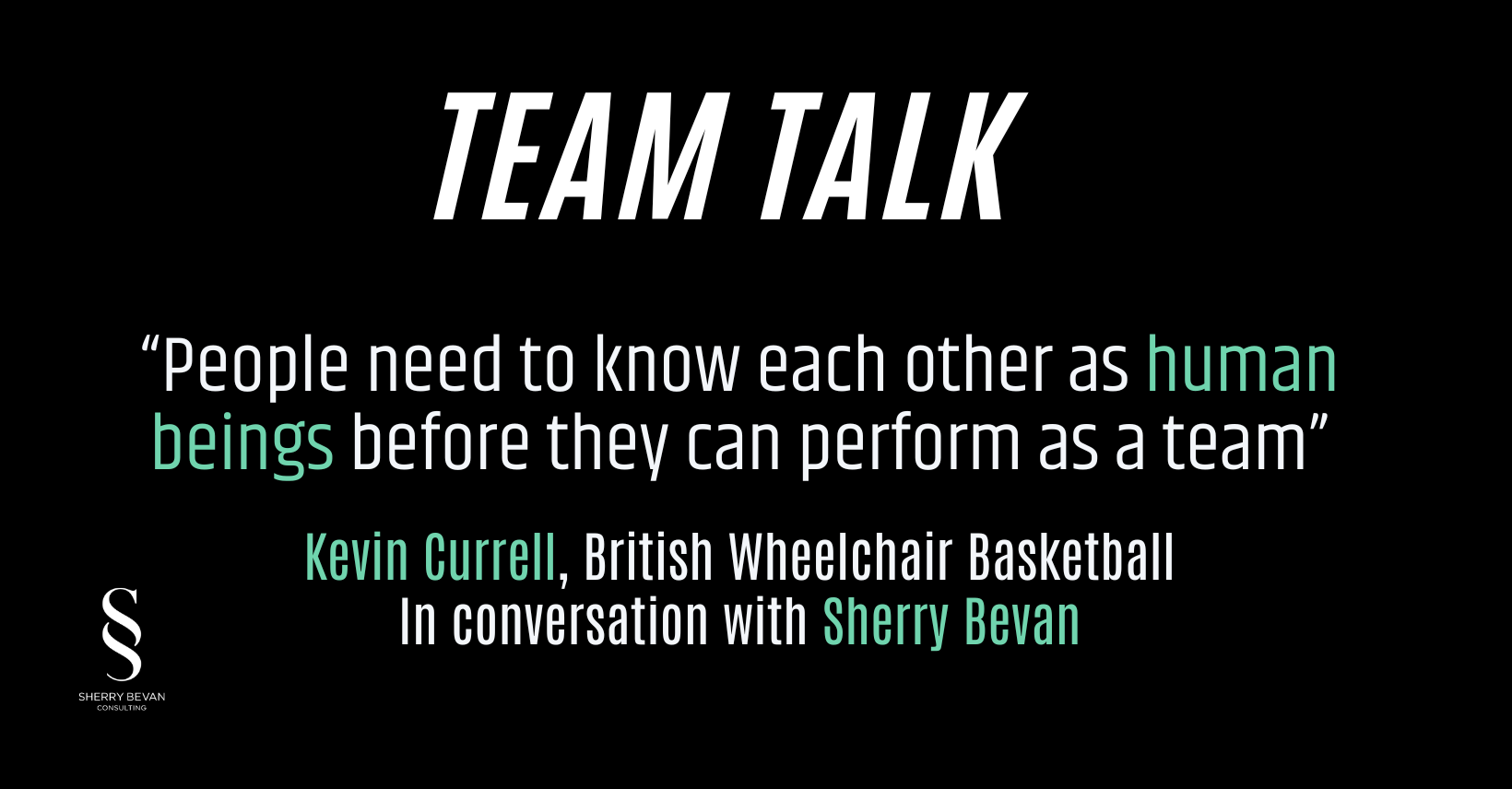
Leadership lessons from elite sport for anyone building a high-performing team.
In this episode, British Wheelchair Basketball Performance Director Kevin Currell shares practical insights on adaptive leadership, shared purpose and creating teams that perform when it matters most.
Listen here
add link
Listen on Spotify
Listen on Apple
Episode 16: Leadership for Building High-Performing Teams
In conversation with Kevin Currell, British Wheelchair Basketball
Sherry Bevan: Hello and welcome. Today I’m absolutely delighted to be joined by Kevin Currell. Kevin is the Performance Director at British Wheelchair Basketball, where he oversees the performance programme on their exciting journey towards the Los Angeles Paralympics.
Kevin has spent two decades working in high-performance sport as both a practitioner and a leader, so a very warm welcome to you today, Kevin.
Kevin Currell: Thank you. It’s a pleasure to be here.
Let’s start by hearing a little about your career journey and how you came to be in your current role.
I’ve been in my current role for about a year now. Like many people, I started out as a sports-mad kid and teenager. I thought I’d play football for England, but I quickly realised I wasn’t good enough!
Fortunately, I was pretty good at science, so when it came to choosing what to study, sports science felt like the obvious route. I always knew I wanted to work in sport and make a difference to performance.
Growing up as a teenager in the 1990s wasn’t exactly the best time to be a fan of British sport. England failed to qualify for the World Cup, the cricket team struggled, and at the Olympic Games we won just a single gold medal. I could never quite understand why that was.
I went on to study sports science, completed a PhD, and specialised in nutrition. After finishing my doctorate, I was fortunate enough to secure an internship with the English Institute of Sport.
That was just after London had won the bid to host the 2012 Olympic Games. I remember sitting in my PhD office watching the announcement and thinking, I just want to work there. I don’t really care what I’m doing, I just want to be part of it. That really set me on the Olympic and Paralympic pathway.
My role evolved as I provided nutrition support across a range of sports, particularly triathlon, canoe slalom and short-track speed skating, so I experienced both summer and winter sports. I was incredibly fortunate to be part of the support team for the GB triathlon squad at the London Olympics.
I’ll never forget the atmosphere when Britain won its first-ever Olympic triathlon gold and bronze medals. There were reportedly a million people lining the streets of London watching these athletes race, and this incredible wave of sound travelled around the Serpentine. It was unlike anything I’d ever experienced.
I remember sitting in the stands afterwards, with Union Jacks waving and David Bowie’s Heroes playing, as it did after every medal ceremony. I found myself thinking, How does it get any better than this? As a practitioner, it felt like an unbelievable privilege to be part of a home Olympic Games.
Around that time I’d also become fascinated by leadership. I was beginning to read about it and had started managing people, and I think I made the decision there and then that I wanted to move into leadership.
I was given the opportunity to lead the nutrition service at the English Institute of Sport, moving from delivering my own profession to leading others within it.
As my interest in leadership continued to grow, I wanted to lead broader, multidisciplinary teams. I spent eight years leading all of the science services at the English Institute of Sport, now the UK Sports Institute.
Then, about a year ago, I made the move to lead an actual sports programme, something I’d always wanted to do. That journey has brought me to my current role as Performance Director at British Wheelchair Basketball, where I oversee the entire performance programme.
Wow, it sounds like an incredible career. I remember that triathlon so clearly because I took my daughters up to Hyde Park to watch it. I was really interested in triathlon at the time – I even entered a couple, although I pulled out because I was too nervous about the swim! Coming from a cycling and running background, it was a sport that really appealed to me.
What I remember most was being amazed by the sheer number of people lining the streets to watch.
Even now, the hairs on my arms stand up when I think about it. It was such an incredible moment and a wonderful demonstration of the power of sport to bring people together. There was such a positive atmosphere, and it felt like a real privilege to be the right age, at the right time, to experience a home Olympic Games. It’s a once-in-a-generation opportunity.
Absolutely. London 2012 really was special.
You’re now working with British Wheelchair Basketball. I’ve watched wheelchair basketball a few times and, if I’m honest, I actually prefer watching it to the running game because it feels so energetic, exciting and fast-paced.
For those who aren’t familiar with the sport, where does Great Britain currently sit in the world rankings?
The men’s team won silver in Paris and have consistently reached the finals of major championships over the last decade or so. We’ve only won one world title, though, so that’s something we’re looking to change over the next few years, starting with this summer’s World Championships and then building towards the Paralympic Games.
The women’s team are also consistently among the world’s best. They’ve never won a Paralympic medal and have one World Championship medal in recent history, but they’re regularly in Europe’s top two and consistently ranked in the world’s top five.
Given that Britain isn’t traditionally a basketball nation, it’s remarkable that we’ve developed the talent to compete with the very best.
Our ambition for Los Angeles is to come home with two medals, with at least one of them being gold. That would be Britain’s first-ever Paralympic basketball gold medal and, for the women’s team, their first Paralympic basketball medal of any colour.
That’s a fantastic ambition, and it certainly doesn’t sound unrealistic given where both teams are competing internationally.
Absolutely. We’ve had opportunities before that just haven’t quite gone our way.
The prospect of trying to win a basketball gold medal in the United States, on a court where players like Kobe Bryant and LeBron James have competed, is incredibly exciting. It’s such an iconic venue and it would be a very special moment for our athletes to perform there—and hopefully succeed.
It’s a really exciting time to be involved.
It certainly is.
You mentioned earlier that, at one point, you made a conscious decision that you wanted to become a leader. What was it that drew you towards leadership?
That’s a great question.
To be honest, managing people always seemed quite daunting. For most people, leadership starts when you’re asked to line manage someone for the first time, and that can feel like a big step.
I’m not sure I can pinpoint exactly what drew me to it, but I’ve always enjoyed working with people and helping them develop.
One memory that really stands out is from the build-up to the London Olympics. I was working with the canoe slalom team after they’d moved from Nottingham to Lee Valley to prepare for the Games. I’m based in the Midlands, so every couple of weeks a colleague of mine, James Glover, and I would drive from Loughborough to Lee Valley together.
James was doing a leadership course at the time and recommended a TED Talk. This was around 2010 or 2011, when TED Talks were still relatively new. He said, “I think you’ll really like this.”
I’d never even heard of a TED Talk, but I watched it anyway.
It was Simon Sinek’s Start With Why, and it just clicked.
I remember thinking, that makes complete sense. You start with why, you create an emotional connection, and people buy into what you’re trying to achieve. Suddenly leadership didn’t seem like something reserved for people in suits—it felt accessible. I remember thinking, I could actually do this.
Around the same time, I went on a coaching skills course for line managers. Between Simon Sinek’s ideas and learning how to coach by asking questions rather than simply giving answers, I started to dip my toe into leadership.
I began leading the nutrition service at the English Institute of Sport, and you could see the difference. People started coming together around a shared purpose. You could almost see their eyes light up when they understood the “why”.
That’s probably when I realised I genuinely wanted to lead.
From there, I became fascinated by leadership—how you improve as a leader and how your leadership has to evolve depending on the people and situations around you.
That’s something that’s come up in a few of these conversations—this idea of adaptive leadership. It’s about staying true to yourself and being authentic, while recognising that different situations, different people and different challenges all require something slightly different from you. You’re still you, but you’re responding to what’s in front of you.
Exactly. I think it’s really important that you stay authentic—you’re still yourself. But different people need different things. Some people need more structure and process. Others need more inspiration or a stronger emotional connection.
When you’re leading teams, the reality is that everyone is different, so you have to recognise that and adapt your approach.
One of the most powerful leadership experiences I’ve had came from a course involving horses. I remember turning up thinking, Oh, here we go, one of those gimmicky leadership courses. But it turned out to be one of the most authentic leadership experiences I’ve ever had.
The horses responded entirely to how you showed up. They could sense whether you were nervous, confident or calm. It really made you think about your own presence as a leader. Sometimes you need to lead from the front. Sometimes you walk alongside people. Other times, you lead from behind and gently encourage them forward.
That idea has stayed with me ever since. It’s something I still think about today—where do I need to position myself to help these people achieve what we’re trying to achieve together?
That’s fascinating. I’ve heard people talk about leadership programmes involving horses before. Horses don’t have a hidden agenda—they simply respond to the person standing in front of them. They’re reacting to how you present yourself.
What did you learn about yourself through that experience?
The biggest lesson was understanding that different situations require different styles of leadership.
Sometimes people need direction—you go to the front and lead. Sometimes they simply want you beside them, walking alongside. Other times, they need you behind them, giving them a little encouragement.
It also made me think much more consciously about how I show up as a leader. If horses can sense your emotions, then people almost certainly can too.
Whether you’re walking into a one-to-one, a team meeting or giving a presentation, how are you preparing yourself? What energy are you bringing? How do you need to show up for the people in front of you?
Absolutely.
As you prepare for the Los Angeles Paralympics—which are now only a couple of years away—how does your role change throughout an Olympic cycle?
It’s amazing how quickly those four years disappear! At the start of a cycle, four years feels like a long way away, and then suddenly you’re halfway through.
Early in the cycle, you’re casting the net wide. You’re exploring ideas, trying different ways of working and giving coaches and athletes the space to be creative.
You’re also dealing with the reality of funding decisions, because every four years the funding is reviewed. That can mean more resources, fewer resources, or simply changes that you have to adapt to.
As the Games get closer, everything becomes much more focused. You have to be really clear about what’s important, what isn’t, and where your effort will make the biggest difference when competition arrives.
There’s also an enormous amount of operational planning involved. Taking a team to an Olympic or Paralympic Games is a huge logistical exercise.
Then, of course, the pressure starts to build. What feels like a distant goal suddenly becomes very real. Everyone becomes more aware of what’s at stake, emotions naturally become heightened, and as a leader you have to think even more carefully about what each individual needs from you during that period.
And does the fact that Los Angeles is so much further away than Paris make a difference? Paris felt almost on our doorstep, whereas LA brings long flights, major time differences and a very different environment.
It certainly adds another layer.
We’re talking about a 10 to 12-hour flight, seven or eight time zones, and almost certainly hotter conditions because of the time of year. Having said that, we’re quite used to travelling internationally. We’ve got a World Championships in Canada this September, for example, so travelling long distances and adapting to different environments is part of what we do.
Across British sport we’ve become very experienced at planning those challenges. You know you need to arrive early enough to adjust to the time zone. You know you need to think about the heat.
For us, the heat isn’t so much an issue inside the arena because we’ll be competing in air-conditioned venues. It’s more about day-to-day living and how each athlete responds, because our players have a wide range of disabilities and medical conditions, some of which require much more careful management in hotter conditions.
One thing that’s really opened my eyes since moving into wheelchair basketball is just how difficult travel can be for wheelchair users.
Airports simply aren’t designed particularly well for people travelling with wheelchairs. You watch baggage handlers loading equipment onto aircraft and, unfortunately, broken wheelchairs aren’t uncommon when they arrive at the other end.
Then there are the logistics. We have two squads of 12 players. Each athlete has at least one chair, and some travel with two, so you could easily have more than 40 wheelchairs to fit into the hold of an aircraft.
That depends on the size of the plane and the airport infrastructure, so it’s another layer of planning that simply doesn’t exist in many other sports.
I’d never really thought about that. I used to travel with my bike quite a lot and I’d always sit on the plane watching it being loaded, thinking, Please be careful—that’s my bike!
But a wheelchair is so much more than a piece of sporting equipment. It’s far more personal and, of course, essential to everyday life.
Exactly. And it’s much more specialised as well.
Yes, and much more personal as well, I’d imagine.
I’d never really considered the logistics of moving so many athletes and all of that specialist equipment around the world. It’s a huge operation.
Before we move on, can I ask something about the sport itself? Is a wheelchair basketball team the same size as a running basketball team, or is it smaller?
It’s exactly the same. You have a squad of 12, with five players on court at any one time.
Most of the rules are almost identical. The court is the same size, the markings are the same and the basket is the same height. There are a few rules specific to the wheelchair itself and how it’s set up, but the biggest difference is the player classification system.
Every player is given a classification between 1.0 and 4.5, depending on the level of functional ability they have. A 1.0 player has the greatest level of impairment, while a 4.5 player has the highest level of mobility.
Those classifications really matter because the five players on court can’t have a combined total of more than 14 points.
You can be under 14, but then you’re probably giving away a competitive advantage. So coaches are constantly trying to build line-ups that total 14 points while giving them the best tactical balance.
That classification system adds another layer of complexity to coaching and substitutions, but apart from that, it’s remarkably similar to the running game.
I imagine that eventually just becomes second nature for the coaches.
It does. They’ll have a number of line-ups already planned and they’ll know exactly how to adapt if someone gets injured or if they want to make a tactical substitution. Those combinations are all thought through in advance.
You have five players on court, but a squad of 12. How do you create a team that performs at such a high level? What are the key ingredients?
First and foremost, people need to know each other as human beings.
Because wheelchair basketball is a relatively small sport, many of the players have grown up together. That’s probably an advantage, although sometimes it can be a disadvantage too.
It’s really important that everyone has a shared understanding of what you’re trying to achieve, how you want to work together and how you want to behave as a team. The best way to do that is collaboratively—bringing together the athletes, coaches and support staff to shape that environment together rather than imposing it from the top down.
The reality is that high-performing teams are messy. You’ve got lots of different personalities, different ways of working and different preferences. At times it can feel chaotic.
For me, though, that’s what makes it enjoyable. In the moment, you’re constantly adapting.
If I had to boil it down, the two biggest things are helping people genuinely understand each other and creating absolute clarity around the common goal you’re all working towards.
And for the team heading to Los Angeles, that common goal is very clear—it’s to win.
Exactly. One of the advantages of elite sport is that the goal is usually obvious. Nobody competes at this level without wanting to win.
The danger is becoming too obsessed with the medal itself.
The question I think we should ask more often is: What does winning actually mean?
Winning gives you a platform. It gives you an opportunity to influence society.
We’ve seen that with teams like the Lionesses. They won the European Championship and almost immediately used that success to campaign for equal opportunities for girls in PE.
I’d love to see us do more of that.
Winning matters—there’s no point pretending otherwise—but once you’ve won, then what?
How are you going to use that success to make a difference?
Because otherwise there’s a real danger that you spend years chasing a medal, you finally achieve it, and then ask yourself, Now what?
And I imagine that’s where some athletes experience quite a significant emotional drop afterwards.
Absolutely.
Sometimes people build this idea in their minds that becoming an Olympic or Paralympic champion will finally make them feel complete or fulfilled.
In reality, that’s often not what happens.
We’ve seen plenty of examples across different sports where incredibly successful athletes have struggled after achieving everything they’d worked towards.
Which brings us right back to Simon Sinek and Start With Why.
Exactly.
I also wonder whether having that deeper sense of purpose helps if things don’t quite go to plan.
If you come home with a silver or bronze medal rather than gold, perhaps the disappointment isn’t quite so overwhelming because you still have the opportunity to inspire young people, grow participation in the sport or influence society in a positive way.
I think that’s exactly right.
There’s definitely more work we can do around that as a sporting community. We’ve already seen how effectively teams like the Lionesses and the Red Roses have used their success to create a much bigger impact than simply winning trophies.
All sport relies on external funding in one way or another. Football relies on supporters buying tickets and commercial sponsorship, for example. But Paralympic sport is much more dependent on grant and National Lottery funding.
How does that shape both the opportunities and the challenges for your team?
Well, first of all, we need everyone to keep buying their National Lottery tickets!
The Olympic and Paralympic system in the UK simply wouldn’t exist in the way it does today without National Lottery funding. It supports athletes and sports at every level—not just elite performance, but participation too. It’s absolutely vital.
Of course, there are pros and cons. We’re incredibly fortunate to receive public funding, but that also brings responsibility. We’re part of a much bigger system, and no system works perfectly for every individual sport.
You have to balance those realities, but overall I think we’re incredibly lucky that the public enables us to do what we do—whether that’s employing people like me as a Performance Director or supporting athletes to compete at the Paralympic Games.
When you look at how British sport has developed over the last 30 years, Lottery funding has played an enormous part in that success.
It really has. When you think about the sports where Britain is now competing at the very highest level, they’re sports that, 30 or 40 years ago, we’d never have imagined becoming world leaders in.
Exactly.
Every four years, the Olympic and Paralympic Games become Britain’s shop window. If I’ve remembered correctly, Team GB and ParalympicsGB are among the most admired and trusted brands in the country, alongside organisations like the NHS and the Armed Forces.
The challenge is that we only get that spotlight once every four years. For the rest of the time, people’s attention naturally shifts back to football, cricket and other sports.
But sport has a unique ability to bring people together.
If, for a few weeks every four years, we can inspire the country and give people something positive to rally around, then I think that’s a wonderful return on the investment the public makes through the National Lottery.
There are even studies suggesting that fewer people visit their GP during the Olympic and Paralympic Games because they’re distracted from some of the pressures of everyday life. I don’t know whether that’s true of other major sporting events, but it does show the wider impact sport can have on people’s wellbeing.
Absolutely.
Going back to London 2012, I was a Games Maker. If you walked around London in your Games Maker uniform, complete strangers would stop you to say thank you, ask to have their photograph taken with you, or tell you how proud they were of what everyone was doing.
It was an amazing experience. For those few weeks it genuinely felt as though the whole country had been lifted.
I remember walking around London in my Team GB kit and people asking if I was an athlete.
I’d have to say, “No, I’m just the nutritionist!”
I felt slightly embarrassed.
I actually got married in 2012 and started my wedding speech by talking about what an incredible year it had been and how privileged I’d been to be involved in the Olympics.
Everyone burst into applause.
I remember thinking, No, no… you’re supposed to applaud when I start saying nice things about my wife—not because I happened to be part of an amazing summer of sport!
It really was an extraordinary summer.
I volunteered at the Paralympics as a Games Maker on the marathon. I was stationed on The Mall, just a short distance from the finish line when David Weir won.
The crowds were so deep that I couldn’t actually see the finish itself, but the roar that travelled along The Mall told us instantly that he’d crossed the line first.
It was one of those moments you’ll never forget.
Those are the moments that make everything worthwhile.
High-performance sport has plenty of difficult days, but then you experience moments like that, or you see the country completely captivated by Team GB and ParalympicsGB.
Or perhaps you’re watching an athlete you’ve worked with appear on Channel 4 in the closing stages of a Paralympic final.
Those moments remind you why you do it, and they make all the hard work worthwhile.
It does, doesn’t it? And that leads me nicely to the question I ask every guest. What’s one of your all-time favourite sporting moments?
That’s a great question.
Obviously, being involved in London 2012 was an incredible experience, but I’m actually going to choose something different.
I’d go for Rory McIlroy’s Masters victory.
I was watching it at home into the early hours of the morning, and I thought it was one of the greatest demonstrations of performance and resilience I’ve seen.
For years he’d been asked, “Is this your year? Are you finally going to win?” He’d come close before and suffered some heartbreaking disappointments, and then even in that final round it looked as though the opportunity might slip away again.
The resilience, persistence and sheer drama of it were extraordinary.
It’s the sort of story you couldn’t write. No novelist would come up with an ending quite like that. That’s what makes sport so special.
For me, it perfectly captures the pursuit of excellence and the emotional journey that comes with it.
Thank you for sharing that.
What strikes me about Rory McIlroy’s story is that, despite all his talent, he wasn’t competing in isolation. Every year he was facing other world-class golfers, all capable of winning.
Golf feels particularly unforgiving because, ultimately, it’s all down to you. I’m not a golfer, so I can’t speak to the technical side, but it seems to demand incredible resilience and mental strength.
I think so.
What I hope is that, if you asked me the same question in three years’ time, I’d be talking about watching our wheelchair basketball players produce something truly special on one of the world’s most iconic basketball courts.
I’d love for the wider public to see just how good this sport really is.
I hope so too.
I’m going to make a note in my diary and come back to you after Los Angeles so we can celebrate.
Fingers crossed!
Fingers crossed indeed.
Kevin, thank you so much for joining me today.
I’ve really enjoyed our conversation about leadership, building high-performing teams and the importance of creating a shared purpose. I think one of the biggest takeaways for me is that successful teams aren’t just built around talent—they’re built on people understanding one another, working collaboratively and knowing why they’re doing what they do.
Thank you again for sharing your experiences, and I wish you and everyone at British Wheelchair Basketball every success on the road to Los Angeles.
Thank you very much.
About the guest
Kevin Currell is Performance Director at British Wheelchair Basketball, where he overseas the performance programme on the journey to the LA Paralympics.
He has two decades of experience of high performance sport as a practitioner and leader.
Important links
- British Wheelchair Basketball website
- Simon Sinek TED Talk “How great leaders inspire action”
About the host
Sherry Bevan believes that high-performing teams start with confident leadership.
Before becoming a Leadership Consultant, she spent more than 25 years working alongside technology teams, including in organisations such as McDermott Will & Emery, Credit Suisse and Arthur Andersen. That experience gives her a deep understanding of the challenges facing today’s IT leaders, particularly within law firms and professional services.
Through her consultancy, coaching and leadership development programmes, Sherry combines commercial understanding with honest conversations, skilled facilitation and practical leadership support to help leaders build confident, high-performing teams.
A former racing cyclist and lifelong sports enthusiast, Sherry is fascinated by what enables teams to perform under pressure. That’s why Team Talk goes behind the headlines to speak with the coaches, performance directors, and leaders who create the environments where success becomes possible.
Because whether it’s a law firm, an IT department or an elite sporting environment, great results rarely happen by accident. They happen when leaders create the conditions for people to perform at their best.
Connect with Sherry
- Sign up for news and updates
- Apply to join the Team Culture Club
- Connect on LinkedIn
- Visit Sherry Bevan’s website