
What does it really take to lead high-performing teams – across different sports, cultures and global stages?
In this episode of Team Talk, Sherry Bevan is by Jon Dutton, Chief Executive of British Cycling and incoming CEO of Team GB. With over 30 years in sport, Jon shares what leadership looks like behind the scenes – from delivering world-class events to building teams that perform under pressure.
Listen to the episode here:
Listen on Spotify.
Listen on Apple.
Episode 11: Leadership Beyond Expertise: What High-Performance Sport Teaches Us About Teams, Trust and Purpose
Guest: Jon Dutton, British Cycling
Thank you for joining me today.
If you don’t know by now, I’m a huge cycling fan, so I’m especially excited to be talking to Jon Dutton, Chief Executive of British Cycling.
Jon was appointed in April 2023 and will leave in July to become CEO of Team GB. He brings over 31 years’ experience in sport, including roles with the PGA European Tour, Manchester FA (with a secondment to UEFA), Managing Director of a sports consultancy, COO of the Rugby League World Cup 2013, Director of Readiness for the Tour de France Grand Départ 2014, Director of Projects and People at the Rugby Football League, Tournament Commissioner for the Rugby League World Cup 2017, and CEO of the Rugby League World Cup 2021.
He was awarded an OBE for services to Rugby League in the 2023 King’s Birthday Honours and an honorary Doctor of Civil Law from Northumbria University.
Welcome, Jon—great to have you here.
Jon Dutton: Thank you very much for the opportunity, Sherry.
I was thrilled to hear the news that the Cyclocross World Cup is coming to Glasgow this December—my favourite discipline. How involved were you?
It’s been a big team effort and a long-held ambition to bring the World Cup back to the UK. We’re delighted it’s happening at Kelvingrove Park with strong support from Glasgow City Council. It’s going to be an incredible event—mud, energy, family atmosphere, and the world’s best riders.
Very exciting. My daughter’s at university in Glasgow—no interest in cyclocross, disappointingly—but at least I’ve got somewhere to stay.
Let’s come back to you. Tell us about your career and how you got here.
I always wanted to be a professional athlete—rugby was my first passion—but I realised I wasn’t quite good or brave enough. So I studied sport management at Northumbria and pursued that dream in a different way.
My career started with the European Golf Tour. At 22, travelling the world was incredible. I didn’t love golf, but it sparked my passion for working in sport—especially events.
Since then, I’ve been fortunate to work with great people across different sports and cultures. More recently, my focus has been on making a social impact—something that’s been central to my time at British Cycling and previously with the Rugby League World Cup.
You’ve worked across golf, football, cycling, and rugby. From behind the scenes, what’s similar—and what’s different?
There are far more similarities than differences. When I joined British Cycling, some people questioned my cycling credentials. But I wasn’t hired to ride a bike—I was hired to lead.
The fundamentals—event delivery, sponsorship, team development, culture—are transferable across sports. The same applies to performance: how athletes prepare has parallels with leadership and organisational performance.
Sport may differ on the surface, but at its core, the principles are shared.
You’ve also worked on major events like the Tour de France, which rely heavily on volunteers. How do you get volunteers ready, motivated, and engaged?
Volunteers are the backbone of community sport—it simply wouldn’t exist without them. But numbers have declined post-pandemic, and that’s a real concern.
People stepped away, formed new habits, and we’ve also got challenges around how welcoming sport feels. We need to look at accessibility, succession planning, and how we create meaningful experiences.
Some roles—like event organisers—are highly specialised. We rely on incredibly committed individuals, and the question is: who replaces them?
We need to both value existing volunteers and create pathways for new ones to join and stay. Too often, people come for a one-off experience and leave. We need to find a better balance.
That’s especially true in cycling, where there are fewer grassroots events and fewer opportunities to learn those skills.
Exactly. Roles like marshals and commissaires aren’t always glamorous, but they’re essential.
We also need to understand changing motivations. Society feels different—less patient, perhaps—and that affects volunteering. Our volunteer base needs to reflect the society we live in, including bringing through younger generations.
Ultimately, it’s about enabling both competitive and recreational sport—helping people stay active, healthy, and connected.
And that matters just as much as elite performance. As you move to Team GB, what are the key opportunities and challenges?
Team GB represents a collection of sports across summer and winter. The landscape is evolving—new sports are emerging, like BMX Freestyle, which has grown rapidly thanks to Olympic exposure.
The opportunity is clear: build on a strong brand and foundation. The challenge is ensuring the Olympic movement stays relevant—balancing tradition with innovation and societal impact.
Sport isn’t just about medals. It’s about connection, inspiration, and contribution to society.
Cycling is a great example—it’s not just a sport, it’s transport, a life skill, and part of everyday life. Our research shows 27 million people rode a bike in the UK last year. That’s powerful.
When you step into a new role, what do you focus on in the first 90 days??
Understand the challenges and opportunities quickly and honestly. When I joined British Cycling, I had a few weeks to really get under the skin of the organisation, which helped enormously.
Then it’s about building relationships and trust, staying curious, and asking questions.
Clarity is critical. One of the first things we did was redefine our strategy—anchored in purpose. That gave everyone direction and removed ambiguity.
I see that a lot—teams struggling because the goal isn’t clear or aligned. What’s the overarching goal for Team GB?
There are two: set athletes up for success at the Games, and bring the Olympic values to life across society.
At British Cycling, our purpose is simple: bring the joy of cycling to everyone. Our strategy focuses on getting more people cycling, leading on the world stage, and driving social impact.
That clarity has been hugely powerful.
As you move on, what will you take with you?
A strong commitment to learning. After 31 years, my appetite to learn is higher than ever.
Curiosity, communication, and role modelling matter. And the opportunity to create social impact—helping more people move, feel inspired, and take pride in sport—is something that carries across all organisations.
Final question—your favourite sporting moment?
There have been many, but the standout was seeing my team, Leigh Leopards, win the Challenge Cup at Wembley in 2023—after 50 years.
I was there with my family. It meant everything to the community. That moment of shared pride was incredibly special.
Professionally, Paris 2024 was amazing, and I think the Tour de France in 2027 will be another huge moment—millions lining the roads across the UK.
Yes—2014 was magical. I volunteered then and can’t wait for 2027.
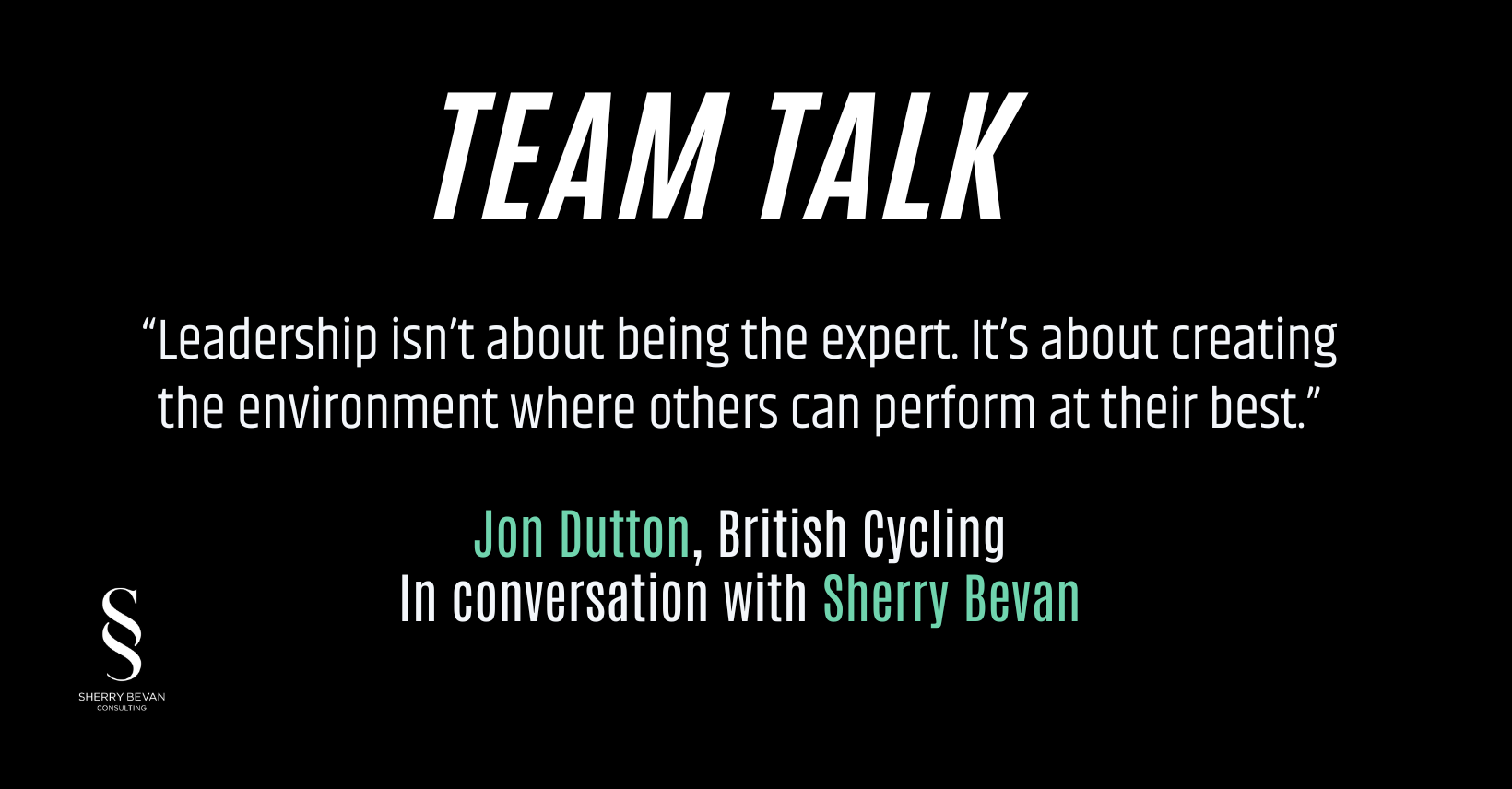
Thank you, Jon. It’s been fascinating—especially your perspective that leadership isn’t about being the technical expert, but about clarity, culture, and impact.
My pleasure—thank you.
Important links
About Jon Dutton
Jon Dutton was appointed Chief Executive of British Cycling in April 2023 and will be leaving in July to become CEO of Team GB.
He brings more than 31 years of experience in the sports industry. His career spans roles with the PGA European Tour, Manchester FA (including a secondment to UEFA), and as Managing Director of a sports consultancy. He’s also been Chief Operating Officer for the Rugby League World Cup 2013, Director of Readiness for the Tour de France Grand Départ in 2014, Director of Projects and People at the Rugby Football League, Tournament Commissioner for the Rugby League World Cup 2017, and CEO of the Rugby League World Cup 2021.
About your host Sherry Bevan
Sherry Bevan helps teams under pressure and teams in transition perform at their best – without the fluff. A former Global Head of IT Service in an international law firm, she now works across technology, professional services and the sports world.
Through her Team Performance Reset, Sherry supports new and changing teams to build trust, strengthen collaboration and set the foundations for high performance.
A former grassroots cyclist and still a runner, Sherry is fascinated by what sport can teach us about teamwork, leadership and sustainable performance – and it’s these ideas she explores with leaders and experts on Team Talk.
Connect with Sherry
- Sign up for news and updates.
- Apply to join the Team Culture Club.
- Connect on LinkedIn.
- Subscribe to the Team Talk newsletter