
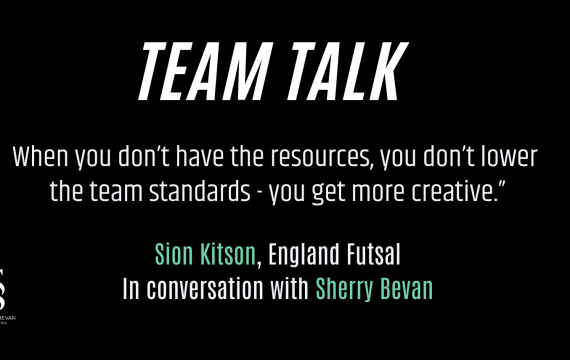
What does it take to grow a national sport with limited resources?
In this episode of Team Talk, Sherry Bevan talks to England Futsal’s Sion Kitson about leadership, resilience, and building high-performing teams on and off the court.
Listen to the episode here
Episode 5: High Standards Without Big Budgets
Guest: Sion Kitson, England Futsal
Sherry Bevan: Welcome to the Team Talk podcast. This is the show where we explore how to build high-performing teams using lessons learned from the world of sport. I’m your host, Sherry Bevan.
In today’s episode, I’m delighted to be joined by Sion Kitson, Head of Development and Technical Lead at England Futsal.
Sion, a very warm welcome to Team Talk.
Sion Kitson: Thank you for having me, Sherry. It’s lovely to be here.
To get us started, there will be listeners – like me – who don’t know much about futsal yet. Can you give us an overview of the sport: how it’s played, how it differs from football, and anything else that’s useful to know?
Futsal is an official FIFA- and UEFA-recognised small-sided format of football, played between two teams of five on a court roughly 40 metres by 20 metres—the same size as a handball court. The goals are also handball-sized: three metres by two metres.
Each team can have up to nine additional players on the bench, and substitutions are unlimited. It’s a very high-intensity, end-to-end game, so players might only be on court for three or four minutes before rotating off. Everyone is constantly involved.
Unlike football, we play to lines, so there are kick-ins instead of throw-ins. Players can move anywhere on the court – there are no restricted areas apart from the goalkeeper using their hands inside the D. There’s also no offside rule, which creates interesting ways to exploit space.
Another key difference is the foul count. Teams are allowed five fouls per half. Any foul after that results in a 10-metre penalty, similar to a free throw in basketball. This changes the tactical and psychological demands of the game.
Futsal is usually played on a hard court, which makes it fast and exciting. The ball is slightly smaller – a size four for adults – and has reduced bounce, so it stays on the floor longer. That really supports skill development, not just for young players but for everyone.
That sounds incredibly exciting to watch compared to some English football matches.
I often say it’s like taking all the most exciting moments of football – shots, dribbles, saves, last-ditch tackles – and putting them on repeat. Because space is limited, something is always happening near one of the goals.
There’s constant psychological pressure. A single moment can win you the game, but a small mistake can cost you. People tend to get hooked very quickly because of that intensity and excitement.
What about the women’s game in England? Is it growing?
Yes, it’s definitely on an upward curve. There are parallels with women’s football more broadly over the last five to ten years.
We currently have a two-tier domestic women’s league. Over the last 12 months, we’ve also re-established the England Women’s Futsal Team, supported by the FA, and entered qualification for the inaugural FIFA Women’s Futsal World Cup.
We didn’t qualify, but we recorded a win in our group, which was a fantastic achievement given that other nations have much longer histories in the sport. We also have an Under‑19 development programme feeding into the senior team.
It’s really positive, and more young girls are getting involved and excited about future opportunities.
How does England compare internationally?
On the women’s side, futsal is still growing globally. In the current FIFA rankings, England sit around 76th.
On the men’s side, England has had a national team since around 2004, though we stepped away in 2020 and returned in the last 12 months. We’ve previously been ranked in the mid‑50s, but we’re currently around 86th as we rebuild.
Anything above 50 usually means professional leagues, with players training and playing full‑time. In England, futsal is still amateur for both men and women, so there’s work to do.
What does your role at England Futsal involve?
My title is Head of Development and Technical, which currently covers quite a lot. England Futsal is an official delivery partner of the FA, so we work closely together.
From a development perspective, my role is about growth and participation – getting more people playing futsal in schools, communities, and clubs, and creating competition opportunities.
It’s also about developing our people: coaches, referees, and administrators, working closely with The FA’s refereeing department.
From a technical perspective, we’re building a pathway for talented young players, from grassroots through to Under‑19s and senior national teams. We’re only in the first year of properly establishing this and want to regionalise opportunities to reduce travel and increase access.
We’re a very small organisation – three full‑time staff, one part‑time role, and a supportive board of directors. Sustainability is a major challenge. Futsal receives very little funding, so we have to be creative in how we generate income and build for the future.
How do people usually discover futsal?
Historically, universities have been a big entry point. From around 2004 to 2015, many students discovered futsal through university leagues and clubs – often influenced by international students from countries where futsal is already popular.
More recently, the domestic game has grown, with more clubs -both football clubs using futsal and futsal‑only clubs – offering opportunities for men, women, boys, and girls.
The big opportunity now is schools. If we can embed futsal in primary and secondary schools, that’s where we’ll see real growth. Space is often limited, and futsal works perfectly indoors or on hard outdoor surfaces.
What’s it like working as such a small, mostly remote team?
Clarity and alignment are key. Because we’re small, it’s easier to be clear about roles and responsibilities. We have regular team meetings and strong one‑to‑one connections.
Face‑to‑face time is also really important. We come together around events – holiday camps, international matches, and other projects – which creates shared experiences and a sense of achievement.
As a small team, delivering things together and seeing the impact firsthand really strengthens our bond.
What are the biggest challenges you face?
Sustainability is the biggest one. We don’t receive guaranteed funding, so everything we generate comes from our own efforts. That means balancing ambition with capacity.
It’s pushed me to think much more commercially, which is different from my background in sports development. We’re learning fast and trying to build a resilient, adaptable mindset across the team.
Our mantra is about loving what we do while staying realistic about the pressures. We want to deliver high‑quality experiences – even with limited resources – and turn constraints into opportunities.
What’s your five‑year vision for futsal in England?
First, I’d love England Futsal to be financially stable, with a mix of earned income and long‑term partnerships.
I’d like to see a more integrated game – from schools and communities through to talent pathways and national teams. Ideally, we’d have well‑resourced national teams, improved international rankings, and a clear, joined‑up development structure.
Most importantly, I want a community that’s proud of the sport’s past and excited about its future. The people – players, coaches, referees, volunteers – are everything. If we can harness that collective passion, futsal has a real chance to thrive.
Before we finish, what’s been your favourite personal sporting moment?
Captaining Wales and scoring at international level as a player stands out – it’s such a high‑octane game, and the emotions are huge.
As a coach, working with England has been a privilege, and there have been some unexpected highs. And as a Sheffield United fan, I’m hoping for another big moment if we can win the play‑offs!
If people want to learn more about futsal, where should they go?
Visit englandfutsal.com, or follow England Futsal on X. You can also find me on X as well.
Thank you so much for joining me, Sion. What really stands out is the passion, human connection, and resilience at the heart of what you and your team are building.
If you’re listening and wondering how your own team could perform at a higher level, do get in touch. I work with the teams behind the teams – so those on the road or on court can make the headlines.
Thanks for listening.
Important Links
- England Futsal: https://www.englandfutsal.com
- England Futsal on X (Twitter): https://x.com/englandfutsal
- Sion Kitson on X: https://x.com/kitsion
- The FA: https://www.thefa.com/football-rules-governance/grassroots/futsal
- FIFA Futsal: https://www.fifa.com/futsal
- UEFA Futsal: https://www.uefa.com/futsal/
About Sion Kitson
Sion Kitson is Head of Development and Technical Lead, England Futsal. Sion has been involved in futsal since 2004. As a player, he represented Wales internationally for five years, captaining his country and scoring at international level. He then coached internationally for almost a decade, working across England and Wales Under-19s, England Under-21s, and the senior men’s and women’s teams.
Sion has worked in the sports sector for nearly 20 years, including roles at The FA as a coach educator, mentor, and development officer, and at Sport England, where he led work on coaching with England Hockey, supporting the implementation of their talent system.
He now heads up the growth and participation of futsal for England.
About your host: Sherry Bevan
Sherry Bevan helps teams in transition perform at their best – without the fluff. A former Global Head of IT Service in an international law firm, she now works across technology, professional services and the charity sector. Through her Team Kickoff Accelerator, Sherry supports new and changing teams to build trust, strengthen collaboration and set the foundations for high performance. A former grassroots cyclist and still a runner, Sherry is fascinated by what sport can teach us about teamwork, leadership and sustainable performance – and it’s these ideas she explores with leaders and experts on Team Talk.
Connect with Sherry
- Sign up for news and updates.
- Apply to join the Team Culture Club.
- Connect on LinkedIn.