What does it take for a leader to build trust in a team?
In this episode of Team Talk, Sherry Bevan talks to Helen Ward, former international footballer turned senior leader to explore her honest lessons on trust, identity and leading through transition in the evolving women’s game.
Listen to the episode here
Or listen on Spotify.
Episode 7: From Player to Leader: Lessons in Trust, Identity and Transition
Guest: Helen Ward, Watford FC Women
Sherry Bevan: Today, I’m delighted to be talking to Helen Ward, Head of Women’s Football at Watford FC. A very warm welcome to you, Helen.
Helen Ward: Thank you very much.
I’m so pleased to have you here. To start, could you give us a bit of background on your career and how you got to where you are now?
My experience growing up was very different from what young girls experience now, which is fantastic because it shows how far the game has come. I followed my brother around – he played football, so I did too. My parents were both very sporty, so every weekend I was on the side of a pitch or court watching someone in my family play.
My mum always tells me that I was adamant I’d never be into sport – it took up too much time and I thought it was boring. Then something clicked with football. I started playing with my brother in the garden and really enjoyed it. He found a leaflet at school for Watford Town Girls, as it was called then, and they needed players. He told me I was quite good – and if you have an older brother, you know that doesn’t happen often, so I ran with it.
I went along with a friend to a training session in a sports hall. It was small, crowded, but brilliant. I loved it. I played that weekend, scored a hat-trick in my first game, and that was it. I was eight or nine years old, and it was my first real exposure to team football.
It grew from there, but it was very different to now. I didn’t have any female football role models. I liked male footballers or female athletes like Sally Gunnell. I loved the Olympics. I didn’t even know female footballers existed – I just played with my friends.
That stayed the same until I was about 15 and joined the senior team, which I didn’t really know existed until I got there. As my career progressed, the game grew and evolved alongside it. What started as a hobby became something I dedicated a huge amount of time to. It only really became a job when I signed my first contract at Arsenal – until then, I’d actually paid to play every season up to about 22.
People often say they wish the game had been different when I was young, but I don’t. It allowed me to appreciate what I had later on, and who’s to say I’d have coped with contracts, pressure and expectations at that age. I don’t know if my journey would have been as enjoyable if it had been any different.
You’ve experienced both the amateur and professional eras of women’s football. What do you see as the key challenges and opportunities of each?
In the amateur game, the challenges are obvious. You’re working at least one other job and fitting training around that. There’s little time for extra gym work or recovery, but somehow you make it work. You lose your social life – birthdays, weddings, family events – but you do it because you love it. You find time rather than excuses.
The transition to professionalism was tricky. Players often still needed to work but couldn’t do full-time hours. They earned more from football, but not enough to live on, so some were effectively doing two full-time jobs. It’s mad to think about.
Now, especially in the top two divisions, players can fully focus on football. The introduction of a minimum salary is a big step, although it probably needs to be higher, particularly in the south. Still, it’s a really positive move.
For me, my whole career was about balance – work and football, then children and football, then children, work and football. Making sure one thing didn’t suffer too much was more of a mental challenge than a physical one. When you have kids, there’s mum guilt and moments of feeling selfish, but I was lucky to have great support around me.
We’re seeing more female athletes have children and return to elite sport. What’s changed to allow that?
Professionalisation is huge, and maternity policies make a massive difference. Knowing you won’t be out of pocket and that your contract will be honoured gives security. There’s also far more expertise around pregnant athletes and postnatal return.
There’s still room for improvement, but it’s a major step forward. When I had my children, I terminated my contracts and was technically unemployed both times, although I was fortunate to find contracts afterwards.
If anyone asked me now, I’d absolutely say go for it. Having children and continuing your career is one of the best things you can do. It’s tough, but it gives perspective. Football can be all-consuming, but children give you another focus. They allow you to breathe.
Having your kids on the sidelines when you’re playing again is an incredible feeling. It doesn’t take away from your dedication – it enhances it. You’re still a footballer, but you’re also more than that.
That sense of identity must be important, especially when a career ends.
Absolutely. Leaving the game can mean losing your identity and your daily community. Football moves on, and sometimes you feel left behind.
Kids aren’t the only answer, but having something else – a hobby, education, another interest – gives you mental separation. If you build that during your career, retirement is less daunting. You’re more than just a footballer, and that matters for your mental health.
Tell us about your current role as Head of Women’s Football at Watford.
It’s a wide-ranging role, and it differs by club. At Watford we’re not heavily resourced – we have two full-time staff: myself and the head coach. Everyone else is part-time, which means I handle a lot of operational work alongside strategy, recruitment and team building.
I didn’t initially see myself in this role. It was mentioned during my playing career and I waved it away. But when I retired, I wanted to stay connected to football. Laura Dyer stepped aside to focus on coaching and suggested I take the role. I didn’t have another plan, so I thought I’d give it a go.
It’s been a steep learning curve – managing people, budgets, logistics. As a player, you turn up, train, and go home. Now I see how much work goes into every session and matchday. I also understand why certain things aren’t possible.
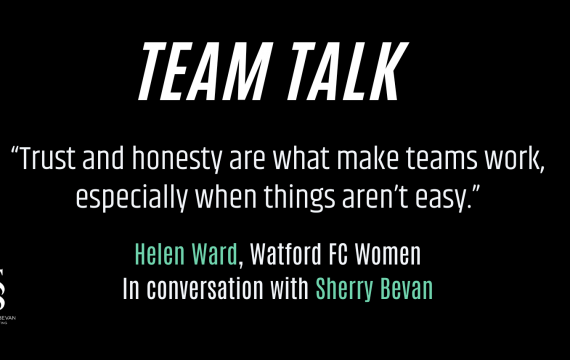
Having been a player helps. The team trusts that I understand where they’re coming from, and that if I could do everything they wanted, I would. That trust and honesty really matter.
How do you get a largely part-time staff team working well together?
Trust is everything. I know they’re working beyond their contracted hours, and I trust them to do their jobs without micromanagement. I don’t dictate when or how they work, as long as the job gets done.
We have set times when everyone’s together, and we use technology well – weekly MDT (multi-disciplinary teams) meetings online, clear communication, and open access to me. Ideally we’ll become fully professional in the next few years, but for now, trust and honesty are what make it work.
Are those values something you learned through sport?
Definitely. Sport teaches you trust, honesty, discipline and communication. In a team environment, you have to trust your teammates and have honest conversations, even when they’re difficult. That’s what builds morale and resilience, both on and off the pitch.
What qualities from your playing career helped you step into leadership?
Being made captain was huge. I learned to lead by example – never expecting someone to do something I wouldn’t do myself. I carry that into my role now.
Honesty is the other big one. If you need more from someone, or you can’t offer something, you have to be upfront. I’m still learning, but I lean heavily on my experience as a player because that’s where my foundation came from.
You’ve mentioned being comfortable with being uncomfortable.
It’s such an important lesson, in sport and in life. Life isn’t always easy, and sometimes you have to push through discomfort. I tell my daughter this all the time – it might only be half an hour of your life, and you’ll be okay.
The thought of something is often worse than the doing. When you get through it, you realise you can do more than you think.
That really resonates. As we close, what’s your favourite sporting moment?
For a long time, it would have been Super Saturday at the 2012 Olympics. That whole day of Great Britain doing so well in our home Olympics. But more recently, qualifying for the Euros with Wales in December 2024 in Dublin was one of the greatest moments of my life.
Hearing the anthem, seeing the red wall behind the team – it was the culmination of years of dedication and sacrifice. That moment trumped everything for me.
Helen, thank you so much. It’s been a real pleasure. I’ve loved hearing about your journey, your career, and how women’s football has changed. It’s been so incredible to witness in recent years. Let’s hope that we’ll be winning those Euros again and again and again.
Thank you for having me – it’s been a pleasure.
Important links
- Watford Football Club website: https://www.watfordfc.com/
- Watford FC on @watfordfcofficial on Instagram
- Watford FC Women @watfordfcwomen on Instagram
- Helen Ward on @HelenWardie10 on Instagram
- Helen Ward on LinkedIn
About the guest, Helen Ward
Helen Ward is a former international player with over 100 caps for Wales. Her former clubs include Watford, Arsenal, Chelsea and Reading. She moved into management after retiring in 2023 and has since worked as General Manager and now Head of Women’s Football. Helen is also an ambassador for the Football Association of Wales and a broadcaster for the BBC and other media outlets.
About the host, Sherry Bevan
Sherry Bevan helps teams in transition perform at their best – without the fluff. A former Global Head of IT Service in an international law firm, she now works across technology, professional services and the charity sector.
Through her Team Performance Reset, Sherry supports new and changing teams to build trust, strengthen collaboration and set the foundations for high performance. A former grassroots cyclist and still a runner, Sherry is fascinated by what sport can teach us about teamwork, leadership and sustainable performance – and it’s these ideas she explores with leaders and experts on Team Talk.
Connect with Sherry
- Sign up for news and updates.
- Apply to join the Team Culture Club.
- Connect on LinkedIn.
- Book a call to explore how I can help you improve team culture and team performance.