What does it take to build – lose – and rebuild a high-performance team without losing belief or values?
In this episode of Team Talk, Sherry Bevan speaks with Doug Ryder about leadership, resilience and community in professional cycling. Doug shares the journey from an “impossible” Olympic-era dream to leading the first African team at the Tour de France – and how Q36.5 Pro Cycling rebuilt after losing all sponsorship during Covid.
This is a candid conversation about belief, trust and what really sustains performance when results disappear.
Listen to the episode here:
Episode 3: Values-led leadership
Guest: Doug Ryder, Q36.5 Pro Cycling Team
Sherry Bevan: Welcome to the Team Talk podcast. This is the show where we discover how to build high performing teams using lessons learned in the world of sport. I’m your host, Sherry Bevan and in today’s episode I’m absolutely delighted to be talking to Doug Ryder, who’s the General Manager at Q36.5, the Pro Cycling team. Welcome, Doug, a very warm welcome to you.
Doug Ryder: Thank you very much Sherry.
Not everyone listening to this podcast is a big cycling fan. Could you start by telling me a bit more about your personal background in the world of cycling as a professional.
Thank you. I was a professional cyclist and rode for South Africa. I was very lucky. I rode at a time when Mandela had just come out of prison. It was a beautiful time to be a sportsperson in South Africa, because we were banned from international sports for a time. When Mandela came into power, that whole “sport has the power to change the world”, that empathy, that purpose, that came through with him as a leader. It was an inspirational time to be a person from South Africa, particularly in the sporting world.
I was fortunate enough to go to the 1996 Atlanta Olympic Games and represent South Africa. That’s where the dream of this team started – to take an African team to the Tour de France. We were a special and small group of athletes that competed together at the highest levels in sport. The cycling was amazing in Atlanta. It was the first professional amateur race at the Olympic Games for cyclists. Previously the Olympics was just for amateurs. We had all the big guns from cycling there, including Lance Armstrong.
I didn’t make it as a pro ultimately. In the late nineties and early 2000s the sport was in a different place; it was like racing motorbikes.
My dream was to take an African team to the Tour de France. I went into the corporate world and worked in IT for 11 years, which helped me plan, strategise, understand business, and putting big deals together.
In 2012, I went to the ASO, the owners of the Tour de France, and I put a plan together to take an African team to the Tour within three years.
They thought I was completely mad. I raised some backing, and I had some riders that believed that they could do it, too. Three years later we were at the Tour de France as the first African team in 2015. It was epic. They made history. It was a remarkable time. It was a beautiful Tour de France.
Wow – that’s so inspirational. When I speak to people in sport, I often hear the same story: “Everyone thought I was mad” or “It was an impossible dream.” I love hearing that, because it proves that impossible dreams aren’t impossible. You just have to set your mind to it.
In the modern world, people sometimes think that if a dream hasn’t happened yet, it never will – that everything’s already been done. That’s simply not true. There are still opportunities to do something uniquely different, something that’s never been done before. If you stick with it and truly believe in it, anything is possible.
I talk about this a lot, and people often say, “Wow, that gives me hope.” It’s inspiring – but it’s not easy. It took me 15 years to make this happen. It didn’t happen overnight, but it was absolutely worth it.
1996 in Atlanta feels like a long time ago now. How does performing at the Olympics in a cycling team compare to racing on the road, not in a national team but in a professional one?
There’s always incredible national pride. Riders love representing their countries – that’s a huge motivator. Going to the Olympics is an absolute privilege. That’s the one percent of the one percent.
Wearing your national colours at a World Championship is special, but working in a professional team environment is different. You’re building something together. You’re on the road 200 days a year. It becomes a family.
Endurance sport isn’t a job – it’s a lifestyle. Everything you do, everyone around you, has to believe and sacrifice for you to exist at this level. When you succeed, the celebration belongs to everyone – from the bus driver to the chef to every single person on the team.
With national teams, those moments are rare. In professional cycling, we lose far more than we win. There are 180 riders on the start line – you have a one-in-180 chance. I always tell my kids to play tennis. They ask why, and I say, “You’ve got a 50% chance of winning.” In cycling, you’ve got weather, crashes, traffic, mechanicals – everything working against you.
That’s why the team becomes your second family. And that’s incredibly special.
Especially because you travel constantly. You’re not all based in one place – you’re moving around the world together.
That’s one of the beautiful things about cycling. Our stadiums are the open roads of the world – the Pyrenees, the Alps, the Netherlands, everywhere. But there’s also loneliness. Riders train alone a lot. They make huge sacrifices, each with very specific roles.
When they come together at races, connection becomes essential. Understanding each other, trusting each other – that’s what makes the sport unique.
Tell me about the team you’re working with now – both on the road and behind the scenes.
We have 25 riders and about 50 staff – roughly 70 people in total. Around 55 of them are travelling ten months a year, across 220 race days in more than 20 countries. It’s a moving billboard, a moving circus.
We run double programmes for most of the year, with separate infrastructure, vehicles, and staff.
It’s amazing – and it’s incredibly complex. Getting everyone to the right place, on time, healthy, in form, with the right equipment, is a logistical nightmare.
And the team is relatively young compared to others?
We’ve got history. We started as MTN-Qhubeka in 2010, grew into a WorldTour team, and then Covid hit. We lost all our sponsorship and didn’t exist in 2022. That was devastating.
But we fought back. Q36.5 is now in its third year. We restarted in the ProTeam division, with incredible partners – UBS, Scott, Q36.5. Our legacy helped us rise again.
Signing Tom Pidcock was a game-changer. He’s a double Olympic champion with global presence. For him to choose us showed that our values, organisation, and support structure are real.
Like many British fans, when Tom joined, I paid much closer attention.
Many people thought he was mad. But it was a calculated risk. He knew our history. He knew we’d support him fully and let him race the way he wants.
And you can see it – he’s enjoying it.
When we’re recording this, you’ve just received a wildcard for the 2025 Giro d’Italia.
It’s huge. So much work went into that. We haven’t ridden a Grand Tour since 2021, and not in our new colours.
I’m thrilled – especially for Tom’s UK supporters. I asked him if he likes pink. He looked at me strangely. I said, “Well, let’s go for pink.”
How do you keep such a large, distributed team aligned?
We rely on experience. Heads of Performance, Racing, Logistics. We plan weekly. Technology is critical – software platforms, messaging tools. Things change constantly: crashes, injuries, last-minute swaps.
People work incredibly long hours. It’s tough. Communication is everything. We trust decision-makers. When decisions are made, we move – no debate in the moment. We review later.
We don’t work in silos. Everything is connected. That makes us fast and resilient.
How do you build trust in the first place?
Loyalty. Honesty. Respect. Understanding people as humans.
Someone once told me: “Your staff are more important than your riders.” At first, I didn’t believe it. But it’s true. Staff drive culture. Riders feed off it.
Cyclists live on a knife edge emotionally. The support system matters more than people realise.
With such long seasons, how do you prevent burnout?
It’s hard. People care deeply, sometimes too deeply. I constantly remind them to protect themselves.
We hold monthly all-team calls – 70 people on Zoom, just talking. Family, life, direction. During Covid, we even did full weekends like that.
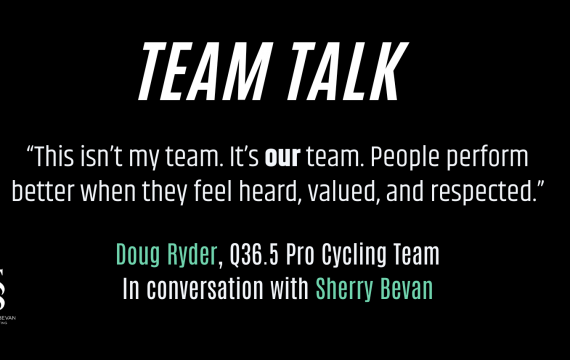
This isn’t my team. It’s our team. People feel heard, valued, respected. That sense of belonging keeps people going.
Your website talks about Ubuntu. Tell me more.
Ubuntu means “I am because we are.” It’s at the heart of everything we do.
There’s a sign at our service course in the Netherlands that says it. It reminds us to care – on the road, in our work, with each other.
It’s not marketing. It’s behaviour. That value system has attracted incredible talent and held us together when times were hard.
What have you learned over the past few years?
We failed – hard. But we didn’t change our values. We focused on impact, not ego.
Coming back with the same principles mattered. Partners believed in us because of that.
In a world that became very individualistic during Covid, we doubled down on community. That gave us energy to rise again.
What are your ambitions for the next few years?
Big ones. Bringing Tom in shows that.
He’s 25 – not winding down, just getting started. His leadership, detail, and professionalism lift everyone. Other riders are noticing. That’s exciting.
We want to return to the top – sustainably, credibly.
Many leaders in cycling are very young. What are your reflections on that?
Experience can’t be bought – it’s earned. We balance young talent with experienced riders who can guide them.
Tom is extraordinary. Riders like him come once a decade. Our job is to maximise everyone’s potential – not turn people into roles.
I don’t want a “climber” or a “domestique.” I want a human being with a dream.
That probably makes cycling more fun to watch.
Exactly. Big teams can buy talent. Smaller teams back belief. Tom chose freedom over security – and that matters.
Before we finish, what’s your favourite sporting moment?
I have two but one leads into the other. In 1996, Josia Thugwane winning Olympic gold in the marathon – that sparked my belief that Africa could produce world-class cyclists.
Then, nearly 20 years later, Steve Cummings winning on Mandela Day in our first Tour de France in 2015. That was the dream realised.
Where can people follow the team?
Instagram: @Q36.5_procycling. Our website at https://www.q36-5procycling.com/ and you can follow me on LinkedIn as well. It’s a pretty special journey we’re on.
It’s been brilliant to talk to you Doug. Thank you so much for joining me today.
If you’re listening to this and wondering how your team could be more effective, please get in touch. I work with the teams behind the sports teams to perform at the highest level so the team on the road or on the pitch makes winning headlines. Thank you for tuning in today, and please do join me for future episodes.
Important links
- Q36.5 Pro Cycling: @Q36.5_procycling (Instagram)
- Website: Q36-5procycling.com
- Doug Ryder: LinkedIn
About Doug Ryder
Doug Ryder is the General Manager of Q36.5 Pro Cycling and a former Olympic cyclist who represented South Africa at the 1996 Atlanta Games.
Doug is best known for founding the team that became the first African squad to compete in the Tour de France in 2015. After the team collapsed during Covid, he led its return to professional cycling with Q36.5, grounded in the principle of Ubuntu – “I am because we are.”
Doug is widely respected for his values-led approach to leadership and his belief that sustainable high performance is built through community, trust and shared purpose.
About your host: Sherry Bevan
Sherry Bevan helps teams in transition perform at their best – without the fluff. A former Global Head of IT Service in an international law firm, she now works across technology, professional services and the charity sector. Through her Team Kickoff Accelerator, Sherry supports new and changing teams to build trust, strengthen collaboration and set the foundations for high performance. A former grassroots cyclist and still a runner, Sherry is fascinated by what sport can teach us about teamwork, leadership and sustainable performance – and it’s these ideas she explores with leaders and experts on Team Talk.
Connect with Sherry
- Sign up for news and updates.
- Apply to join the Team Culture Club.
- Connect on LinkedIn.