
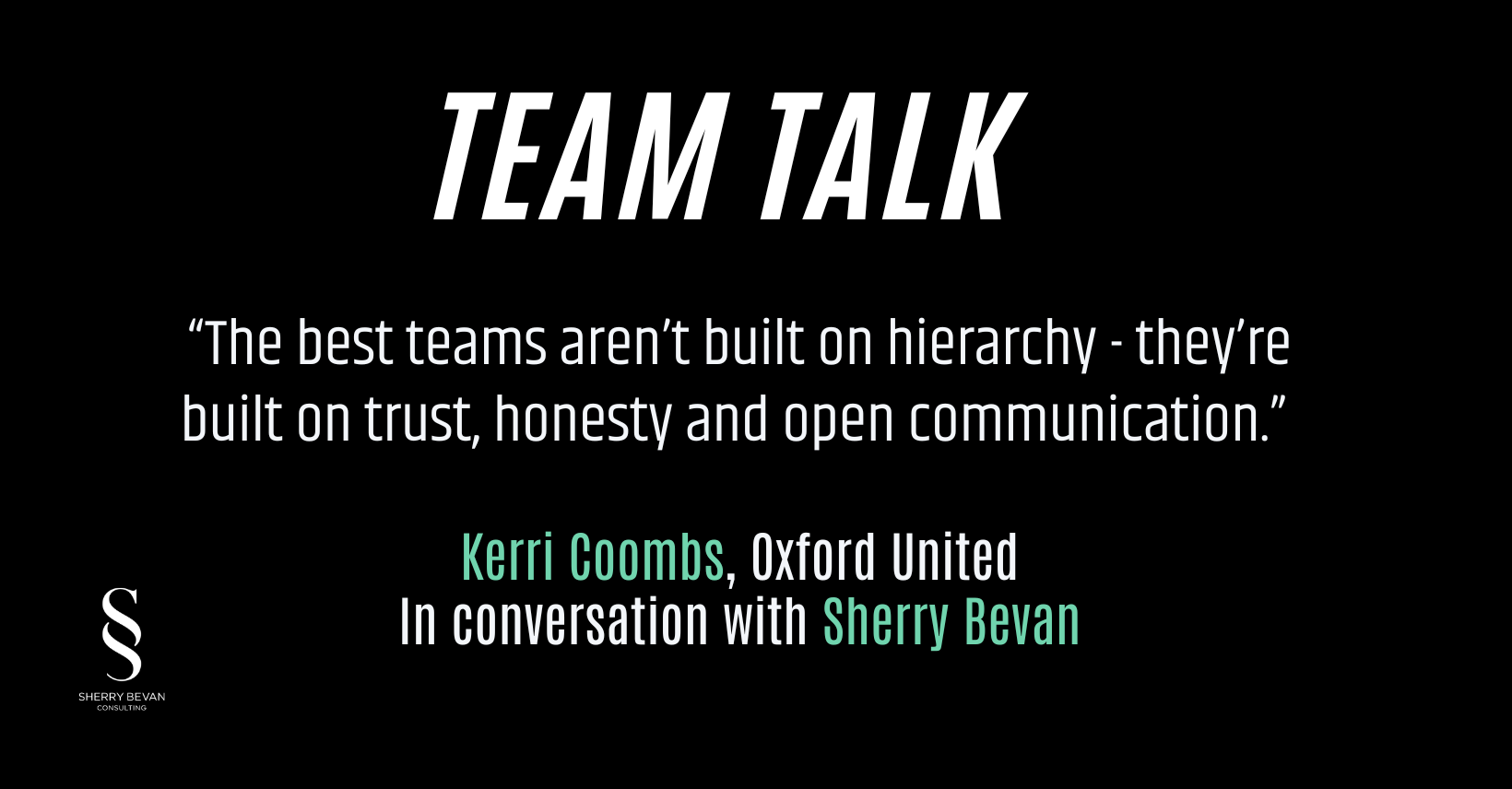
Learning to Lead Without Controlling Everything
In this episode of the Team Talk Podcast, Sherry Bevan speaks with Kerri Coombs. At the time of the interview, Kerri was Head of Girls’ Football and First Team Coach at Oxford United. She talks openly and honestly about what it really takes to build high-performing teams – on and off the pitch.
Listen to the episode here:
Listen on Spotify.
Listen on Apple.
Episode 12: Learning to Lead Without Controlling Everything
Guest: Kerri Coombs, Oxford United
Sherry Bevan: Welcome to the Team Talk Podcast. This is the show where we discover how to build high-performing teams using lessons learned from the world of sport.
I’m your host, Sherry Bevan, and today I’m delighted to be talking to Kerri Coombs, who is Head of Girls’ Football and First Team Coach at Oxford United.
Kerri is very much a globetrotter. Between 2012 and 2022 she coached full-time overseas in private clubs, academies and companies in Morocco, the United States, China and Hong Kong. During that time she also held roles such as Academy Head Coach and Coach Educator.
Kerri returned to the UK in 2022 to take the role of Pathway Technical Lead with the then Women’s Championship side Lewes Football Club, before taking up her current role at Oxford United, who are in Tier 3. She also recently completed her UEFA A licence with the Football Association of Wales. A very warm welcome to you, Kerri.
Kerri Coombs: Hey Sherry, thank you for having me.
Tell us a bit about your background and how you got into football coaching.
Very simply, I played as a young girl from probably five or six years old all the way through. My dad coached grassroots teams that my sister played in, and I got the bug there.
Through university it was a good way to earn money – flexible hours, not too many hours a day – and I worked for a few community trusts around London while I was studying. Then it kind of just evolved. It wasn’t really a plan, and then it ended up being my full-time job. Twenty-odd years later I’m still doing it and still enjoying it, so that’s how I got into coaching.
Wow, it really sounds like football’s in your blood. You’ve been doing it for a long time, and if your father was coaching as well, I guess it was a natural thing for you to do.
Yeah, and probably quite strange because I was extremely shy as a kid. Football gave me confidence. I love the game – whether I’m playing or coaching – and because I had such a strong desire to be part of it, it forced me out of my comfort zone.
I ended up developing that coaching personality. I’m still quite a shy person away from the pitch, but in front of teams and groups of players I’m a very different version of myself.
I can imagine. And at university, just out of curiosity, did you do a sports-related degree?
I studied sports science. My original thought was to work in the background staff, maybe in a lab or something like that. But I quickly realised biomechanics and things like that were not for me, so I carried on down the coaching route.
You’ve worked with a lot of different teams in different cultures and countries. I’d really love to hear what you see as the difference between teams that are successful and perform well and those that aren’t so successful?
If we think first about teams of coaches – the multi-disciplinary team, if you like – the places where I’ve thrived, and where other coaches have thrived, have always had strong collaboration. There’s open-mindedness, people are willing to challenge each other constructively, but they also support each other. No one’s trying to tear anyone else down, which unfortunately does happen sometimes.
I’ve been very fortunate to be part of clubs, companies and academies where those values were already there, so I’ve really thrived in those environments.
In environments where it’s more like “you do you, you’re on your own”, where there’s a lot of criticism but not many solutions, that’s where things tend to fall down – especially for young coaches.
If you bring players into the picture, the most successful teams I’ve seen are built on very simple things: open communication, collaboration and getting their input. It’s not just you and them – it’s us.
That communication, trust and honesty with each other – even when the conversation isn’t easy – is the key to success.
You mentioned the coaching teams that worked well together had that collaboration and open feedback. What made the difference so that honesty and trust develop?
That’s hard to define. I think it often comes down to the type of people and why they’re there.
Earlier in my career, when I was working in the US for example, there were a lot of coaches trying to get time on the grass. But there was a huge range of people – some thought they were further along their journey than they were, while others were just starting out and knew it. They were trying to learn and absorb everything around them.
If you’re around people who are open when you ask a question – people who share their ideas, their challenges, or say “this is where I got it wrong” – that kind of behaviour spreads. It creates a culture.
From a personal point of view, if someone is open with me, I find it much easier to be open with them. But if there’s defensiveness or gatekeeping, it becomes much harder to reach out to that person for their experiences, whether good or bad.
When I’m part of a team now, or leading one, I try to create that openness myself. Even when I’m leading a session as the Head of the Pathway, I’ll ask the coaches: What did you think? What worked? What didn’t? What would you change?
By approaching things that way, I think it helps people feel more relaxed. At least I hope so – some of them might say they’re not always relaxed when I’m there, which I’m trying to work on!
But I think if the people in leadership positions show that vulnerability first, it creates a culture where everyone else feels able to do the same.
None of us have all the answers in coaching or support roles, so being open-minded, willing to communicate, share and be vulnerable is what builds those cultures of trust.
It sounds like role-modelling from leaders is really important. Once that culture starts to form in a club or academy, it almost becomes self-perpetuating. When someone new joins, they gradually adapt to that open style of communication.
Definitely. Whenever we bring in a new coach – whether during recruitment or later on – I always try to emphasise that my role is to be a second pair of eyes for them.
I wish I’d had more of that earlier in my career. It’s so valuable to understand your blind spots, because you don’t know what you don’t know.
If someone has an idea or challenges what I’m doing, it can open my mind. I have my own philosophy, and there’s a club philosophy we need to align with for the players’ sake, but I still want those conversations.
I’ve had a couple of mentors who gave me patience too. They let me fail, then helped me reflect and pick things back up afterwards. That’s the way I try to lead now.
You mentioned failure and mistakes. Do you think that’s a key part of developing as a coach?
Absolutely. I think it’s impossible not to fail or make mistakes because the goalposts are always moving. The context is always changing, and the people in front of you are changing day to day – especially young people.
I find it hard to understand if someone says they’ve never failed or made a mistake. I know I’m a different coach from who I was even a month ago sometimes, when I’ve learned something new.
The way I phrase things, the way I approach conversations, or how I teach aspects of the game – all of that evolves. If I look back to last year or ten years ago, I probably wouldn’t even recognise myself as a coach.
Hopefully that’s growth in a good direction. But I’m sure six months from now I’ll look back again and think, “Why did I used to do it like that?”
Failure is part of the process. You have to go through it to improve.
That’s continuous learning and development. You make the best decision you can with the information you have at that moment. Six months or six years later you may see it differently, but you were doing your best with what you knew at the time.
That’s where those collaborative coaching teams you mentioned become really valuable.
What about the teams themselves – the football teams? What do you think makes a successful team on the pitch?
Are we talking youth teams or senior teams?
You choose. Pick a team and tell me what’s worked.
I’ll go with youth teams, because that’s where most of my experience is.
With youth players, it’s about trusting them more than you might think you can. They don’t have the same perspective or life experience as you, and emotionally they’re still developing. But their perspective can be really refreshing and eye-opening.
Just as they can’t fully see things from your perspective, you can’t truly see things from theirs either.
It’s about trusting them, creating leadership groups, encouraging them to share ideas and acting on those ideas – even if you’re not completely convinced in the moment.
When you do that, it builds trust. Then when you give honest feedback, they’re more receptive because they know you trust them.
Earlier in my career I sometimes did it the other way around. It was all about the tactics and structure – do this, do that – thinking that would make them better players and the relationship would follow.
I realised that approach was wrong, especially with young players.
A good example was when I was at Lewes. We had an under-16 girls team and decided to put them in a boys’ league. We thought it would challenge them and improve the games programme.
But they really struggled – technically and tactically. Our first instinct was to double down on coaching: more technique, more tactics, more structure.
Eventually we realised they weren’t looking forward to games anymore, and that’s heartbreaking as a coach.
We stripped everything back and started talking about confidence – what it means, why it matters, and how they could support each other.
The next game they played was one of the most rewarding moments of my career. You could see the belief and the fight come back. We praised their intent, bravery and confidence.
They still lost the game, but the way they felt afterwards was completely different. We’d listened to them, acted on their feedback and created a turning point.
Listening to your examples, there’s a strong thread of openness and collaboration running through everything you do – whether it’s with coaches or players.
I really admire that. In some organisations or teams you can tell when trust isn’t there, because people simply aren’t performing at their best.
It takes courage to step back and ask, “What’s going on? What are we missing here?”
What have you learned about yourself through all these experiences – working with different teams in different countries?
There’s a long list!
If we’re talking about being part of or leading a coaching team, one thing I’ve learned is that although I love collaboration and opening the floor for discussion, sometimes I need to be more decisive.
People still need clarity and guidance.
I sometimes describe it to our coaches and players as “drowning in freedom”. If things are too open, people don’t know which direction to go because there are a thousand ways to do the job.
Over the last year with this group of coaches, I’ve realised I need to meet them where they are in their journey and provide more guidance.
My instinct was to avoid being prescriptive because I didn’t want to be a dictator. I wanted to build relationships first and understand where everyone was at.
But I’m learning that leadership sometimes means giving clearer direction and explaining why we’re doing something a certain way.
Another thing I’m learning about myself is around emotional regulation.
I’m not explosive, but I feel like I need to be more aware of myself. Our job is hard and it’s tiring. We’re often rushing in from somewhere else, and sometimes I know I arrive a bit like a hurricane because I haven’t taken the time to regulate myself. That’s something I’ve only really started learning about recently – that it’s something I can control much better. I think being more mindful of that will really help me.
I’m always still in the learning phase – it comes back to what we talked about earlier. Don’t let people drown in freedom, but also I need to delegate more. I need to give people tasks that might not be done exactly the way I would do them, and that’s okay, because then we can talk about it afterwards. Sometimes it might even come out better, and then I’ve learned something as well.
I think it’s about learning to be more decisive, learning emotional regulation as a leader – because you can’t be all over the place, you’ve got to be consistent – and… I’ve forgotten my last point now. I’ve talked too long.
Allowing people to do it their way.
Exactly – delegating and letting people grow that way. Being patient, even if we don’t get to the outcome I want as quickly as I’d like. That’s okay, because we’re building other things in the meantime.
You’ve coached internationally – what interesting opportunities has that created compared to working in the UK?
I think one of the most organic opportunities has simply been working with players and parents from different backgrounds, with different expectations of what a coach should be.
For example, in Morocco it was an Arsenal soccer school, so it was a private company, and in Hong Kong it was also a private academy. As coaches, we all have our beliefs about how we should coach – not joystick coaching, not constantly telling the player on the ball what to do and not being overly expressive on the sideline.
But you quickly realise that parents sometimes expect that. They’re paying for coaching and they have a certain idea of what coaching looks like. When I first stepped into that environment, my philosophy was probably too heavily weighted towards “the game is the teacher”. Looking back now, I think that was probably a bit of a cop-out. I didn’t fully know what I was doing yet, so I leaned on that idea. But it didn’t really work for the players or the parents. I had to learn to be more expressive and adapt my approach.
In America, the players are very respectful of the coach, but they also want answers from you. You’ll hear a lot of “Yes, coach” and “No, coach”, and they’ll run through brick walls for you. That’s very much their mentality. But if a parent has a question, they will approach you. That environment gave me a lot of experience in managing parent relationships and the coach-parent dynamic. I really enjoyed working with players who were incredibly hard-working and passionate about the game.
The opportunities weren’t necessarily material things like trips or events. But looking back now, those experiences stretched and challenged me. If I’d stayed in one environment or one culture, I definitely wouldn’t be the coach I am today. I’ve had to adapt and grow in ways that maybe British parents and players wouldn’t have pushed me to in the same way. I went abroad simply to coach football – I didn’t realise how different football culture could be around the world.
That’s fascinating. You’ve had to adapt to the cultural norms around football and coaching in different places. Even something as simple as how expressive you are on the sideline depending on the country or the club environment. It proves to you that you can adapt your coaching and leadership style.
I’d probably add that maybe it’s because I’ve spent so much time in the youth game, and I have such a passion for youth development.
On a Saturday or Sunday, the result isn’t the be-all and end-all. In the environments I’ve worked in, it’s about developing players. The joy comes when you see something a player has been working on appear in a game, or something the team has been practising come together on the pitch. Or when players simply love being part of the club, and they keep coming back year after year because they feel committed to the environment you’ve created. That’s a huge win as a coach.
When you come back to the UK, where football is such a huge part of people’s lives, it’s different. Football used to be everything to me as a player, but it isn’t in quite the same way any more. In some ways that gives me a sense of calm. I still love the competitiveness, I love seeing teams play well and dominate games, but my ego isn’t tied as strongly to the result.
Since stepping back into senior football recently, I feel that emotional side starting to come back a little bit. Being on the sideline again brings that excitement. I’m being stretched again – how do I stay level and balanced in that environment? Last year I was around it, but I didn’t really feel it, and I remember thinking, “What’s wrong with me?” Because as a player I was incredibly passionate and quite emotional about football.
Those years spent in environments focused on development – planning sessions, supporting players, helping them grow – changed my perspective. If I’d stayed coaching only in the UK, I might still be quite volatile about results.
It highlights the difference between youth football and senior football. With youth teams, the focus is very much on developing players. You can still lose a game but see lots of positives in the performance to encourage and build on.
Exactly. Those are the moments I really get excited about. When something a player has been working on suddenly appears in a match and you’re on the sideline thinking, “Yes! That’s brilliant.” Those are the moments that give you that visceral feeling.
Now when I’m with the senior team on a Sunday, I find myself thinking a lot more about the result – desperate for us to score and not concede. Thankfully the emotional side of me as a player hasn’t fully returned, because that was a bit too much.
I imagine it’s very different when you’re the one on the pitch. As a coach you’re probably able to step back a little and look at things more objectively.
Exactly. And that comes back to lived experience. I have much more empathy now than I did as a young coach for what players are going through. They haven’t experienced everything yet, so they might not realise that getting overly emotional can sometimes work against them.
Looking back at how I was as a player has helped me as a coach. It makes me think about what I would want from a player now, and how I can support them. And what I might have needed at that age to become a better player and person.
I’m getting such a strong sense of what a thoughtful coach you are. As we come to the end, I’d love to ask you one final question.
What has been your favourite sporting moment ever? It doesn’t have to be football, although I have a feeling it might be!
The obvious one would be the first Euros win. I was still in Hong Kong at the time, so we were watching it at about two or three in the morning.
That was the first time in a long time that I felt that real excitement watching football again. I was nervous before the game, completely invested in it, full of emotion and passion.
Another moment that really stands out for me was my time at Lewes with the under-16s. When we really stripped everything back and focused on what the players needed as people. How do we genuinely support them on the pitch, but also give them the tools to grow into successful young women?
That was a turning point. There was a particular performance from that team that has always stayed with me. Two moments: the Euros win, and that time with the Lewes under-16s.
Brilliant. Thank you so much, Kerri. And if people want to connect with you or follow your work, where’s the best place to find you?
The best place is LinkedIn. Feel free to reach out. We’re always looking for keen coaches in the women’s game, and we’re always looking to develop them too, so there are often opportunities.
Thank you so much. It’s been fascinating listening to you and hearing about the different elements involved in building a successful team – the openness, the trust, the honesty in communication and collaboration. You’ve also talked about having a growth mindset: being willing to learn, make mistakes, and keep developing.
Thank you so much for joining me today.
Thank you for having me. I really appreciate it.
Important Links
About Kerri Coombs
Between 2012-2022, Kerri Coombs was overseas, coaching full time in private clubs/academies and companies in Morocco, the US, China and Hong Kong.
During that time, she held roles such as Academy Head Coach and Coach Educator.
Kerri returned to the UK in 2022 to take the role of Pathway Technical Lead with then Women’s Championship side Lewes FC before taking on her role (at the time of recording) as Head of Girls Football and First Team Coach at Oxford United who are in Tier 3. She moved to Bristol City Women as U21 Head Coach in February 2026.
She recently completed her UEFA A License with the FAW.
About your host, Sherry Bevan
Sherry Bevan helps teams under pressure and teams in transition perform at their best – without the fluff. A former Global Head of IT Service in an international law firm, she specialises in supporting technology teams in professional services and the sports world.
Through her Team Performance Reset, Sherry supports new and changing teams to build trust, strengthen collaboration and set the foundations for high performance.
A former grassroots cyclist and still a runner, Sherry is fascinated by what sport can teach us about teamwork, leadership and sustainable performance – and it’s these ideas she explores with leaders and experts on the Team Talk podcast.
Connect with Sherry
- Sign up for news and updates.
- Apply to join the Team Culture Club.
- Connect on LinkedIn.
- Subscribe to the Team Talk newsletter.