Episode 8: How to Build High-Performing Teams with Agile & Human-Centred Design – Team Talk podcast

Using Agile lessons from the world of Talent Development

In this episode of Team Talk, Sherry Bevan talks to Roxy Allen, strategic Talent Development Manager to explore how using Agile and human-centred design can help you build high-performing teams more quickly.

Listen to the episode here:

Or listen on Spotify.

Or Apple.

Episode 8: How to Build High-Performing Teams with Agile & Human-Centred Design

Guest: Roxy Allen, Strategic Talent Development Manager

Sherry Bevan: Welcome to the Team Talk Podcast, where we explore how to build high-performing teams using lessons learned, mostly from the world of sport. I’m your host, Sherry Bevan, and in today’s episode, I’m delighted to be talking to Roxy Allen.

Roxy is a strategic talent development manager who leverages modern ways of working to enable performance, change, and transformational culture. We connected through our shared love of Agile ways of working on LinkedIn, when I was working on a large-scale Agile change programme in a charity. I was drawn to her approach to Agile and human-centred design for building scalable infrastructure.

Roxy is passionate about systems thinking, workforce transformation, and future-ready strategy. In her role, she designs modular development, performance, and career frameworks built to empower others. A very warm welcome to you, Roxy.

Roxy Allen: Thank you so much! I’m really happy to be here and speaking with you again.

Let’s start with a bit about your background.

Sure. I’ve spent 15 years in HR, across construction, the games industry, health, public sector, and most recently, the gas industry in a talent development manager role. I was also the Agile People Ops UK Ambassador for two years, running events, webinars, and mini-podcasts – you featured on one a while back!

Brilliant. You use Agile and human-centred design in your work. Could you give a brief overview of what those terms mean for listeners who might not be familiar?

Absolutely. “Human-centred” or “person-centred” approaches focus on using evidence and data from individuals to solve key problems for them. Historically, learning and development often lagged behind, acting more like “order takers” rather than problem solvers.

For example, if a manager says they struggle with communication and requests a course, we wouldn’t just deliver a generic program. Instead, we use performance consulting to dig into the context: who’s impacted, what the real problem is, and what experiences, tools, or resources are needed to solve it. All of this is evidence-based and directly supports the individuals involved.

That’s a fabulous summary. How did you come to use this approach in your work?

For me, it started around 2016 with a short Lean course. It wasn’t quite Agile, but it sparked the idea that these approaches could apply more broadly. Lean appealed to me because it’s factual, evidence-based, and focused on continuous improvement.

At the time, I was a training administrator managing Excel spreadsheets across disconnected systems. I realized we could leverage existing business tools, like Microsoft Dynamics, to streamline processes. That experience gave me the excitement of applying evidence-based improvements practically.

In 2019, in my first advisory role, I read How People Learn by Nick Shackleton-Jones. That was a real “aha” moment – it highlighted where learning design had gone off track and reinforced person-centred, neuroscience-backed approaches. It introduced me to design thinking and inspired me to dig deeper into Agile ways of working beyond project delivery, considering co-creation, psychological safety, and continuous improvement across teams and organizations.

So it opened the floodgates for research and experimentation. How has this impacted the teams you’ve worked with?

Initially, I was a bit of a lone wolf. In the games industry, my iterative approach – delivering minimal lovable products – stood out. It sparked curiosity from leadership about what I was doing differently.

I started working out loud with my team, operating like a pseudo-solution delivery team: daily stand-ups, Kanban boards, iterative delivery. I ran sessions on Agile HR, incorporating design thinking and real-life examples like the Airbnb story. We shared half-finished work, worked cross-functionally, and tried a community-of-practice model for management development. Everyone contributed: HR Admin handled communications, Talent Acquisition helped review content, the facilitator guided sessions, and I coordinated the experience.

The trial went extremely well – it energized the team, made work fun again, and encouraged experimentation while producing meaningful outcomes.

I can imagine the impact on engagement and motivation. It’s a stark contrast to delivering generic training, like an Excel course, when people just want to learn something practical.

Exactly. Including advisors in content creation, we produced bespoke learning experiences informed by real needs. It gave the team a sense of energy and purpose.

Agile is often seen as an IT or manufacturing tool. How would you recommend other teams adopt it?

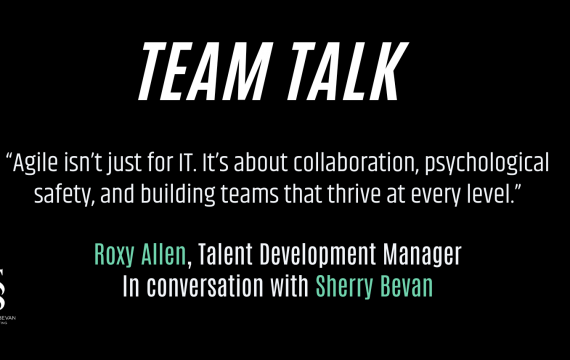
Agile provides a more efficient approach. Frequent, structured conversations and sharing work builds psychological safety and trust. It encourages collaboration and helps tackle issues like workplace loneliness.

If someone wants to start small, what’s a good first step?

Begin with regular, short check-ins on your work – 10 minutes every couple of days, for example. Share unfinished work to gather feedback. That helps build trust and continuous improvement before diving fully into Agile processes.

That resonates. At the charity I worked at, sharing imperfect work encouraged honest feedback, leading to solutions better tailored to people’s actual needs.

Absolutely. I also value a clear “definition of done.” Iteration isn’t endless – it’s guided by reaching that goal. I think of it like baking a minimal, lovable cake and adding layers gradually, rather than endlessly making fairy cakes.

That’s a fantastic analogy. What have been your biggest learnings from using these approaches?

I treat projects as experiments. Recently, I ran an innovation session for young people on our Young People’s Council. Using design thinking sprints and workshops, I could see their curiosity and energy. Later, they participated in a hackathon, pitching prototypes to senior leaders. It showed me you can use design thinking as a learning framework, not just a problem-solving tool. It energized everyone and encouraged equal participation.

I love that. It really flattens hierarchy – everyone’s contribution is valuable, no matter their role.

Yes, we had panels from across the business – operations, non-operations, ex-apprentices, leaders, technical experts. Their input shaped the young people’s ideas and solutions, creating a truly collaborative experience.

As we close, most of my guests are from sports backgrounds. What’s your favourite sporting moment to watch?

The 2008 Olympics. Seeing Usain Bolt win gold for the first time was a proud moment for me, reflecting my Jamaican heritage. The excitement and national pride were incredible – it really connected me to my roots.

That’s fantastic. He was such an incredible athlete. Finally, where can listeners connect with you?

LinkedIn. I’m Roxy Allen – happy to chat about Agile or anything else.

Lovely. Thank you so much, Roxy.

About Roxy Allen:

Roxy Allen is a strategic Talent Development Manager leveraging modern ways of working to enable performance, change, and transformational culture.

Roxy uses agile and human-centred design to build infrastructure that scales. She’s passionate about systems thinking, workforce transformation, and future-ready strategy. In her work, she designs modular development, performance, and career frameworks built to empower others

Important links:

About your host Sherry Bevan

Sherry Bevan helps teams in transition perform at their best – without the fluff. A former Global Head of IT Service in an international law firm, she now works across technology, professional services and the charity sector.

Through her Team Performance Accelerator, Sherry supports new and changing teams to build trust, strengthen collaboration and set the foundations for high performance.

A former grassroots cyclist and still a runner, Sherry is fascinated by what sport can teach us about teamwork, leadership and sustainable performance – and it’s these ideas she explores with leaders and experts on Team Talk.

Connect with Sherry

Episode 4: Culture beats resources – Team Talk podcast

What does it really take to take a football club into the Football League for the first time in its history?

In this episode of Team Talk, Matt Hall, Head of Football Operations and Administration at Bromley Football Club, shares the club’s journey from non-league football to promotion in 2024, and what it means to be part of the “team behind the team”.

This conversation reveals powerful lessons about leadership, alignment and culture – particularly in organisations with limited resources but big ambition.

Listen to the episode here:

Episode 4: Culture beats resources

Guest: Matt Hall, Bromley Football Club

Sherry Bevan: Hello and welcome to the Team Talk podcast. This is a show where we discover how to build high performing teams, using lessons learned from the world of sport. I’m your host, Sherry Bevan, and in today’s episode I’m delighted to be talking to Matt Hall from Bromley Football Club. Welcome, Matt.

Matt Hall: Thank you very much for having me.

I’m especially excited to speak to you because Bromley is my most local football club. For anyone not so familiar with the club, could you share a bit of background – where Bromley sits in the Football League and some of the exciting things that have been happening recently?

This is Bromley Football Club. You can see the crest behind me – we were formed in 1892, so we’ve been around a long time. We’ve made real strides over the years, particularly in the last handful.

We’re a fully professional club based in the London Borough of Bromley – though some might prefer to say North West Kent, and I’ll leave that debate there. It’s the largest borough in London and Bromley deserves a football club it can truly be proud of. I think over the past few years we’ve shown that we can be exactly that.

We play at Hayes Lane Stadium, we’ve got a fantastic group of players, and this season we’re in the Football League for the first time in our history. That’s a huge moment for us. We’ve spent our entire existence in non-league football, most recently in the National League, and last May [2024] we were promoted to the Football League for the very first time.

It was a groundbreaking achievement – not just for the club, but for the borough as a whole. To have witnessed that journey, and to have played even a small part in it, is incredibly special for me, especially as a Bromley supporter. It makes it all the more meaningful.

Are you local? Were you born and brought up in the area?

I was – an Orpington boy. I grew up there and lived there very happily with my family. A couple of years ago I moved to North Kent with my partner, but I still work in Bromley, still spend a lot of time with my family in Orpington, and I’ll always consider myself an Orpington and Bromley boy wherever I am.

I really bought into everything the club was doing in the community early on, and Bromley and Orpington will always feel like home to me. Being a local person involved in this journey means a great deal.

You’ve set the scene brilliantly. Tell us a bit about you now – your background, your role, and how you ended up here.

I first started watching Bromley when I was about 15 or 16. This was before social media, so I’d read match reports in the back of newspapers and think, I’ve got to go down there. Eventually, in 2011, I did. My first game was against Eastbourne Borough.

We lost 3–1. The players were part-time, there were probably about 250 people in the ground – but something about the place just grabbed me. I was hooked.

It felt more real to me than top-level football. You could relate to the players; they weren’t earning millions. It felt accessible. My support grew and grew, even though it took three or four months before I saw us win a game. That tested my patience – but I loved it regardless.

Eventually I became programme editor for a season, editing the matchday magazine. Around the same time, I got the opportunity to take over stadium announcing as a teenager. That was a huge moment for me. I fell completely in love with the club.

I got to know the Commercial Manager, became more involved, started commentating for what was then a small club radio station, which has grown significantly since. In 2018, I was offered a full-time role while finishing a university degree in education. I spent two years teaching before moving fully into this role.

It’s been an incredible journey. I’ve done almost every job at the club – everything except pulling pints behind the bar. Nothing really phases me anymore.

You haven’t been called up to play on the pitch yet, then?

If that happens, we’re in serious trouble.

You’re very much running the team behind the team. What does that involve?

I report into our CEO, Mark [Hammond], who’s been here a similar length of time to me. We’ve also got a chairman and owner who’s a Bromley boy himself. When I first became full-time, we were working out of a portacabin. Before that, it was literally a bar.

Now we’re in a state-of-the-art facility, which is a huge credit to the leadership of the club.

My role is Head of Football Operations and Administration. Everything that happens off the pitch for the players and coaching staff comes through me – administratively and operationally. That includes player registrations, contracts, compliance with league regulations, and ensuring we’re operating within the rules.

Since promotion to the Football League, the learning curve has been steep. The regulations are completely different. I manage player eligibility, transfers, travel logistics, matchday operations, audits, kit compliance – you name it.

I’m essentially the main conduit between the footballing authorities and the club. If you hear from me publicly, it’s usually because something’s gone wrong somewhere.

It’s a wide-ranging role. Hundreds of emails a day. But it’s also incredibly rewarding. Out of 72 Football League clubs, we’re the only one who’s never been here before. The workload has been immense, but making sure we meet every requirement is my responsibility.

I also support the integration of academy players, sit on the board of the Community Trust, and previously led it for several years. In short, I do a bit of everything – and I do it because I love the club. No job too big, no job too small.

How does what happens off the pitch affect performance on it?

Our manager, Andy Woodman, is brilliant at reinforcing this. There has to be mutual respect. The players can’t do their jobs without us, and we can’t do ours without them.

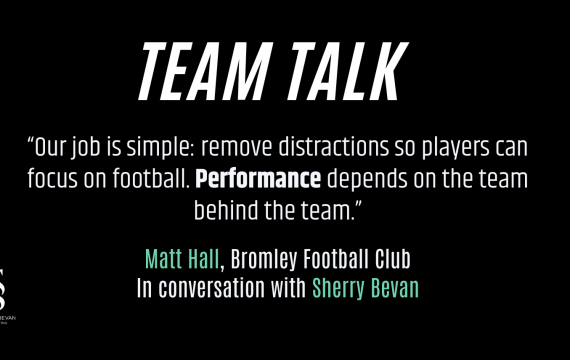
The goal is simple: remove distractions. Players should only be thinking about football – not travel, kit, logistics, or admin. Every department works together – sports science, medical, coaching, analysis, kit, operations – so players can perform at their best.

Andy has created a culture where everyone understands their role. That alignment is why we’re where we are today.

What have you learned about high-performing teams?

Culture is everything. Andy brought Premier League-level professionalism with him, and we’re very deliberate about recruiting people who fit our culture. He talks about a team “DNA” – looking after each other, working for the team, being punctual, respectful, and representing the club properly.

That clarity matters. People know what’s expected. Andy is exceptional at understanding individuals and motivating them differently. He’s also very good at spotting characters who might disrupt the group – and we’ve never signed a bad egg.

We’re a small club with limited resources, but we’re incredibly tight-knit. Everyone gets stuck in. “That’s not my remit” doesn’t exist here. That mindset is mirrored on and off the pitch.

How has the community embraced Bromley as the club has grown?

The change has been remarkable. Years ago, only a handful of kids recognised the badge. Now, you hear people say, “That’s Bromley FC – Michael Cheek’s my favourite player.”

The real penny-drop moments were our FA Trophy win in 2022 and our promotion. The open-top bus parades were unforgettable. As we came over the hill into Bromley High Street, the bus went silent. Streets were lined with people. Some of us were genuinely emotional.

When we arrived at The Glades and I stepped onto the stage, the crowd just kept going – floor after floor of people. That outpouring of support was overwhelming. It showed what the club truly means to the community.

Community is at the heart of everything we do. The Trust runs projects for everyone – from toddlers to people in their 90s, including dementia support. That matters deeply to us.

How have you grown through all of this?

Massively. I was incredibly shy growing up. I never imagined speaking in front of thousands of people. This club has helped me find confidence, resilience, and purpose.

It’s broadened my skills, strengthened my character, and given me something I truly care about. I’ve learned how to deal with complex personalities and professional footballers – who, despite stereotypes, are some of the most grounded people you’ll meet.

Players like Carl Jenkinson, a former Premier League and England international, are incredibly humble. Others like Michael Cheek – our record goalscorer – prove that talent and mindset transcend levels. When he told me, “The goal never moves,” that really stayed with me.

My aim is simple: to be the best possible ambassador for what this club represents. I’m incredibly proud of that responsibility.

Finally – your favourite sporting moment?

It has to be Bromley. That winning penalty at Wembley in 2024. Byron Webster – our captain – stepped up. A centre-back, not a striker. The composure, the confidence, the smirk. It was iconic.

What that moment meant to the club, the borough, and everyone involved is impossible to describe. He went down in history that day. I don’t know if anything will ever top it – unless we reach the Premier League one day.

What a moment. And what a story – not just about the team on the pitch, but the team behind it too.

Thank you so much for joining me today, Matt. I’ve really enjoyed talking to you.

Important Links

About Matt Hall

Matt Hall is Head of Football Operations and Administration at Bromley Football Club. A lifelong supporter and local to the area, Matt has grown with the club – moving from volunteer roles and matchday announcing to leading football operations at League level.

He is responsible for all off-pitch operations supporting players and coaching staff, including compliance, logistics, registrations, and league relations. Matt also sits on the board of the Bromley FC Community Trust and is a passionate ambassador for the club’s values and its role in the borough.

About your host: Sherry Bevan

Sherry Bevan helps teams in transition perform at their best – without the fluff. A former Global Head of IT Service in an international law firm, she now works across technology, professional services and the charity sector. Through her Team Kickoff Accelerator, Sherry supports new and changing teams to build trust, strengthen collaboration and set the foundations for high performance. A former grassroots cyclist and still a runner, Sherry is fascinated by what sport can teach us about teamwork, leadership and sustainable performance – and it’s these ideas she explores with leaders and experts on Team Talk.

Connect with Sherry