Using Agile lessons from the world of Talent Development
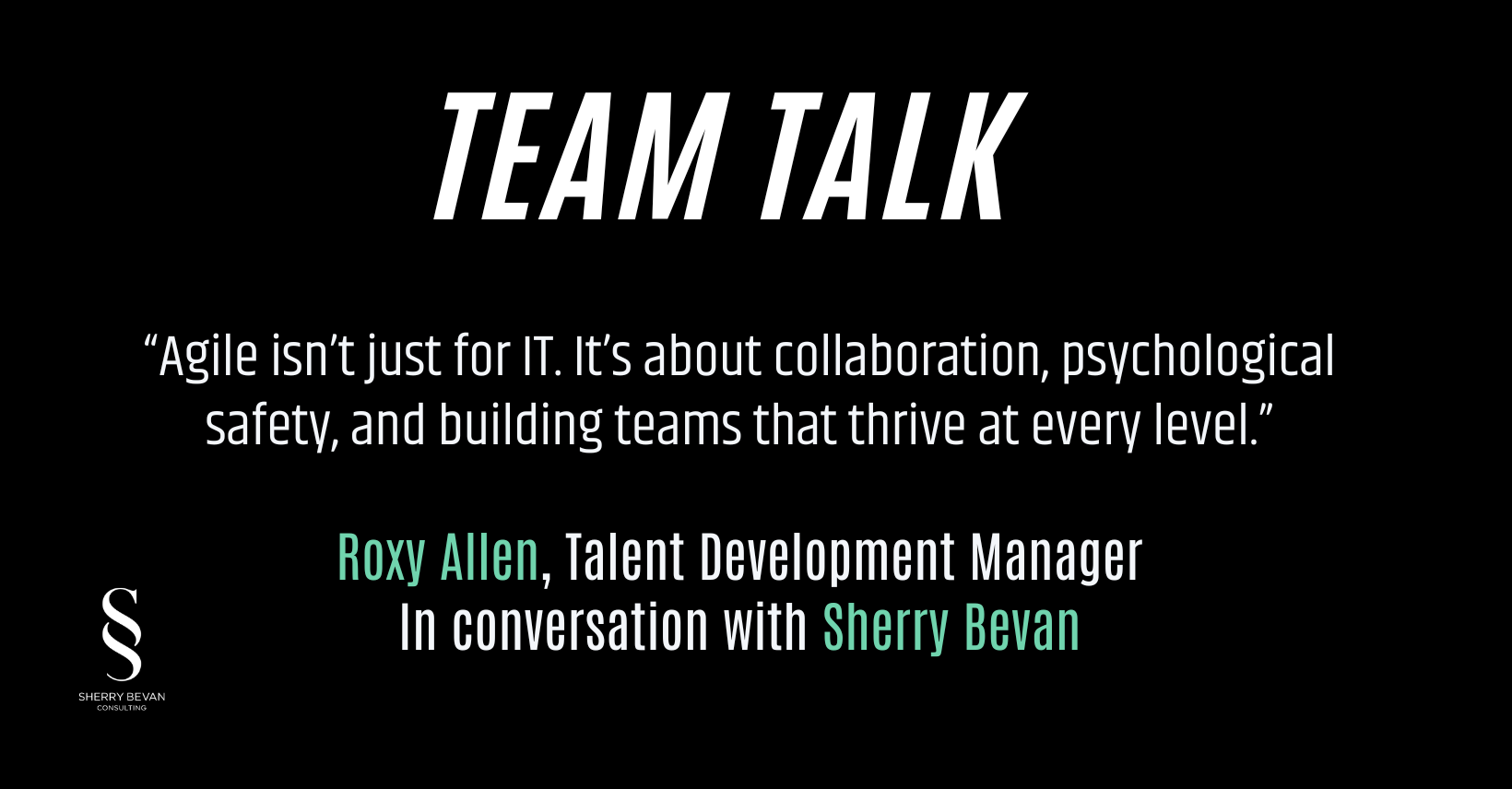
In this episode of Team Talk, Sherry Bevan talks to Roxy Allen, strategic Talent Development Manager to explore how using Agile and human-centred design can help you build high-performing teams more quickly.
Listen to the episode here:
Or listen on Spotify.
Episode 8: How to Build High-Performing Teams with Agile & Human-Centred Design
Guest: Roxy Allen, Strategic Talent Development Manager
Sherry Bevan: Welcome to the Team Talk Podcast, where we explore how to build high-performing teams using lessons learned, mostly from the world of sport. I’m your host, Sherry Bevan, and in today’s episode, I’m delighted to be talking to Roxy Allen.
Roxy is a strategic talent development manager who leverages modern ways of working to enable performance, change, and transformational culture. We connected through our shared love of Agile ways of working on LinkedIn, when I was working on a large-scale Agile change programme in a charity. I was drawn to her approach to Agile and human-centred design for building scalable infrastructure.
Roxy is passionate about systems thinking, workforce transformation, and future-ready strategy. In her role, she designs modular development, performance, and career frameworks built to empower others. A very warm welcome to you, Roxy.
Roxy Allen: Thank you so much! I’m really happy to be here and speaking with you again.
Let’s start with a bit about your background.
Sure. I’ve spent 15 years in HR, across construction, the games industry, health, public sector, and most recently, the gas industry in a talent development manager role. I was also the Agile People Ops UK Ambassador for two years, running events, webinars, and mini-podcasts – you featured on one a while back!
Brilliant. You use Agile and human-centred design in your work. Could you give a brief overview of what those terms mean for listeners who might not be familiar?
Absolutely. “Human-centred” or “person-centred” approaches focus on using evidence and data from individuals to solve key problems for them. Historically, learning and development often lagged behind, acting more like “order takers” rather than problem solvers.
For example, if a manager says they struggle with communication and requests a course, we wouldn’t just deliver a generic program. Instead, we use performance consulting to dig into the context: who’s impacted, what the real problem is, and what experiences, tools, or resources are needed to solve it. All of this is evidence-based and directly supports the individuals involved.
That’s a fabulous summary. How did you come to use this approach in your work?
For me, it started around 2016 with a short Lean course. It wasn’t quite Agile, but it sparked the idea that these approaches could apply more broadly. Lean appealed to me because it’s factual, evidence-based, and focused on continuous improvement.
At the time, I was a training administrator managing Excel spreadsheets across disconnected systems. I realized we could leverage existing business tools, like Microsoft Dynamics, to streamline processes. That experience gave me the excitement of applying evidence-based improvements practically.
In 2019, in my first advisory role, I read How People Learn by Nick Shackleton-Jones. That was a real “aha” moment – it highlighted where learning design had gone off track and reinforced person-centred, neuroscience-backed approaches. It introduced me to design thinking and inspired me to dig deeper into Agile ways of working beyond project delivery, considering co-creation, psychological safety, and continuous improvement across teams and organizations.
So it opened the floodgates for research and experimentation. How has this impacted the teams you’ve worked with?
Initially, I was a bit of a lone wolf. In the games industry, my iterative approach – delivering minimal lovable products – stood out. It sparked curiosity from leadership about what I was doing differently.
I started working out loud with my team, operating like a pseudo-solution delivery team: daily stand-ups, Kanban boards, iterative delivery. I ran sessions on Agile HR, incorporating design thinking and real-life examples like the Airbnb story. We shared half-finished work, worked cross-functionally, and tried a community-of-practice model for management development. Everyone contributed: HR Admin handled communications, Talent Acquisition helped review content, the facilitator guided sessions, and I coordinated the experience.
The trial went extremely well – it energized the team, made work fun again, and encouraged experimentation while producing meaningful outcomes.
I can imagine the impact on engagement and motivation. It’s a stark contrast to delivering generic training, like an Excel course, when people just want to learn something practical.
Exactly. Including advisors in content creation, we produced bespoke learning experiences informed by real needs. It gave the team a sense of energy and purpose.
Agile is often seen as an IT or manufacturing tool. How would you recommend other teams adopt it?
Agile provides a more efficient approach. Frequent, structured conversations and sharing work builds psychological safety and trust. It encourages collaboration and helps tackle issues like workplace loneliness.
If someone wants to start small, what’s a good first step?
Begin with regular, short check-ins on your work – 10 minutes every couple of days, for example. Share unfinished work to gather feedback. That helps build trust and continuous improvement before diving fully into Agile processes.
That resonates. At the charity I worked at, sharing imperfect work encouraged honest feedback, leading to solutions better tailored to people’s actual needs.
Absolutely. I also value a clear “definition of done.” Iteration isn’t endless – it’s guided by reaching that goal. I think of it like baking a minimal, lovable cake and adding layers gradually, rather than endlessly making fairy cakes.
That’s a fantastic analogy. What have been your biggest learnings from using these approaches?
I treat projects as experiments. Recently, I ran an innovation session for young people on our Young People’s Council. Using design thinking sprints and workshops, I could see their curiosity and energy. Later, they participated in a hackathon, pitching prototypes to senior leaders. It showed me you can use design thinking as a learning framework, not just a problem-solving tool. It energized everyone and encouraged equal participation.
I love that. It really flattens hierarchy – everyone’s contribution is valuable, no matter their role.
Yes, we had panels from across the business – operations, non-operations, ex-apprentices, leaders, technical experts. Their input shaped the young people’s ideas and solutions, creating a truly collaborative experience.
As we close, most of my guests are from sports backgrounds. What’s your favourite sporting moment to watch?
The 2008 Olympics. Seeing Usain Bolt win gold for the first time was a proud moment for me, reflecting my Jamaican heritage. The excitement and national pride were incredible – it really connected me to my roots.
That’s fantastic. He was such an incredible athlete. Finally, where can listeners connect with you?
LinkedIn. I’m Roxy Allen – happy to chat about Agile or anything else.
Lovely. Thank you so much, Roxy.
About Roxy Allen:
Roxy Allen is a strategic Talent Development Manager leveraging modern ways of working to enable performance, change, and transformational culture.
Roxy uses agile and human-centred design to build infrastructure that scales. She’s passionate about systems thinking, workforce transformation, and future-ready strategy. In her work, she designs modular development, performance, and career frameworks built to empower others
Important links:
- How People Learn by Nick Shackleton-Jones.
- Agile People Ops
- Roxy Allen on LinkedIn: https://www.linkedin.com/in/missroxanneallen/
About your host Sherry Bevan
Sherry Bevan helps teams in transition perform at their best – without the fluff. A former Global Head of IT Service in an international law firm, she now works across technology, professional services and the charity sector.
Through her Team Kickoff Accelerator, Sherry supports new and changing teams to build trust, strengthen collaboration and set the foundations for high performance.
A former grassroots cyclist and still a runner, Sherry is fascinated by what sport can teach us about teamwork, leadership and sustainable performance – and it’s these ideas she explores with leaders and experts on Team Talk.
Connect with Sherry
- Sign up for news and updates.
- Apply to join the Team Culture Club.
- Connect on LinkedIn.