
Why Individualised Development Matters in High Performing Teams
In this episode of Team Talk, Sherry Bevan talks to Will Nelson, Head of Operations at GB Surfing about what it takes to build an Olympic team from scratch… with limited competition, no established pathway, and athletes who’ve never had this level of support before.
Listen to the episode here
Or listen on Spotify.
Or Apple.
Episode 9: Why Individualised Development Matters in High Performing Teams
Guest: Will Nelson, Head of Operations, GB Surfing
Sherry Bevan: Hello, and today my guest is Will Nelson. After more than 10 years in communications, working for Sky Sports and Soapbox London with clients such as Anthony Joshua, Jason Fox, Turkish Airlines and Amiga, Will moved into a Chief of Staff role with Victoria Gosling OBE nearly four years ago.
In this role, he provides strategic and operational support across GB Snowsport, the Invictus Games and various startups. He also leads the GB Surfing Olympic programme, overseeing the operation while a head coach manages performance.
A very warm welcome to you, Will.
Will Nelson: Thank you for having me.
Tell us how you came into your current role in sport.
My background was in communications—first in-house at Sky, then agency-side at Soapbox London. During my time there, I worked closely with Victoria Gosling.
Vicky’s an incredible operator. She spent 21 years in the RAF, leading missions in Iraq and Afghanistan, before being asked to help launch the Invictus Games in 2014 with Prince Harry. That became her pivot into sport, and she went on to become CEO of the 2016 Games and now chairs the 2027 Games in Birmingham.
We built a strong working relationship, and over time I realised I wanted to move beyond comms into operations and strategy. I told her that if an opportunity ever came up, I’d be interested.
True to form, a week later she called and offered me a Chief of Staff role working across her portfolio – including Invictus, GB Snowsport and GB Surfing. That was my transition into the operational side of sport.
What’s different about working in sport compared to communications?
The biggest shift is moving from supporting communications to supporting the whole business. In Olympic sport, many leaders come from performance backgrounds—coaches, physios, athletes.
I’ve come in from communications, and I don’t try to pretend otherwise. Instead, I use that lens to build clarity—what is GB Surfing, what are we trying to achieve, and how do we communicate that?
If I can remove confusion and distractions, it allows coaches and athletes to focus on performance.
Have you ever been tempted to try surfing yourself?
I’ve done a bit when I was younger, down in Cornwall or on holiday. More recently I’ve been to The Wave in Bristol. I haven’t been in the water with the team yet, but I’m sure that’ll happen—maybe when it warms up a bit.
Tell us more about GB Surfing and what goes on behind the scenes.
This is the first time surfing has had UK Sport funding. We secured around $1.35 million for the Paris Olympics cycle.
The first two years were about building the foundations—identifying talent, setting up systems, and proving to UK Sport that we’re worth investing in long term.
We brought in experienced leadership and worked with world-class coaches, particularly in Australia. It was about finding the best waves, the best coaching, and the right equipment so athletes could compete on a level playing field.
Now we’re evolving. We’ve identified a group of high-potential surfers and are moving to a more individualised development model. Each athlete has their own plan—different locations, coaches and conditions depending on what they need.
It’s much more intentional now. Every trip has a clear purpose linked to Olympic qualification.
Has that structure made a difference?
Yes. Structure is new for these athletes—they’ve never had this level of support before.
We’re seeing progress. It’s been a slow build, but results are improving. We’ve had strong performances at World Surf Games and a recent European final, which shows we’re starting to compete at the level required.
Where does Britain sit internationally?
We’re not seen as a leading nation yet. Once a sport becomes Olympic, you see countries invest heavily, and that’s happened in surfing.
But there’s a strong grassroots scene here – around 125 surf clubs across the UK—and a lot of passion. Internationally, we’re starting to get noticed. People are beginning to recognise that if a British surfer is in your heat, you’re in for a tough round.
What are the biggest challenges right now?
Competition exposure is a big one. In Europe, there are only a handful of events each season. If you get knocked out early, you might only compete for a few hours all year.
That’s nowhere near enough to build experience under pressure.
We created a national championships—the GB Cup—to simulate that environment with elite judging and selection on the line. It worked well, but funding constraints mean we can’t continue it right now without commercial support.
So we’re looking for other ways to create meaningful competition opportunities.
What’s been your biggest learning so far?
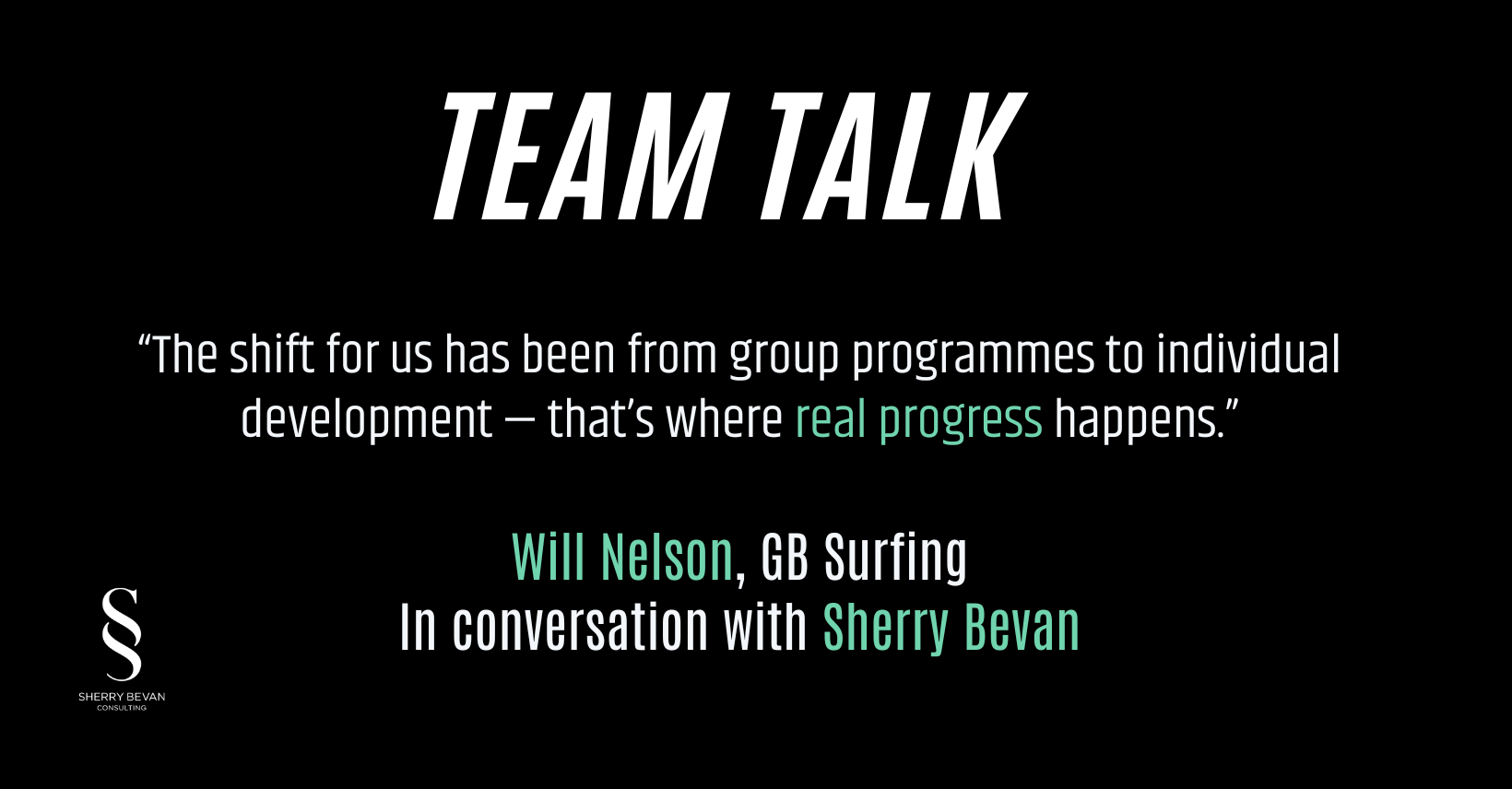
The importance of individualisation.
We initially ran a centralised model—same camps, same approach for everyone. It worked at the time, but it became fragmented.
Now we’re building 12-month plans for each athlete. They know what they’re doing throughout the year, even if some details flex. That consistency is key.
Do the athletes feel like a team?
They’re individual athletes first. They get on well and support each other, but they’re competing for places. That competition is important—it pushes standards.
What’s coming up next?
Everything builds towards Olympic qualification.
The ISA World Games and European Championships are key. We also have World Surf League events running throughout the year. Right now, we’ve got an event in Morocco, followed by coaching blocks and then international training over the summer.
What’s your favourite sporting moment?
Two stand out.
One is a cricket Test match at Trent Bridge when I was young—England vs South Africa. The atmosphere and intensity really stuck with me.
The second is the 2009 Lions rugby tour in South Africa. The second Test in Pretoria was incredible – decided at the end by Morne Steyn. I’ve never seen a game like it.
Where can people find you?
LinkedIn is best for me—just search Will Nelson. For GB Surfing, we’re on Instagram and at gbsurfing.com.
I’ve really enjoyed talking to you. It’s been absolutely fascinating to learn more about a sport that I’ve never tried. I’ve always been so amazed and impressed by what these athletes can do on the waves. What I’m really loving about what GB Surfing is doing is how you’ve had this funding, and you’ve tried one approach, and you’ve stopped and thought about it, and learned from what’s worked and what’s not worked, and that you’ve been able to change your strategy so that you get a better performance.
I think that’s a big lesson that we can all take into our lives and into our workplaces – taking that time to reflect on what’s working, and what’s not working, and look at how you can make that better.
Thank you so much for joining me today.
Thank you—really enjoyed it.
About Will Nelson
Following a 10+ year career in Communications, working for Sky Sports and Soapbox London with clients such as Anthony Joshua, Jason Fox, Turkish Airlines and Omega, Will Nelson moved into a Chief of Staff role with Victoria Gosling OBE.
In this role, as well as providing strategic and administrative support for Vicky across GB Snowsport, Invictus Games, and various startups, Will leads the GB Surfing Olympic programme. He has oversight of the whole programme but has brought in a leading surf coach to manage performance, whilst he focuses on the business operations.
Important Links
- Will Nelson on LinkedIn.
- GB Surfing website.
- GB Surfing on Instagram @gb.surfing.
About your host Sherry Bevan
Sherry Bevan helps teams in transition perform at their best – without the fluff. A former Global Head of IT Service in an international law firm, she now works across technology, professional services and the charity sector.
Through her Team Performance Accelerator, Sherry supports teams under pressure to build trust, strengthen collaboration and set the foundations for high performance.
A former grassroots cyclist and still a runner, Sherry is fascinated by what sport can teach us about teamwork, leadership and sustainable performance – and it’s these ideas she explores with leaders and experts on Team Talk.
Connect with Sherry
- Sign up for news and updates.
- Apply to join the Team Culture Club.
- Connect on LinkedIn.
- Book a call to explore how I can help you improve your team’s performance.