This episode explores what it really takes to lead performance when the spotlight is unforgiving and results matter.
If you care about culture, leadership and sustainable high performance, this episode is for you.
Listen to the episode here:
Episode 2 High-performing teams
Guest: Scott Drawer, INEOS Grenadiers
Sherry Bevan: Hello and welcome to the Team Talk podcast. This is the show where we discover how to build high performing teams, using lessons learned in the world of sport. I’m your host, Sherry Bevan.
In today’s episode I’m delighted to be talking to Scott Drawer, who is the Performance Director at INEOS Grenadiers, A very warm welcome to you, Scott.
Scott Drawer: Thank you for the invitation to speak.
You’re very welcome. For context and for our listeners, it would be nice to hear about your background and how you came to be in your current role.
In my current role, I’m the Performance Director for INEOS Grenadiers. We’re a professional cycling team, formerly called Team Sky. If you don’t know the sport well, it’s a professional cycling team.
We’re part of the World Tour Circuit. We compete in all the biggest races that people know, such as the Tour de France, which is the biggest. It’s the second highest viewed sporting event behind the FIFA World Cup. As well as events like the Giro d’Italia and la Vuelta a España. Then there’s a series of races in the Spring that are called the Classics: Paris-Roubaix, Strade Bianche. These are really artistic, historical races that people can connect to.
The team is made up of around 30 bike riders Overall, 128 staff and that includes everything from marketing to HR. My job is Performance Director. I am fundamentally responsible for winning races and helping achieve our race targets. That covers everything from managing a coaching team: we have 5 specialist technical coaches who train and prepare our riders to go and win bike races and the demands of that. We have a team of sport directors – sport directors are typically former bike riders. They’re the tacticians. They own races. They organise and are responsible on a race for making decisions about the strategy and tactics. It’s like taking a head coach in a football team and splitting the role into two. They would maybe do all the training in the week and then pass it over to somebody else on game day. That doesn’t happen in cycling because of the nuances of it. The coaches look after the riders holistically and are preparing them for racing, but they speak with the sport directors. The sport director goes into the race with a particular team. He understands where that rider’s capabilities are at and then calls the tactics and strategy for the race.
We also have a large technical team which is predominantly science and medicine. A really important part of what we do involves technology, engineering, physiology, nutrition, therapy, physical therapy, physiotherapy and our doctors. They are really important and they attend races.
I’m also responsible for rider recruitment and our rider performance management. There’s a big remit. I report into our CEO who has big oversight of the whole team, particularly the business side of it.
I’ve been with the team since March [2024]. I had a former stint with the team in a very a technical role. All my career, I’ve been involved in high performance sports in some remit whether that’s at youth sport level, through to the extreme that we’re now at. It’s genuinely high performance in the sense that it’s the highest level you can go relative to your ability level.
I have a multi-sport background. I spent a lot of my career in Olympic sport right up to London Olympics [in 2012). I worked in professional rugby. I then did a stint with the team initially and then went to work in one of Europe’s leading schools for sport called Millfield in Somerset. You need to make a different life decision around family and balance and travel before the opportunity came to come back to the team.
I’ve had breadth and depth of experiences. My background is science so I think very logically. I’m intrigued by science and research which often drives my general approach. It’s been a pleasure to come back to the team.
The team’s not where it would like to be. It dominated the sport. Primarily, I think because it was the 1st sport that it spun out of British cycling, which was hugely successful prior to the Olympics. I think the sport was probably lazy. I think Sir Dave Brailsford brought in significant number of professional concepts to take the sport on, and that’s why it was super successful.
COVID hit new owners, and I think that the landscape of the sport changed dramatically, faster than any other sport – and it hasn’t kept up to pace with that. We’ve just been through a significant change process in an attempt to get back to where we are. It’s an exciting time for us.
It does sound like a really exciting time for you to come back into the team. Under Team Sky, it was hugely successful and very much THE dominant team. I imagine that you would love to get back to being the dominant team in in the sport. Coming back into the team last year, what have been the biggest challenges for you?
The biggest challenges when coming back is getting back to grips of understanding the landscape of the sport. You invariably had a preconceived idea. I had a bias from being part of the team in the past in a very different role, not as close front line, but very much in a technical role supporting in the background. The landscape of the sport had changed significantly. I think it’s the ability and pace to get back up to speed. It sounds quite simple, but you have to fully immerse yourself. There’s a lot of travel even on races across Europe; you spend a lot of time trying to get to know people. Whenever you go into any industry or any business in a new role, the faster you can do that the better.
That takes time. The nature of this sport means that it’s quite dispersed across Europe. You don’t come into an office every day. Your coaching team, your rider team, live in different places. They only come together for races and camps which makes it really difficult to create connection and trust with those around you and really understand them.
It’s the nature of the sport and the time it takes to get yourself back up to speed. It’s important to try not to come in with any preconceived ideas or cognitive biases. We want to get back to where the team were [in the past]. It’s not that the team’s gone backwards. The team has plateaued. Everyone else has moved on at a faster rate. The nature of the sport and the nature of this team means there isn’t a natural environment to see things on a day-to-day basis. I had to spend time on bike races, observe, and get to know the riders, get to know staff that were there before making any conclusions in my head.
You talk about the importance of having that connection and trust between the different teams behind the team on the road. How did you do that? How do you build connection and trust?
We’ve got to remember that we’re quite simple creatures. Evolutionary biology and psychology hasn’t changed that much. Society changes a lot because of technology. But I think the fundamental needs of individuals are to connect with humans. You need to be part of a clan and part of your tribe. I’m really influenced by the work of Owen Eastwood and Robin Dunbar, anthropologists who really studied and understood that importance of being part of something, part of a community, because it’s how you survive.
Even nowadays you will read that loneliness is one of the strongest predictors of an early death. You can’t escape some of these fundamental evolutionary concepts around human connection with others and that takes time.
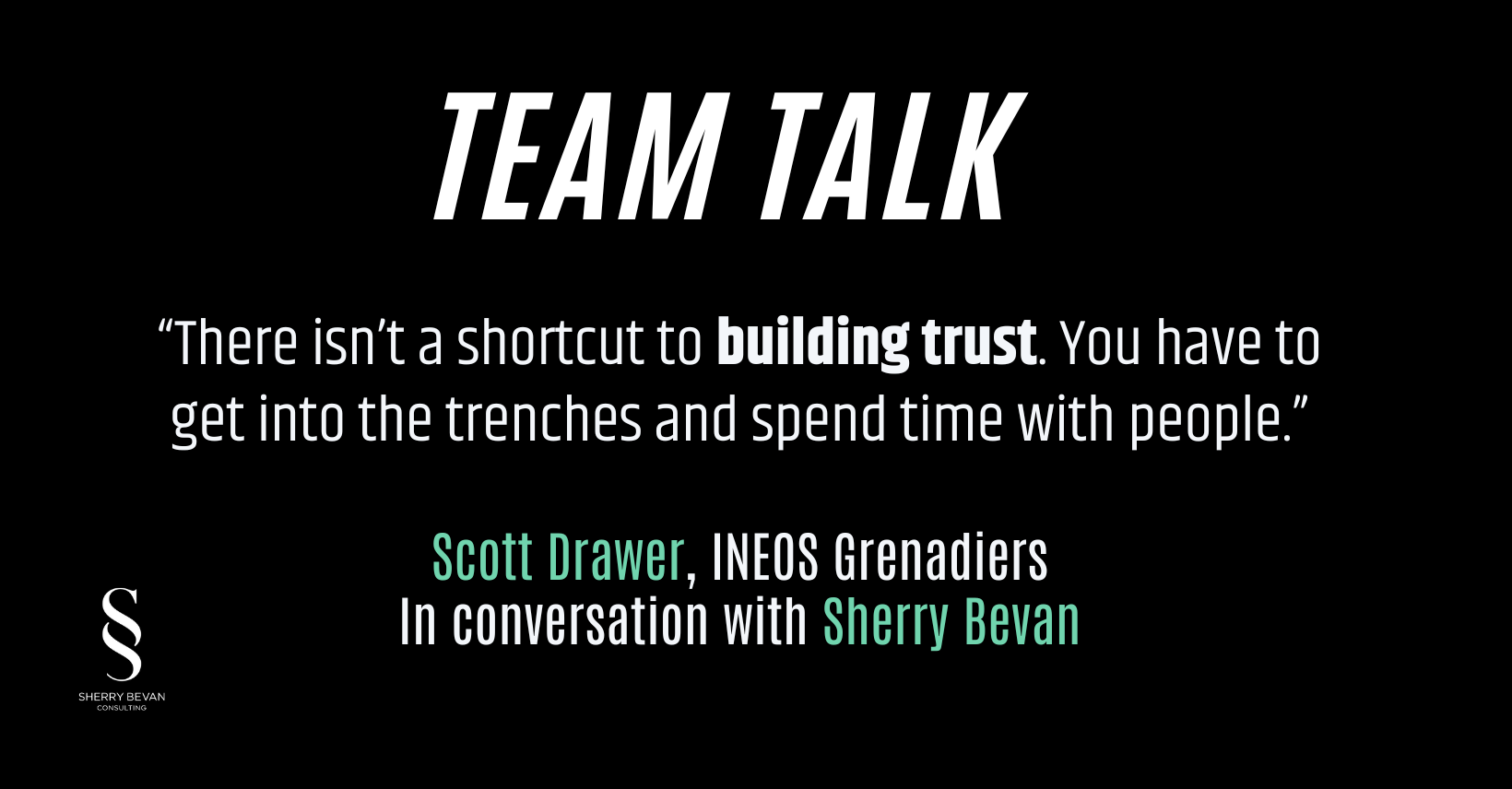
Being around people, the social element of it, you’ve got to be very empathetic, you have got to understand where people have come from. Coming back into the team, there is a tremendous legacy with what the team’s done, but the sport has changed. How do you look forward and not take that baggage with you? You want to take the good stuff. I don’t think there’s a shortcut. You have to get into the trenches – it’s the best way. And really connect with people to listen and to understand.
Lots of people that I work with had lots of things to tell me about why things weren’t working. That’s helpful and sometimes that’s not helpful because I think you have to experience it. I always felt like I needed to experience it and see it, and observe it, to believe it. Eventually, you see those themes and trends. Only by spending time, does it start coming to the surface. I’ve seen that two times, three times, four times – now that’s interesting. Those patterns and themes begin to emerge. Because of the dispersed nature of what goes on, you can’t get away from the idea of human connection. It’s taken time to get that right.
You’ve not come from a professional cycling background. I know many in the sport have that background. Do you find that gives you advantages or disadvantages when working with the teams?
There’s two sides to that. I certainly came to the sport late in life. in the early part of my career, I was really fortunate to work with Olympic track cycling. That was my 1st immersion. It’s a sport that I fell in love with. I don’t know why, I can’t explain. My background is in football and cricket. I think it was the nature of what that sport was doing at the time.
Yes, there are pluses and minuses. The nature of this sport means I’ll come with very different perspectives. Having worked in a number of sports, I think there are some consistent principles and design factors that if you went into any sport, you’d expect to see if they were successful. It doesn’t matter whether it’s cycling, rowing, football – there are key characteristics which shape it. If you went in as a consultant, there’d be things that you look at if somebody said “come in and review my sport”. It wouldn’t matter what sport. You start with the right talent. I think that’s fundamental.
There’s lots of things that are a critical part of that. I think that’s an advantage if all you’ve ever known is that sport, you will have a particular bias. That’s not a good or bad thing. But you have a view of how that sport operates and what it should do. Again, that’s dangerous in some elements. I think there’s a balance point.
I don’t have the depth of knowledge of a former bike rider. But we’ll employ former bike riders who know, and they’re better than me. They have better knowledge and know how. It’s about the collaboration and the marriage of those ideas that help you move forward. You need the right culture and environment for that to happen.
If you go back to Team Sky, that was the essence of where they started. Professional cycling at that time was probably lazy. Olympic track cycling, and the work Sir Dave Brailsford did with his team was so far on the edge in terms of real fundamental understanding about what you need to do: planning, periodisation, science, medicine, and all those elements. Team Sky could bring that across. The team had this big aspiration to win the Tour within 5 years; they had done it within 3. It really changed the nature of it. There’s no right or wrong to it. But I think you can’t do one or the other. If you’re going to be successful, you need to really understand the business you’re in. In this case, high performance sport. There are some common principles, whatever sport it is. Having a breadth of experience, is of value. But you need that depth as well. That’s why the team needs to be a bit of both. We have a lot of sport directors and coaches who’ve been immersed in the sport. They know it that really, really well and I would bow to their expertise. I listened and I’d ask lots of questions. They ask me lots of questions as well. If you got the right environment, it can work.
What about the teams that aren’t involved in the cycling directly? Your HR, marketing, partnerships team? How much of an impact do those teams have with what happens on the road or on the track?
Massively. Only once a year, there’s a whole team get together when our back office staff come together with riders and performance staff. That happens usually in November each year. This is a celebration. But it’s also about connection and riders connecting with those that organise their travel and sort out their contract, etc.
They’re not as frontline but you have to create opportunities for that group to connect as much as possible. We’ve spent time doing a lot more of that this year. The business doesn’t operate without them and vice versa. At times of course, riders are on the pitch competing and the staff may be up in Row Z, but that doesn’t demean what they’re doing. They’re playing a valuable part of enabling those riders to succeed and perform. We’re really fortunate that our riders recognise that.
They’ll know that somebody sorting out travel has made their life really easy for the rest of the year so they get to spend more time with the family, e.g. they go on a later flight. There’s lots of things which make a difference that often you don’t see in the way things are logistically organised. They’re appreciated – they may not be at a race, but the job they do in the background is equally as important in terms of promoting the sport and supporting riders to help achieve what they need to do.
The riders are not going to be able to turn up to the right race at the right time with the right kit, unless there are these back room cogs turning.
As a sport, people recognize we’re like a traveling circus. Just imagine a Grand Tour. There are 21 stages at different locations in the country. When a rider gets up in the morning to take part in his race; he has his breakfast, and there’s a big kitchen truck. He gets fed. He then goes and gets ready for his race. Off he goes to the race with a performance team. All the logistics are already moving to the next hotel.
There’s an advanced party going to get the next hotel ready. The kitchen truck is moving. By the time they finish the stage and jump on the bus to go to the next hotel, all their bedrooms are prepared, blackout blinds are in, dehumidifiers, the kitchen truck is ready, the massage team is ready. That’s moving around the country every day. It gives you a feel of the scale of it.
Those guys are on race others maybe not on race. They could be in the back office. But everything they do plays a role in giving the riders the best opportunity to achieve their potential. That’s fundamentally what we’re trying to do.
What are the team’s big goals for this current season in 2025?
Last season wasn’t as successful as we wanted it to be in terms of the number of bike races we won. It’s probably the least successful since the team started which gives you a feeling of the landscape. Without a doubt we need to get back to winning bike races. We’ve targeted what that may look like from a very specific KPI and objectives perspective, but also more building to win a Grand Tour again.
We have got some talented riders, without a doubt. Lots of circumstances played against us last year. That’s what happens when you’re not winning.
We spent a lot of time trying to reshape and rebuild the culture. The mood is strong. The hunger is back in the bike riders and the staff. There’s a much more open, collaborative, engaging culture which is enabling the right challenge and the right support to happen at the right time.
We’re really optimistic. We’ve always had the talent. We didn’t punch where we should have done last year. If we do, we certainly should be back as one of the top three teams. That gives us a great platform to build on. You can’t control the outcome, but I think the process that we have put in place in terms of planning, riders we signed, our advanced recruitment strategy, some very particular technical strategies that are big priority for us that we identified last year; for example the use of altitude. We’ve got a plan. We’re working really hard. We have lots of new staff who are transitioning as quickly as possible to get up to speed as the season starts. We’re really optimistic and I think the team feels different. We just need to get back winning. It’s that momentum which carries you through. A real positive vibe, positive atmosphere. But ultimately, we’re going to be judged by what happens on the road. We’ve got to get one in quickly.
Was it a big job to get everybody re motivated because 2024 wasn’t a great season for the team as a whole. How did that affect morale? What have you had to do to bring morale back up?
It’s a thing that’s most difficult to do when mood isn’t good. How do you change that culture and feel the mood in the camp. It’s really hard. It’s an intangible around it. We had to change our staffing structures, and the way we’re set up. We’ve had some brilliant people in the organisation. But they had stagnated in some ways and were becoming obstacles to progress.
We had to make some tough decisions around some people that had given a huge amount for the team. That was the first decisions we needed to make about which direction we’re going and who wants to come on the bus. There are always difficult decisions through that change process.
What you find at this level is that people move on very, very quickly. Sometimes there’d be shock about a change that’s been made. But within the next few minutes it’s “Right, where are we going and what are we doing”.
There’s a quick transition process. Then it’s about building belief. It’s difficult to know if you’re going to get it right. We had two significant camp opportunities in November and December. We worked really hard to talk about what was important as part of this group. I invited Owen Eastwood, whose book I really recommend – some brilliant work around culture. That was a really good stimulus for the group, to think about how important it is for us to get connected, to back one another, and what that feels and looks like. We didn’t over-engineer those opportunities when we were together. We enabled people to have a lot of social time. We had 4 days in Manchester. Everyone was there from the back office and the riders. We went bowling. We had dinner together. We created lots of social opportunities to get people connected. People responded to that in the right way. Then our 1st work camp happened in December. Lots of change. The riders were calling for change. The content, the location – all of those things helped us to continue to take that story forward. Riders were enthused by that opportunity and super motivated also by realising we underperformed last year. They wanted to put it right and they have the capability. They’re out firing. Typically, every year, you have new riders as well, who are not influenced by the past. And they’re on their own personal mission. That really helps.
Did I know it was going to feel like this? Absolutely not. I think lots of dialogue about what we believe would have created the right environment to enable people to move forward. Acknowledge the past but move on from it. It’s about now – what we can do now, and what we can do going forward to try to be the best we can. I was nervous about that. If we were to do it again, were there things I’d change? Of course, but it’s put us in the right place to go and compete this year.
What you’re saying about not over engineering. Those opportunities when you’re bringing everybody together are important. Every time I run a team day or a team workshop, everybody always says, “We needed more networking time, we wanted more time to connect as human beings and get to know each other”. I think that’s a really sound approach.
I’d really recommend any of the audience to read Owen Eastwood’s book. We did some real simple things with the team, inspired by his work. Owen’s done some brilliant work: South African cricket, All Blacks, England Football. He’s done stuff with the Ryder Cup, where you get different people coming together to compete. We spent some time trying to understand where people come from. It’s a conversation people hadn’t had. They understood a bit more about individuals – where they were from, heritage, history, what it meant to them – that started creating connection. It’s simple, evolutionary concepts that maybe we’ve forgotten during Covid in some ways. If we reflect back on that time and how important it is to create high performing teams. I think the foundations and the glue that hold you together are really important, for when you have to go and perform. If somebody has got your back when it really matters, if they’re critiquing you or giving you feedback, how’s that going to land and respond for you? But if you trust them because you understand them a bit more, it gives you the right platform to progress. We did simple things like that. I’ve really been influenced by Owen’s work, and Professor Robin Dunbar, who’s written some amazing stuff about culture and connection.
It really resonates with me because it’s got a scientific edge to it. But when you see it in real life, it’s been really helpful.
It resonates because it’s true, because it’s right. At the end of the day we are all human beings and humans want that connection We can all work towards a goal. But we need to understand why we’re working towards that goal and what’s the point of it. Understanding where each individual is coming from, and why that goal is important to them, it makes a huge difference.
Conversations are different then and it’s more authentic. You understand more about someone that’s got children for example; you’re able to have a very different dialogue. It creates balance and balance in high performance is critical because when it’s full on, it’s intense. You can’t manage that 365 days a year. You genuinely need a way of being able to step away from it to rest, recover, and go again. It’s more important than it ever has been.
What about learnings for you since you came back to INEOS Grenadiers?
I’m learning every day, it’s the best thing about managing. We have a very multicultural, multilingual community. On a very practical level, I’m learning Spanish again, which is helpful because we have a big Spanish cohort in the team. That’s an everyday challenge. Duolingo’s doing me good, as I can currently see. My prior experience before coming back to the team, something particularly clicked for me, post Covid, around this importance of being together – connection – culture. I practiced a lot of things in this. I was at Milfield School as Director of Sport; you have teachers, and coaches all around you, but in some ways, it was the perfect training ground.
I had lots of observations and ideas that we were trying and refined to the point where I could then take them forward in this environment. You’re learning every day about how to bring people together. Clarity, simplicity, and message – clarity on the vision. The way you work with people in terms of understanding them, your messaging as a leader. I’m typically very reflective anyway, as an individual. Every engagement I have I’m always spending time thinking about what I’ve said, how I’ve said it. To try to be a real consistent leader in my style and approach.
The nature of this sport and high performance sport means you can’t stand still. That’s an environment I love to be in. I see so much opportunity. We’re trying so many things to push ourselves forward. If anything, I’m learning, we’re probably doing too much. There’s a time and a point where you can’t do that as well. Every day is a learning day. It’s like being back at school but I’m loving it – loving the challenge, loving the people I’m working with. Equally I realise we’re going to be judged by the results that come as a consequence of that. We spent a lot of time trying to get our processes right and improve them. And you never really know until you get bike racing.
Ultimately, we’re getting into that environment now where we’ll begin to see if some of the cultural changes and approaches we’ve taken, are going to stand up to the pressure of trying to win bike races.
What are you most proud of since you’ve been back in the team?
I’m more proud of the individuals, the riders and the staff around. I don’t know if this is the right word, we hear the word resilience a lot. Steve Peters is our lead psychologist. He wrote the Chimp Paradox. He’s got a different view and perception on that. I’m more proud about the pace at which people have been willing to recognise and adapt to change. It’s their willingness to embrace that and go with it. That’s not me. That’s what I’m most proud of. The organisation was crying out for change. In some senses, sometimes people are unsure that they could change. When that opportunity arose, the riders and the staff embraced that really quickly. They saw the opportunity and are running with it as fast as they can. It’s not about what I’ve done. I’ve been the catalyst for something that was ready to go. I tried to support those staff who also recognised it. Ultimately, I’m the one that had to make the decisions as Performance Director. They fully backed those and now they’re running with it. It works on both sides.
Sounds like you’ve got a real energy in the team; that they were waiting for someone to come to light the touch paper, to go again, and to do things afresh. It was the right time.
Often that’s life, isn’t it? Serendipity. Timing. Sometimes the best ideas don’t land immediately. That was definitely was part of it. Sir Dave Brailsford had this great simple formula. He used to talk about balance plus hunger plus belief, minus distractions is what gives high performance. We have talented staff, talented riders and they had lost some of that hunger and belief in themselves. We managed to rekindle that. It’s back, and they’re highly motivated to go and prove themselves as individuals. Nobody liked the stinging criticisms we were getting. Ultimately, that’s down to us to change.
The job of the programme is to remove distractions so that the bike riders can concentrate on high quality training, high quality fuelling, sleep and repeat, and be given the best possible. We tightened up that part of it. I’ve always liked the simplicity of that. Talent plus hunger plus belief, minus distractions and you’ve got a high-performance environment. What underpins the culture, that culture of exploration, experimentation, collaboration, the nature of very technical based environments where you have a lot of different skills, our job is to act as the bridge that brings them all together and enable people to shine when they need to shine. Sometimes you’re in the dugout. Sometimes you’re in row Z. Knowing when those opportunities are there is really important. Yes, the energy is there. It’s showing through the hunger and the belief that people have that they can take on the best in the world.
I’ve always been a huge fan of the team, I wish the team every success in the coming season, in the Classics and in the Grand Tours. What are you most looking forward to over the next 6 months?
Just getting racing.
People want to get racing, because that’s ultimately why they do it. They love competing. Being back in that environment, knowing that the riders have done the work, and to see how it plays itself out. Not everything’s going to work, we know that. We’re going to have to tweak, iterate and change as we go along. That’s the dynamic nature of human performance. The guys are working super hard. We’ve got some talented riders. I can’t wait to see it explode where it really matters.
Let’s get into the chamber now and into the racecourse, in the parcours. Let’s see what we can do. That’s where we’re really going to learn. We’ve done all this work. We’ve had lots of deep conversations, lots of planning, lots of decisions have been made. Riders have been training a bit differently, trying new things. We’ve got a much clearer philosophy about how we’re going to race and compete. Let’s see how it plays out. I think we’re really looking forward to the test, is the best way of describing it for the next 6 months.
Is there a particular race that you’re looking forward to personally?
The Tour de France is always another level. But this year I’ll spend a lot more time in and around the Classics. We have a really good group there that I want to spend a bit of time with. We believe Filippo Ganna’s going to be really strong in Milan-San Remo.
I’ll spend a bit more time around some of those, and that’s just a lot of history and heritage of the sport. The Giro’s interesting this year – it starts in Albania.
The Grand Tours are always fantastic. But you can’t get away from the Tour de France. It’s another level, the pressure bubble that comes with it. The best racers in the world, day in, day out, really. The parcours this year, and the design of the course in and around France, it’s going to be pretty spectacular in that first week. Then it gets really hard at the back end. But the Classics is where I’m going to spend a lot more time. They are the most demanding races – based on everything we measure and assess.
We are not a traditional Classics team. But we’re going there to try to compete. And we’ve got some talented bike riders. We’d love to see how they’re going to do. The racing is brutal, but they love it. It’s unbelievable. They love the fact that it’s brutal, which is what they thrive off.
I’m excited to see what happens. Not just cycling, but sport generally, what’s been your favourite sporting moment for you personally?
I spent a lot of my early career in Olympic sport with Team GB in my role as Head of Research Innovation. I spent a huge amount of time exploring and experimenting, but the culmination of what was more than a 10-year journey was London in 2012. I’ve still got great memories of that event. It was one hell of a journey personally in terms of career, development and engagement, and I learned so much from that. That’s stood me to the point I am today. That whole experience at Olympic sport was phenomenal. It was a time when the sport was quite entrepreneurial. Yes, government backed, but not so bureaucratic and fast-moving. Lots of chance to try things. Of course you make lots of mistakes. But the pace of movement often was faster than many high-performance professional sports. That will always have an indelible mark in my memory for me. But I think the experiences I’m having now are equally like that.
Maybe it’s come full circle. This is an environment I love being in. I’m naturally competitive on a very quiet scale. At this level, you’re against the best in the world. There’s nothing better to test yourself than in that cauldron.
Thank you so much for joining me today. If people want to find out more about the team, where would you suggest they go?
Go to our social channels. I’m on LinkedIn, search for Scott Drawer. If people want some direct contact and want to explore or share ideas, or they’ve got things they can bring to the table, we’re open minded. Otherwise, go to INEOS Grenadiers website. There’s so much great content and social to follow. we’re always happy to get feedback on what people think about that too.
Thank you so much. I’ve really enjoyed talking to you today and hearing about how culture is important – that human-to-human connection. On television, we see the likes of Geraint Thomas, or Filippo Ganna on screen. There are so many people in the background to make the whole thing work. It’s the team behind the team that fascinates me. If you are listening to this and wondering how your team could be more effective, please do get in touch. I help teams perform at the highest levels so that the team on the road or on the pitch makes winning headlines. Book a call with me today sherry@sherrybevan.co.uk.
Important links
- Owen Eastwood – Belonging
- Professor Robin Dunbar – research on social connection and group size
- Professor Steve Peters – The Chimp Paradox
- Scott Drawer on LinkedIn
- INEOS Grenadiers website, Facebook & Instagram
About Scott Drawer
Scott Drawer is the Performance Director for INEOS Grenadiers, responsible for race performance, coaching strategy, rider development, recruitment and the integration of science, medicine and technology across the team.
With a background spanning Olympic sport (including London 2012), professional rugby and elite education, Scott brings both scientific rigour and human insight to high-performance environments.
About your host: Sherry Bevan
Sherry Bevan helps teams in transition perform at their best – without the fluff. A former Global Head of IT Service in an international law firm, she now works across technology, professional services and the charity sector. Through her Team Kickoff Accelerator, Sherry supports new and changing teams to build trust, strengthen collaboration and set the foundations for high performance. A former grassroots cyclist and still a runner, Sherry is fascinated by what sport can teach us about teamwork, leadership and sustainable performance – and it’s these ideas she explores with leaders and experts on Team Talk.
Connect with Sherry
- Sign up for news and updates.
- Apply to join the Team Culture Club.
- Connect on LinkedIn.